A Watering Routine That Checks Top, Middle and Bottom Separately
“How often should I water my vertical garden” has no answer, and every page that gives you one is describing a combination of medium, depth, plants, position, season and climate it did not tell you about.
What does have an answer is how to find out, on your own system, in a few minutes, and then how to keep checking that the answer is still right. That is a routine rather than a schedule, and it is more useful than any frequency.
Why a Frequency Cannot Be Right
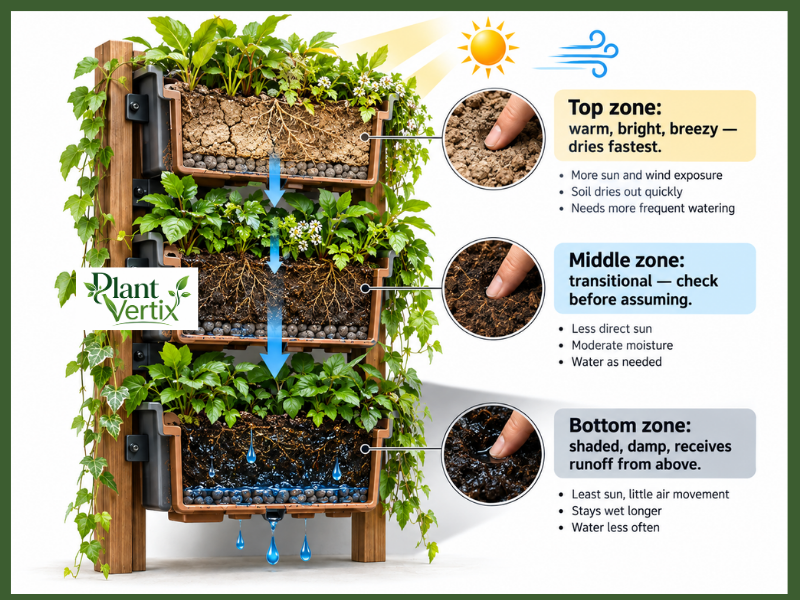
A vertical system has a gradient in it. The top position is warmer, brighter, breezier and dries faster; the bottom is shaded, damper and receives water that has already passed through everything above. This site sets out the four mechanisms that produce it in its own article on why gravity makes every vertical system uneven.
One frequency applied to a structure with a gradient produces one of two outcomes: a dead top, or a rotted bottom. Usually both, on the same day.
So the routine below does not water the system. It waters three zones, each on its own evidence.
The Routine
Before you water: check, in three places
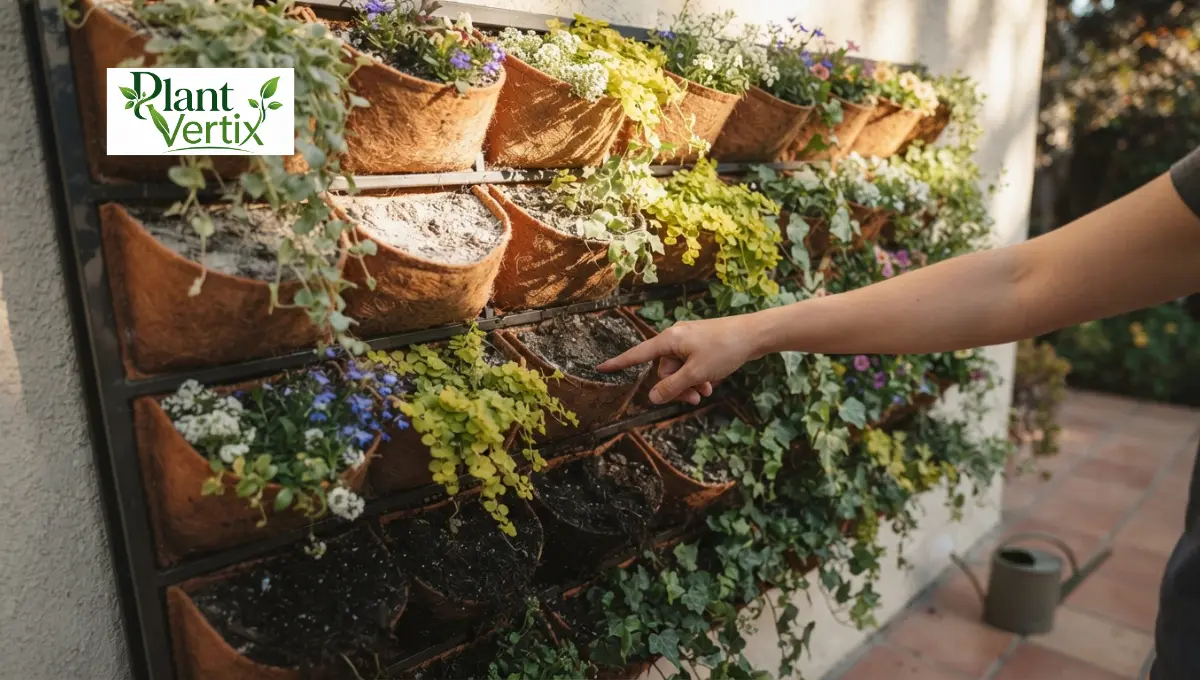
Top zone, middle zone, bottom zone. Put a finger into the medium past the surface, an inch or two down, in each. The surface tells you almost nothing; a pocket can be dry on top and saturated below, and the surface dries first in exactly the position you are most worried about.
What you are looking for is different in each zone, because the plants there are different and their tolerances are different. A top-row plant chosen for a drying position is supposed to be drying out between waterings. A bottom-row plant chosen for damp is supposed to be damp.
If everything feels the same, that is information too, and it usually means the system is either draining into itself or not draining at all.

Then water only what needs it
This is the whole change, and it is the part people resist because it takes longer.
Water the zones that are dry. Skip the zones that are not. On most systems, most of the time, the top wants water and the bottom does not, and applying it to both is how the bottom rots.
Water slowly. Water applied fast to a shallow pocket runs down the sides and out the bottom without wetting the medium at all, which produces the specific and infuriating situation where a container is dry immediately after being watered.
Stop when it starts to run through, rather than when the pocket looks full.
After you water: check the bottom
The step almost nobody does, and it is the one that turns the routine into a measurement.
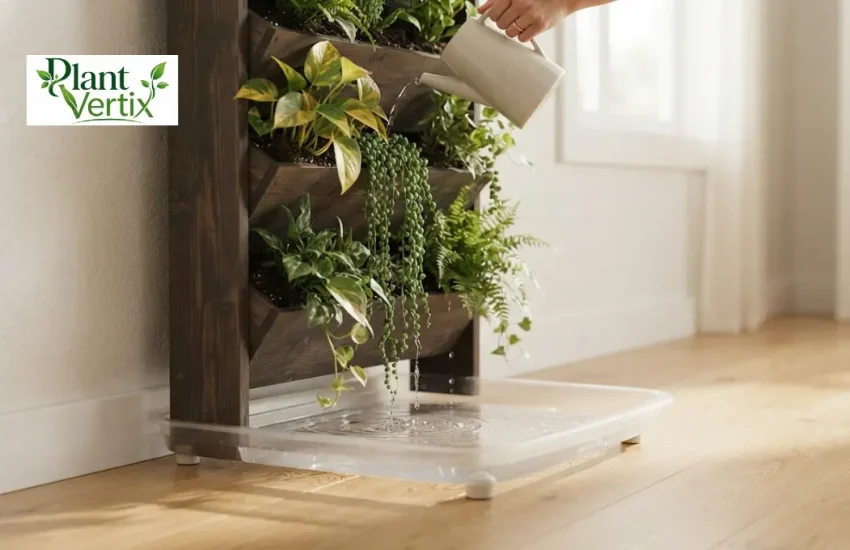
Go back to the bottom zone a few minutes after watering the top. If it is now noticeably wetter than it was, your tiers are draining into each other and the bottom is being watered by the top whether you intended it or not.
That single observation explains most persistent bottom-row failures, and it is a design problem rather than a schedule problem. Our guide to how to water a vertical garden covers where the runoff should be going instead.
Once a month: check the weight
A useful cross-check that requires no equipment beyond your hands.
Lift the edge of a removable container, or push the structure gently, and note how heavy it feels. A system that feels much heavier than usual is holding water it should have released, and that is the earliest warning of a drainage problem you will get.
It is also the thing to notice for a different reason: the loaded weight is what the structure is carrying, and our article on what a vertical garden actually weighs covers why the saturated number is the one that matters.
What Changes the Interval, So You Can Predict Rather Than Guess
None of these is a number. All of them are directions.
Season. Everything dries faster in summer and much slower in winter, and the same routine applied year-round is how houseplants drown in January. Watering frequency should fall substantially in the cold months and it usually does not.
Heat and air movement. A position near a radiator, a vent, an open window or an outdoor breeze dries faster than the same position without them.
Light. More light means more growth and more water use, as well as faster evaporation.
Container depth. Shallow dries faster. That is the constraint the whole vertical format is built around.
Medium. An open, free-draining mix dries faster than a water-retentive one, and that is a choice you can make differently in different rows.
Plant size. The same plant uses more water in August than it did in May, so the interval that worked at planting will be wrong by midsummer.
The Three Failures the Routine Catches Early
A pocket that is dry immediately after watering. The water ran past the medium rather than into it. Water slower, or the medium has dried to the point where it repels water and needs rewetting gradually.
A bottom zone that is never dry. Drainage, not schedule. Nothing you do to the watering can will fix it.
A top zone that dies every summer regardless. The microclimate has exceeded what that plant will tolerate in that position, which is a planting decision rather than a watering one. Our guide to choosing plants by tier position is the fix.
Writing it Down, Briefly
Not a spreadsheet. A note on your phone with the date each time you water, and one word about what you found.
Two months of that tells you your own interval, per zone, per season, more accurately than anything published, because it is a record of your system rather than of somebody else’s.
And it makes the seasonal change visible, which is the adjustment people miss most reliably, because it happens gradually and nobody notices they are watering a January system on an August routine.
FAQ
How often should I water a vertical garden?
This page deliberately does not give a frequency, because the right interval depends on the medium, the container depth, the plants, the position, the season and the local climate, and any published number is describing an unstated combination of those. What it gives instead is a routine: check the top, middle and bottom zones separately before watering, water only the zones that are dry, and record what you find so that within a couple of months you know your own interval per zone and per season.
Do I water the top and bottom rows the same amount?
No, and doing so is how bottom rows rot. On most systems most of the time the top wants water and the bottom does not, because the top is warmer, brighter and breezier while the bottom is shaded and already receiving whatever passed through the rows above.
Why is a pocket dry right after I watered it?
The water ran down the sides and out the bottom without ever wetting the medium, which happens when water is applied fast to a shallow pocket. Water slowly instead, and stop when it starts to run through rather than when the pocket looks full. A medium that has dried out completely can also repel water and needs rewetting gradually.
How can I tell whether my tiers are draining into each other?
Water the top, then go back to the bottom zone a few minutes later. If it is noticeably wetter than it was before, the top is watering the bottom whether you intended it or not. That is a design problem rather than a schedule problem, and no change to how you use the watering can will fix it.
Should the routine change in winter?
Yes, substantially. Everything dries far more slowly in the cold months, and running an August routine in January is how plants drown. The seasonal shift is the adjustment people miss most reliably, because it arrives gradually, which is exactly why a dated note each time you water is worth keeping.
When You Are Away
Worth planning before you need it rather than the night before. The options are a person, an automated system, or reducing the system so it can survive the gap, and which of those is realistic depends on how long you are gone and how shallow your containers are. That is a subject of its own on this site, and the honest short version is that a shallow vertical system is the hardest kind of planting to leave unattended.
For the general planning that avoids most of this, our vertical garden planning checklist is the place these decisions belong: before the plants go in, rather than in the third week of a hot July.