Vertical Garden Weight: The Real Math Behind the Load
A vertical garden’s real weight is the volume of growing medium it holds, multiplied by that medium’s weight once fully saturated, plus the water the system is actually retaining at any given moment, plus the planter and frame hardware itself, and all of that hangs on a fastener whose true rated capacity comes only from that fastener’s own manufacturer, applied to whatever is actually behind your wall.
No gardening article, including this one, can hand you a safe number for your specific wall. What this article can do is walk you through the calculation honestly, give you the one figure in it that is not in dispute (water), and tell you exactly where to stop guessing and call a professional.
The Equation, Stated Plainly
Total hanging load = (volume of growing medium x its saturated weight per unit volume) + retained free water in the reservoir or drainage layer, if any + the weight of the planter, frame, and any hardware, empty.
That total is what your fixing carries, continuously, for as long as the structure stays mounted and watered. It is not the weight on the day you bought the empty planter, and it is not the “up to X lbs” figure printed on the planter itself, which describes the planter’s own construction, not your wall.
Water is the one number here you do not have to guess
One liter of water weighs one kilogram. A US gallon of water weighs about 8.34 pounds (3.79 kg). These are physical constants, not estimates, and they are the most useful numbers in this entire calculation, because they let you compute your own worst case directly: measure how much water a filled system holds at saturation, in liters or gallons, and you have an exact figure for the water component with no guessing at all.
A two-gallon reservoir alone is roughly 16.7 lb (7.6 kg) that sits on your wall for as long as it stays full, before a single gram of growing medium is counted.
Growing Medium: Named Estimates, and Why They Vary
Nobody sells a single, universal “potting mix weighs X” number, because the answer depends on the mix’s composition (peat, coir, perlite, bark, compost each behave differently) and how saturated it is at the moment you weigh it. What follows are figures as reported by named sources, not this site’s own measurements, offered as reference points rather than a number to design around:
| Source | What it reports |
|---|---|
| Florafelt (living wall panel manufacturer) | Its unplanted felt panels weigh about 1.5 lb per square foot (7.3 kg/m²); planted and fully wet, about 5 lb per square foot (24 kg/m²) |
| Green roof industry guidance (FLL-compliant growing media, an analogous saturated planted medium) | Roughly 6 to 8 lb per square foot per inch of media depth (29 to 39 kg/m² per 2.5 cm), fully saturated |
You will also see a widely repeated online claim that saturated potting mix weighs roughly double its dry weight. It is directionally reasonable and consistent with the two figures above, but it is not traceable to a named study, extension service, or manufacturer test, and the pages repeating it do not cite one either, so it is not included in the table above as if it were sourced.
How much does wet potting soil weigh goes deeper into why bag-label dry weight is the wrong starting number, and works through the direct way to get your own real figure instead of borrowing an unsourced multiplier.
A Worked Example, With the Assumptions Labeled
Say you are planning a wall panel roughly 2 feet by 3 feet (0.6 m by 0.9 m), 6 square feet (0.56 m²) of planted surface, using a felt-pocket style system similar in construction to the Florafelt figures above. At their reported saturated weight of about 5 lb per square foot, that panel’s growing medium and retained water alone comes to roughly 30 lb (13.6 kg), before the frame, the felt backing, or any hardware is added.
A rigid modular panel system with a deeper growing cavity, or a system that also carries a reservoir, would run heavier still. This is an example built on one manufacturer’s reported figures for one specific product type, not a universal answer, which is exactly the point: your own system’s real number depends on its own construction, and the only way to know it for certain is to weigh it, covered below.
The Planter’s Rated Capacity is Not theWall’s Rated Capacity
This is the confusion behind most of the load figures that do turn up in a search for this topic: a product listing that says a planter “holds up to 70 lbs” is describing what the planter itself, as a container, can structurally carry without failing or deforming.
It says nothing about what your wall, at the specific point you intend to mount it, can carry. Those are two separate engineering questions with two separate answers, and a planter rated for a given weight tells you nothing about whether your particular drywall, stud, plaster, brick, or masonry wall is rated for the same number at that spot.
What Actually Determines Your Fastener’s Real Capacity
The fixing you need changes with what is behind the surface:
- Drywall alone, with no stud behind it, has the lowest real capacity of the group and generally suits only light, small pots, using anchors specifically rated for the weight and the wall thickness.
- A timber stud, found and fixed into directly, carries substantially more than drywall alone, and is the target most guides recommend for anything beyond a light load.
- Plaster over masonry, brick, or solid concrete each need their own specific fixing type, rated for that material, and installed per that fixing’s own instructions.
This site does not publish anchor ratings, safe-load figures, or a “this will hold” verdict for any of these, on purpose. The honest source for a fixing’s rated capacity is its own manufacturer’s specification, checked against the total load you calculated above, and applied by someone who has actually confirmed what is behind your wall.
The five-minute weigh test
If you want a real number instead of an estimate, this is the reliable way to get one, and it takes less time than reading a comparison chart:
- Weigh the empty planter or panel, dry, with a bathroom or luggage scale.
- Fill it with growing medium and weigh it again, still dry.
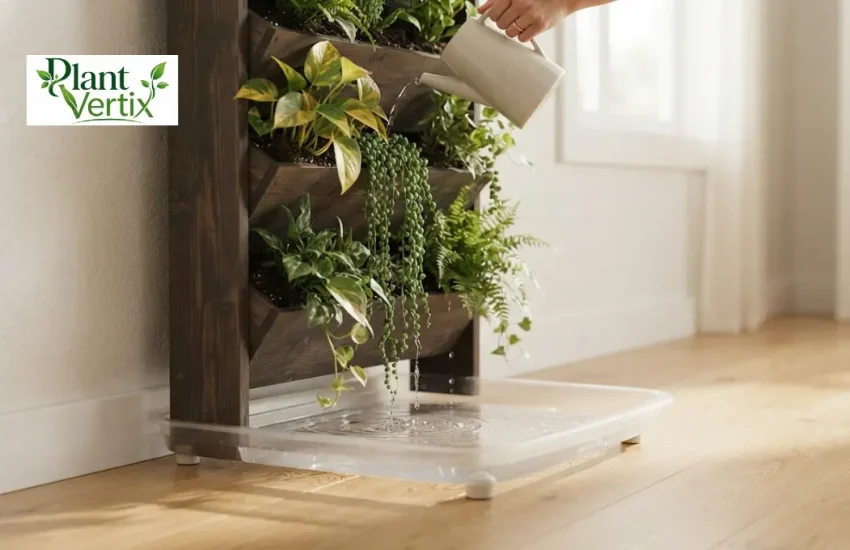
- Water it thoroughly, the way you actually would, and let it finish draining (typically 20 to 30 minutes).
- Weigh it a third time. That number, at full saturation, is the one to give to whoever is assessing your fixing, not the dry weight from step 2.
Do this before you mount it, using the same planter and medium you plan to use on the wall. It replaces every estimate on this page with your own confirmed figure.
When to stop and call a professional
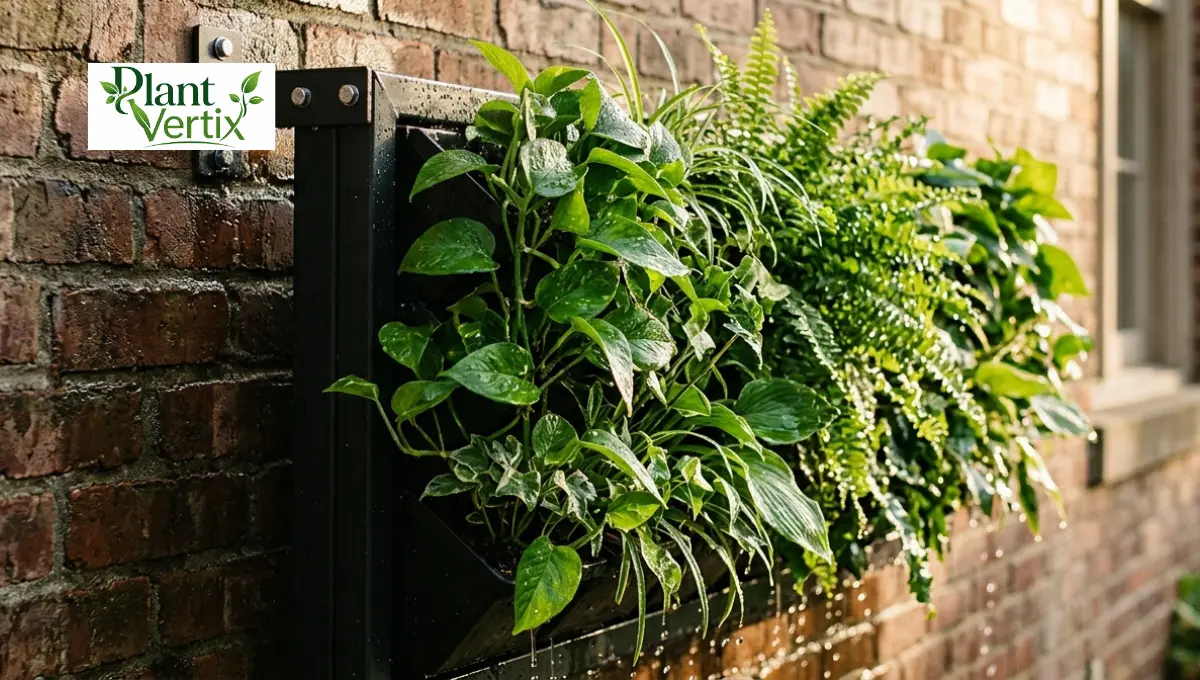
Beyond a small planter or two, or any structure mounted to a balcony railing, a rendered exterior wall, or a shared or load-bearing wall, this is a builder’s or structural engineer’s question, not a gardening one.
That is true regardless of how confident a product’s marketing sounds, and it is true even if the fixing’s own rated capacity looks like more than enough on paper, because the fixing’s rating and the wall’s real capacity are still two different numbers. When a vertical system is the wrong answer covers the situations, lease restrictions, walls that must stay dry, spots nobody will water, where the honest answer is not to build at all.
Where this connects across the site
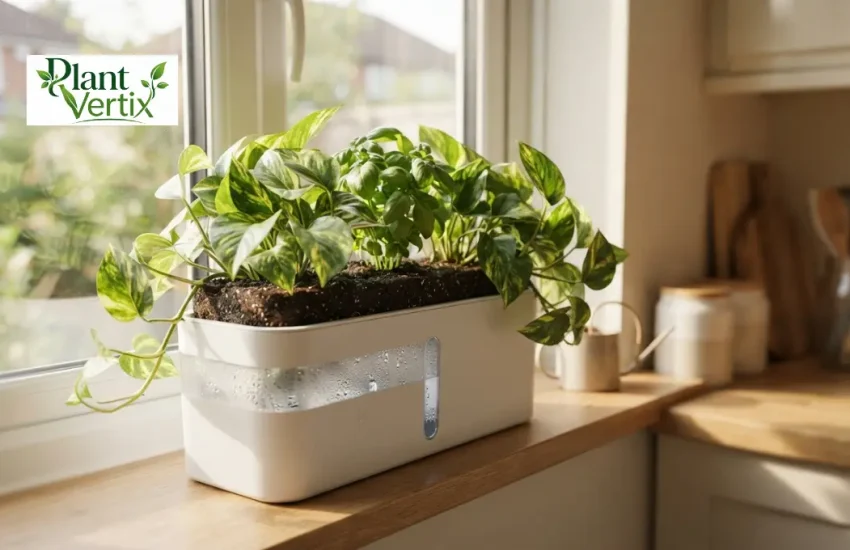
Weight is the constraint that shapes almost every other structural decision on this site. Wall-mounted planter rails concentrate this same total load into just a few fixing points instead of spreading it. Self-watering vertical planters keep a system near its saturated weight most of the time rather than cycling toward dry.
Vertical garden mistakes covers what goes wrong when this calculation gets skipped mid-build. And how to build a vertical garden for a small space is the full sequence that puts this question first, before structure or plant selection, rather than last.
Frequently asked questions
How much does a typical vertical garden weigh?
There is no single number, because it depends on the system’s size, the growing medium’s saturation, and whether it carries a water reservoir. Manufacturer-reported figures range from roughly 5 lb per square foot for a thin felt panel, fully wet, up to considerably more for deeper or reservoir-based systems. Weigh your own filled system for a real number.
Does a vertical garden get heavier over time?
Its weight cycles with watering rather than climbing indefinitely: heaviest right after watering, lighter as it dries, unless it is a self-watering system designed to stay near saturation. Root and foliage growth adds relatively little weight compared to the medium and water.
Is the weight on the tag or product listing the number I should plan around?
No. A product’s rated capacity describes what the planter itself can structurally carry, not what your specific wall can carry at your mounting point. Confirm the fixing’s own rating separately from the planter’s.
Who do I actually ask if I am not sure my wall can take it?
A builder or structural engineer for anything beyond a small, light planter, especially on balconies, rendered exterior walls, or shared walls. A fixing’s own manufacturer for what that specific anchor or bracket is rated to carry.