
Wind, Exposure and a Vertical Garden on a High Balcony
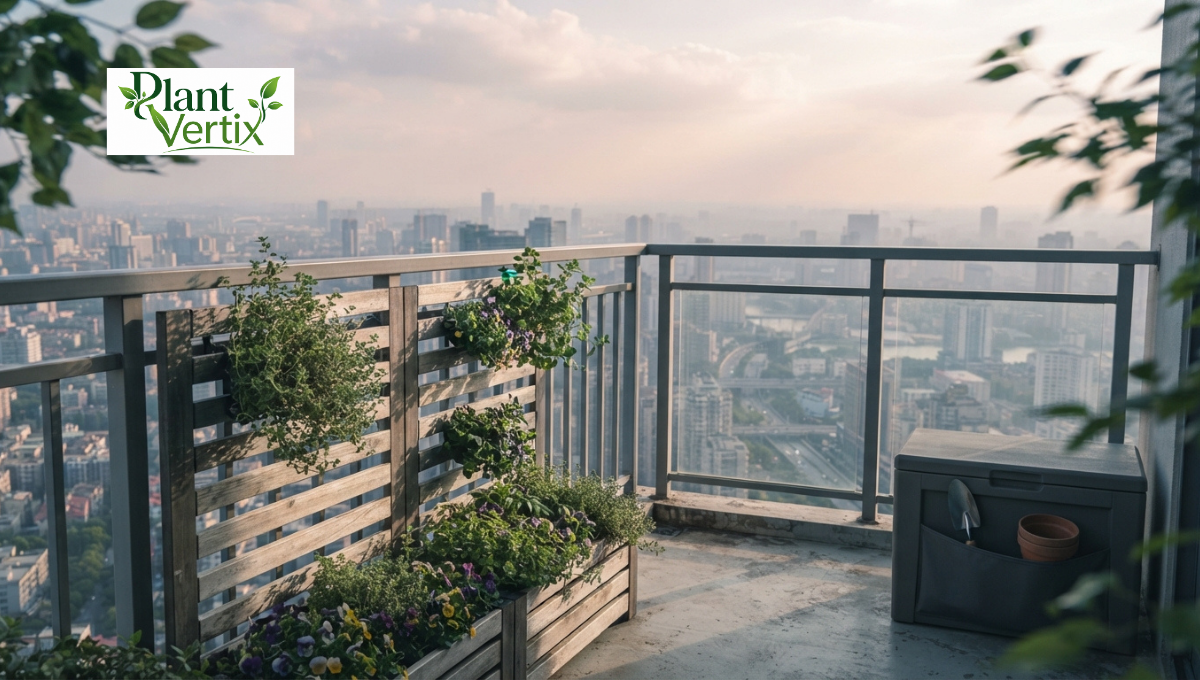
Ninth floor, and it is always windy up there. That is not an inconvenience to design around; it is the primary design constraint, and it changes the project more than any other single factor on this site.
Here is what wind does to a planted structure, why this page publishes no number, and the design decisions that reduce the load rather than resisting it.
Start With the Consequence, Because it Decides Everything Else
Anything that leaves a high balcony is falling onto a place where people are.
That sentence is the whole reason this row is treated differently from the rest of the site. A planter coming off a wall in a ground-floor garden is a mess. The same planter coming off a ninth-floor balcony is a different category of event, and it is why building rules about balconies exist and why they are frequently strict.
So the design question is not “will this hold in normal conditions”. It is “what happens in the worst conditions this building sees, and what is underneath”.
What Wind Actually Does to a Planted Structure
Three separate things, and they are worth separating because the responses differ.
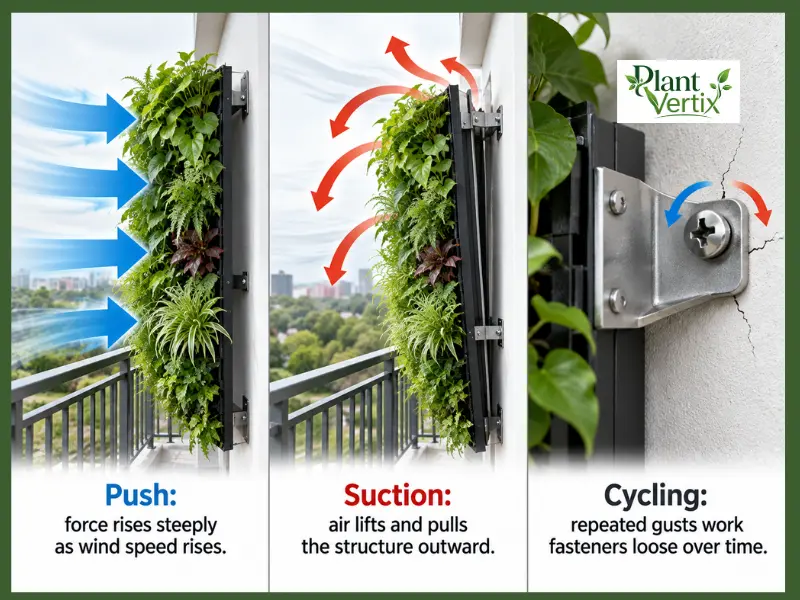
It pushes. A planted panel presents a surface to moving air, and the force on it rises steeply as wind speed rises. This is the part people picture.
It lifts and pulls. Air moving over and around a building creates suction as well as pressure, and a structure on a balcony can be pulled outward, away from the building, rather than pressed against it. That is the direction most fixings resist worst.
It cycles. Wind is gusty rather than steady, and repeated loading and unloading works fasteners loose over time in a way a constant force does not. The failure that happens on a windy night is frequently the result of a hundred previous windy nights.
And buildings make it worse locally. Air accelerates around corners, through gaps between buildings, and up the face of a tall structure. A balcony on the corner of a building can be substantially more exposed than one in the middle of the same face, on the same floor, and neither the weather forecast nor any website knows which yours is.
Why this Page Publishes No Number
You would like a figure: how much wind, how much area, what is safe.
Wind load on a structure is an engineering calculation, and it depends on the height, the exposure category of the site, the shape and porosity of the structure, how it is fixed, and what code applies where the building is. None of those is something a website knows about your balcony.
This site publishes no wind load, no safe area, no anchor rating and no balcony capacity, on its own authority or anyone else’s. That is a standing rule here, and this row is one of the clearest cases for it: a number that sounded reassuring and was wrong, applied nine floors up, is a serious matter.
Where the answer matters, it comes from building management, from the building’s own rules, or from a qualified professional. In a managed building, the first of those is also the party who decides whether you are allowed to do it at all, which makes it the right first call regardless.
Design So the Load is Smaller, Which is the Part You Control
This is where the useful work is, and none of it requires a number.
Reduce the sail area
A solid panel catches everything. A structure air can pass through catches much less. An open trellis, a slatted frame, or a system with gaps between containers presents far less resistance than a continuous surface, and this is the single largest lever available to you.
Our article on trellises for a vertical garden covers the open-structure options, and it is worth reading before choosing a solid panel for an exposed position.
Plants add area as they grow. A structure that was fine in spring can be a much larger sail by August. That is a real seasonal effect, and it is why pruning is a wind measure and not only a tidiness one.
Put it where the wind is not
Balconies are not uniformly exposed. A wall that faces the prevailing wind, an open corner, and anything near a gap between buildings are the worst positions, and a sheltered inside corner may be a completely different environment a few feet away.
Watch your own balcony before you build. Which corner is always dusty, where does furniture end up, which side dries first. Those observations are worth more than a forecast. Our guide to where to put a vertical garden covers the general version of that assessment.
Keep it low and keep it heavy at the bottom
Height increases both exposure and leverage. A shorter structure with the weight low is a different proposition from a tall one with a planted top.
Secure everything that is not attached
Loose containers, trays, tools, covers and empty pots are the things that actually leave a balcony first. A system that is well fixed and surrounded by loose items has not solved the problem.
Choose plants that do not fight the wind
Small-leaved, flexible, low-growing plants take wind far better than large-leaved or tall ones, which act as sails in their own right and tear. Our article on choosing plants by tier position is about a different variable and the same principle applies: match the plant to the position rather than the position to the plant.
The Seasonal Part
Exposure is not constant through the year, and the two moments worth planning for are the storm season where you live and the winter.
Before a forecast storm, the honest answer for a high balcony is often to take it down or bring it in rather than to reinforce it. That is only possible if the system was designed to be movable, which is an argument for freestanding and modular over fixed and monolithic in an exposed position.
Over winter, a system left up is a system loaded for months without being watched. Reducing it, or taking it down, is a legitimate seasonal decision rather than a failure.
And after any strong wind, look at it. Fixings, joints, the feet of any freestanding structure, and anything that has shifted. Cyclic loading is the mechanism, and a check after each event is what catches it.
What to Ask, and Who to Ask
Building management, first, about what is permitted on balconies at all, including weight, attachment and anything visible from outside. Many buildings prohibit fixing anything to a balcony wall or railing, and finding that out first saves the rest of the project.
The manufacturer of anything you are hanging on, about whether it is intended for exterior, exposed use.
A qualified professional, for anything about what the structure will carry.
And your own eyes, repeatedly, because the thing that goes wrong is usually visible for a while first.
FAQ
How much wind can a vertical garden take?
This page does not answer that, and the reason is not caution for its own sake. Wind load is an engineering calculation that depends on height, the exposure of the site, the shape and porosity of the structure, how it is fixed and what code applies where the building is, and none of those is something a website knows about your balcony. Building management, the building’s own rules, or a qualified professional is where that answer comes from.
Does an open trellis really help compared with a solid panel?
It is the single largest lever you have. A solid panel presents a continuous surface to moving air and catches everything, while an open trellis, a slatted frame or a system with gaps between containers lets air through and catches much less. In an exposed position, that choice matters more than anything else in the build.
Should I take a balcony system down before a storm?
On a high balcony, that is often the honest answer, rather than trying to reinforce it in place. It is only an option if the system was designed to be movable, which is a real argument for freestanding and modular over fixed and monolithic anywhere exposed. The same logic applies to winter, when a system left up is loaded for months without being watched.
Why check the fixings after every strong wind?
Because wind is gusty rather than steady, and repeated loading and unloading works fasteners loose in a way a constant force does not. The failure that happens on a windy night is frequently the result of a hundred previous windy nights, so a look at the fixings, the joints, the feet of a freestanding structure and anything that has shifted is what catches it in time.
Which part of a balcony is least exposed?
Your own observation beats any forecast here, because balconies are not uniformly exposed and a corner on the face of a building can be far windier than the middle of the same face on the same floor. Notice which corner is always dusty, where furniture ends up, and which side dries first, then build in the sheltered spot rather than the convenient one.
The honest conclusion for a very exposed position
Sometimes the answer is that this balcony is not a place for a large planted structure, and a couple of low, heavy, sheltered containers is the version that survives.
That is a real outcome rather than a failure of planning, and our article on when not to build a vertical garden makes the general case for it. On a high, exposed balcony over a public space, it is the conservative answer and it is frequently the right one.