Trellis for a Vertical Garden: Match Frame to Plant
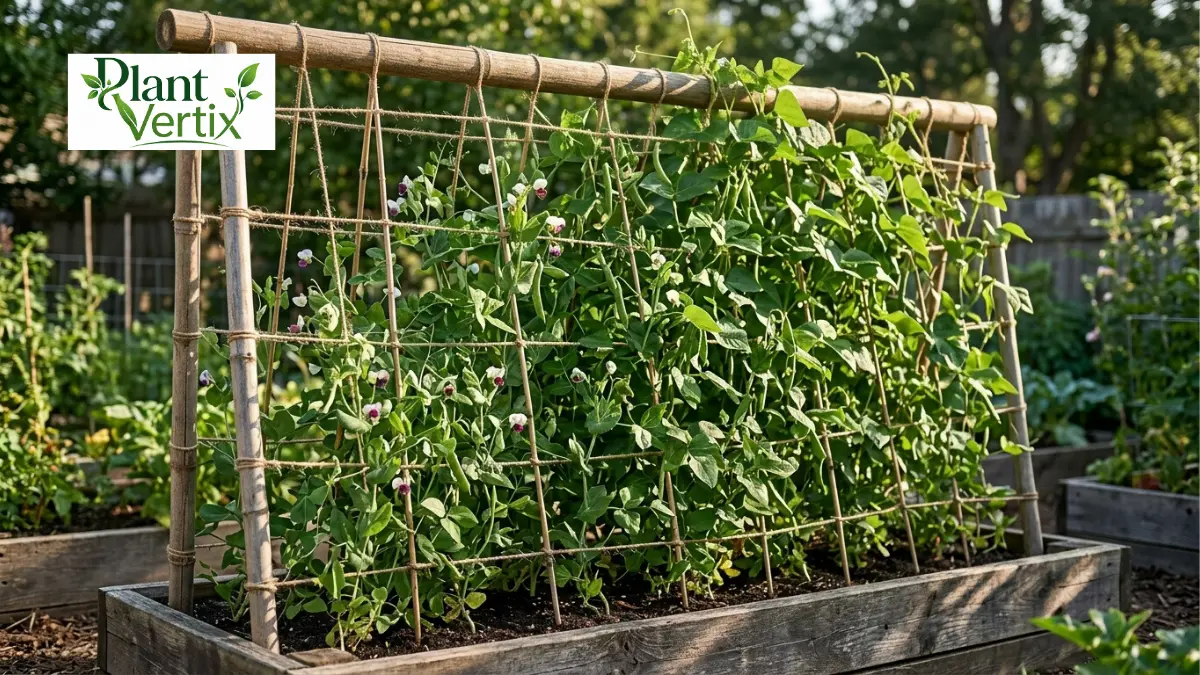
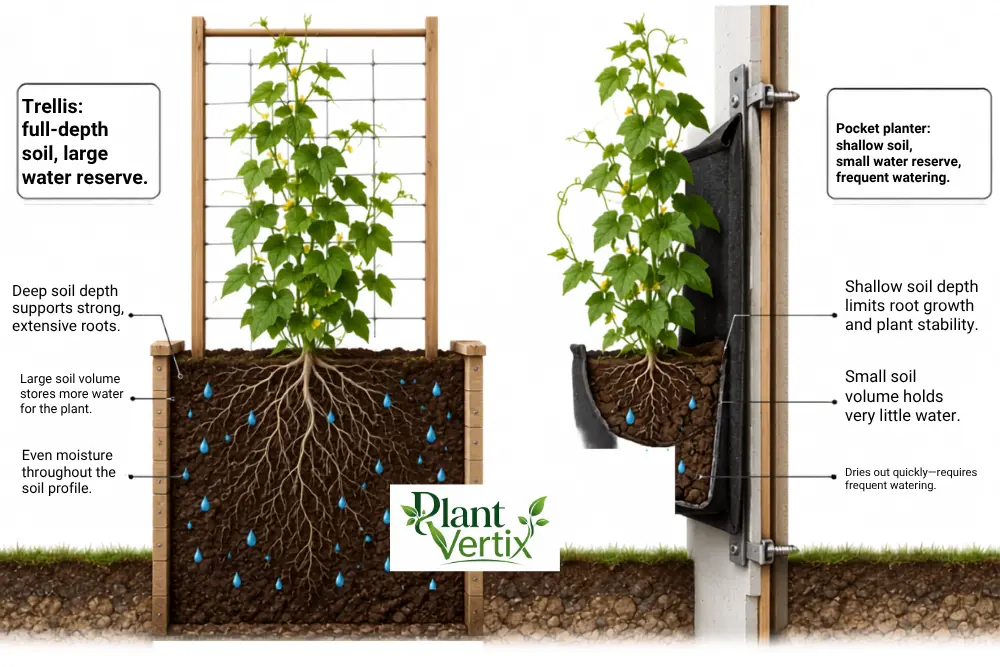
No, you do not need pockets. For a large share of small-space gardeners, a trellis with the roots in a proper pot or bed is the better vertical garden, and it is cheaper than every other system on this site. The reason is soil volume. Every pocket, panel and tower system buys its compact footprint by giving each plant a small amount of growing medium, which is why they need watering so often. A trellis does the opposite: the roots stay in full-depth soil at ground level, and only the top growth goes vertical. You get the space-saving without the drought problem.
The catch is that a trellis only works if the frame matches the way your plant physically climbs. Plants climb in four different ways, and a frame that suits one of them is useless for another. That is the part almost every trellis article skips, and it is the whole article here.
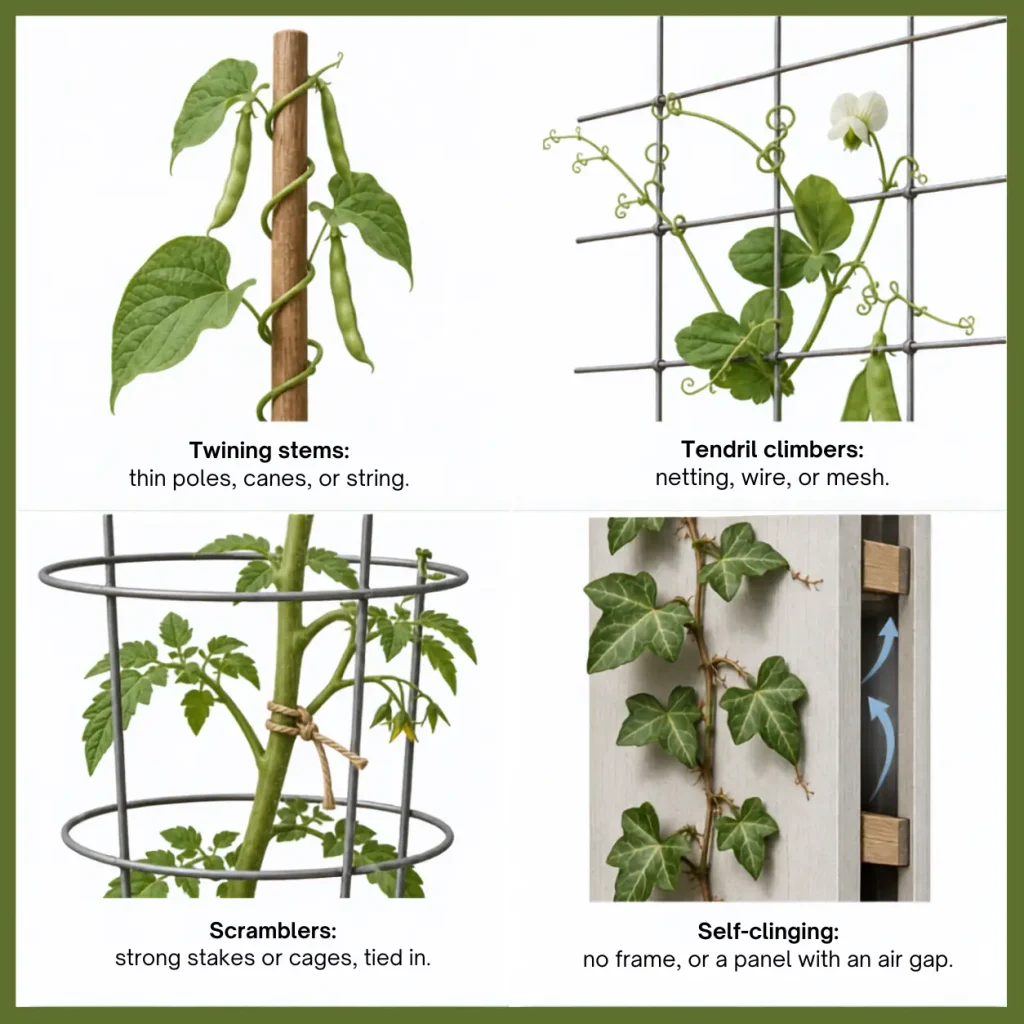
The Four Climbing Mechanisms and the Frame Each One Needs
Before you buy or build anything, find out which of these your plant is. It is the single most useful piece of information on this topic.
1. Twining stems
The growing tip of the whole stem circles in the air and wraps itself around whatever it touches. Pole beans and morning glories are the classic examples, and they will climb enthusiastically with no help at all.
What the frame must be: something thin enough for a stem to coil around. Poles, canes, string, wire, netting, and thin lattice all work. A wide flat board does not, because a stem cannot wrap it. A twiner presented with a chunky pergola post will climb around the post if it can reach around it, and sit at the bottom sulking if it cannot.
Practical note: a stem that has wrapped a support is holding on with the whole stem, which is why bean poles carry a lot of weight without ties.
2. Tendril climbers
The plant sends out thin specialized shoots that grip on contact and then coil to pull the plant up. Peas, cucumbers, grapes, sweet peas and passionflower work this way.
What the frame must be: thin. Tendrils are small and can only grip something they can close around, which in practice means netting, string, wire, mesh, or thin lattice. This is the mechanism that fails most often on a decorative trellis because the timber battens are far too thick for a pea tendril to hold, and the plant simply lies against the frame and falls off.
Practical note: if you only remember one thing from this section, remember that peas and cucumbers want mesh or string, not a chunky wooden panel.
3. Scramblers and non-climbers
Some of the most popular “vertical” crops do not climb at all. Tomatoes, roses, blackberries and squash have no mechanism for attaching themselves to anything. In the wild, they lean, sprawl and hook through other plants.
What the frame must be: strong, and you supply the attachment. These plants get tied in, woven through, or supported in a cage, and they need revisiting every week or two through the growing season as they extend. Cages, stakes and sturdy grids all suit them.
Practical note: this is the group where the frame carries a real fruit load, so it is the group where frame strength genuinely matters. A tomato plant loaded with fruit in wet weather is heavy.
4. Self-clinging climbers
Ivy, Virginia creeper and climbing hydrangea attach themselves directly to a surface using aerial roots or adhesive pads. They need no frame at all.
What the frame must be: nothing, and that is the problem. Do not plant self-clinging climbers directly on a house wall unless you have thought about it hard. They hold onto masonry, render and paint; they get into small cracks and joints; they are difficult to remove without taking the finish with them; and they can reach under siding and into eaves. If you want that look, grow them on a freestanding frame or on a panel mounted with an air gap, so the plant clings to the panel rather than to your building.
Why a Trellis is the Most Efficient Vertical System
The roots stay in a full-depth container or bed. That is the entire argument, and it is a strong one. A trellis-grown plant has the same drought buffer and the same root run as a plant grown flat on the ground. A pocket-grown plant does not. Our comparison of how much growing space you actually gain by going vertical covers the arithmetic.
Air moves through the foliage. Getting a plant up off the ground and spread out improves air circulation around the leaves, which is one of the standard reasons horticultural extension services recommend trellising vegetables at all. University of Minnesota Extension’s guidance on trellises and cages, and Virginia Cooperative Extension’s publication HORT-189 on vertical gardening with trellises, stakes and cages, both cover trellising as ordinary good practice for vegetable growing rather than as a design trend.
Harvest and inspection get easier. Fruit hanging in the air is visible, reachable and cleaner than fruit lying on the soil.
It costs almost nothing. String, canes, and a roll of netting will grow a productive wall of beans. Nothing else in vertical gardening has that price.
It is genuinely renter-friendly. A freestanding frame or an obelisk in a large pot touches no wall, needs no fixings and leaves nothing behind.
What a Trellis Cannot Do
Be clear-eyed about this, because a trellis is not a substitute for every other system.
It is seasonal if you grow annuals. Beans, peas and cucumbers give you a green wall from midsummer and a bare frame in winter. If you want year-round coverage, you want evergreens or a different system.
It gives you no growing positions of its own. A panel has twelve pockets and therefore twelve plants. A trellis is a surface for plants that grow from below. If your ground is entirely paved and you have no room for pots at the base, a trellis has nowhere to start.
It will not grow lettuce, herbs or strawberries up a wall. Those are not climbers. For those, pockets, trays or shelves are the right tools. Best plants for vertical gardening by tier sorts plants by the positions they suit.
It becomes a sail. This is the load consideration that matters for trellis, and it is different from the one that matters for planted panels. A trellis weighs very little. A trellis covered in dense summer foliage catches a great deal of wind, and the force goes into whatever the frame is attached to. That is how fence panels bow and how freestanding obelisks end up flat on the lawn in September. Plan the frame for the plant in August, not the plant in May. If you are attaching to a fence, our guide to vertical gardening on a fence explains why the load has to reach the posts rather than the panels.
Choosing the Trellis Frame Itself
| Frame type | Suits | Watch out for |
|---|---|---|
| Netting or garden mesh on a frame | Tendril climbers and twiners. The most versatile and cheapest option | Choose a mesh that lets your hand and your harvest through. Fruit that grows through a small mesh gets stuck |
| Strings run vertically from a top rail | Twiners and tendril climbers, especially beans and cucumbers | Cut the strings down with the plant at the end of the season and compost them together |
| Wire on eye bolts or vine eyes | Long-term climbers on a wall or fence, with a proper air gap | Wire stretches. Tension it, and give the plant space behind it to circulate air |
| Timber lattice panels | Twiners, and anything you will tie in | Usually too thick for tendrils to grip. Check the batten thickness against the plant |
| Obelisks and freestanding towers | Pot-grown climbers with no wall available | Needs weight or ballast in the pot. A tall obelisk in a light plastic pot goes over |
| Cages | Tomatoes and other scramblers | Strength matters here more than anywhere else, because you are carrying fruit |
| A-frames over a bed | Cucumbers, squash and melons | The fruit hangs underneath, so leave headroom to reach it |
| Existing chain-link fence | Almost anything that grips | Already a ready-made trellis, and it is free |
Materials come down to lifespan and looks: bamboo canes are cheap and last a season or two, treated or naturally durable timber lasts years, galvanized or coated steel and wire last longest, and untreated softwood rots first at the point where it enters the ground. There is no need to overthink it for annual crops.
Sizing the Frame to the Plant
Two mistakes account for most disappointing trellises.
Too short. Pole beans and vigorous cucumbers will run past a short frame and then flop back down over themselves into a tangle that shades itself and traps moisture. Check the mature height of what you are growing before you buy the frame, and if in doubt go taller.
Too weak at the base. A frame carrying a mature crop in the wind is loaded most heavily at ground level. A freestanding frame needs its legs set firmly into the ground or a base heavy enough to resist the leverage of everything above it. This is the same overturning arithmetic that applies to any tall garden structure, and it gets tested by the first autumn gale rather than by anything you do in spring.
If you are weighing a trellis against panels, towers and shelves, our neutral comparison of vertical garden systems sets out the criteria side by side, and vertical vegetable gardening in small spaces covers what a climbing frame can realistically produce.
FAQ
What is the best trellis for a vertical garden?
The one that matches how your plant climbs. Tendril climbers such as peas and cucumbers need something thin, such as netting, string or wire. Twiners such as pole beans and morning glory need thin poles or netting that they can wrap. Scramblers such as tomatoes climb nothing and need a strong frame plus ties. A frame chosen for looks alone often fails one of those tests.
Can I use a trellis instead of a pocket planter or wall panel?
For climbing plants, yes, and usually better. The roots stay in full-depth soil, which means far less watering than a shallow pocket system, and the frame costs a fraction as much. What a trellis cannot do is grow non-climbers like lettuce, herbs or strawberries up a wall.
Which vegetables actually climb a trellis?
Pole beans and peas climb readily on their own. Cucumbers, melons and small squash climb with tendrils and often need a little guidance early on. Tomatoes do not climb at all and must be tied in or caged. Extension guidance from Virginia Cooperative Extension and University of Minnesota Extension both treat trellising these crops as standard practice.
Will a trellis damage my wall or fence?
The trellis itself is light. The problem is wind on the foliage once the plant fills out, which loads whatever the frame is fixed to. On a fence, send that load to the posts rather than the panels. Also avoid self-clinging climbers such as ivy directly on a house wall, because their aerial roots and adhesive pads grip the surface and are hard to remove cleanly.
How tall should a trellis for climbing vegetables be?
Match it to the mature height of the crop rather than to the space available, and go taller if you are unsure. A vigorous climber that outgrows its frame flops back down over itself, which shades the plant, traps moisture in the foliage and makes harvesting difficult.