Tiered Plant Shelf Outdoor: Floor Load, Not Wall
Putting the weight on the floor instead of the wall removes one failure mode and introduces two others. You no longer have to worry about fixings pulling out of plasterboard, which is the most common way a wall system fails. In exchange, you get tipping over, which is what actually happens to loaded tiered shelves outdoors, and point loading, because the entire weight of the shelf arrives at the ground through four small feet rather than being spread across a wall. Neither is hard to manage. Both are ignored by almost every “best tiered plant stand” article, which treats the choice as a styling decision.
So, is a tiered plant shelf safer than a wall-mounted planter? For most people, on solid ground, yes. On a balcony, on decking, on a lawn, or anywhere exposed to wind, only if you deal with the two problems below.
What Do We Mean By a Tiered Shelf
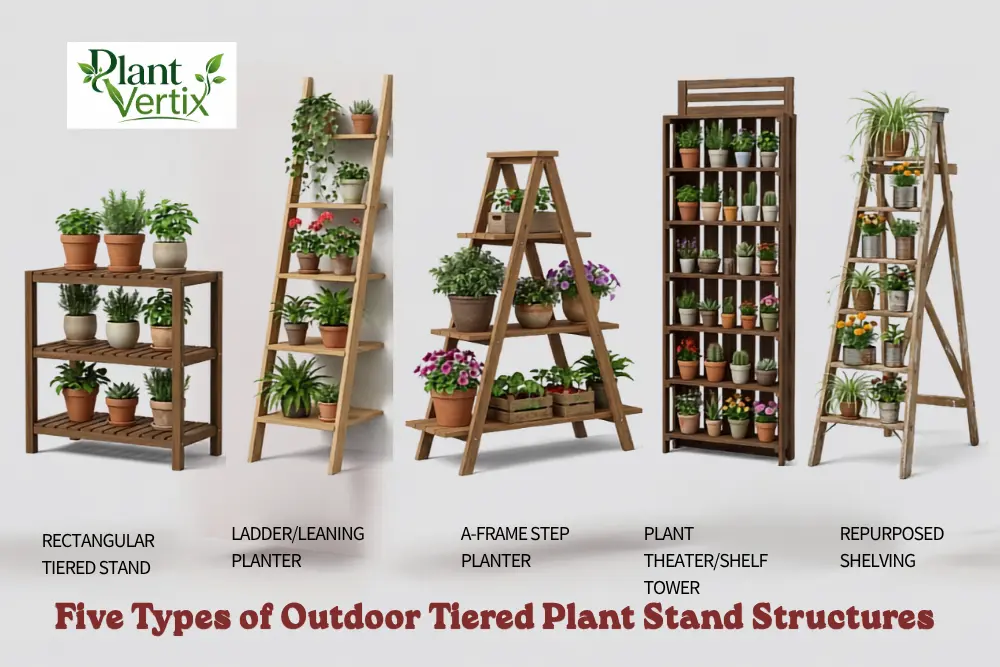
Rectangular tiered stands. A freestanding unit, usually three to five shelves, with a footprint roughly the same at top and bottom. The most stable geometry in this category.
Ladder and leaning planters. A frame that leans against a wall, with shelves that typically get deeper toward the bottom. Attractive, space-efficient, and the type with the most interesting failure behavior.
A-frames and step planters. Two legs meeting at the top or a staircase profile. Wide at the base, generally stable, and they eat floor area.
Plant theaters and shelf towers. Tall and narrow, sometimes with a back panel, and the most exposed to wind of the group.
Repurposed shelving and furniture. An old bookcase, a shoe rack, a stepladder. Cheap and often the least suited to outdoor loads, because it was designed for dry indoor objects that never got heavier.
Problem One: Tipping Over
A tiered shelf is a tall object with a modest footprint whose center of mass rises as you fill the upper shelves. Four things push it toward tipping, and they compound.
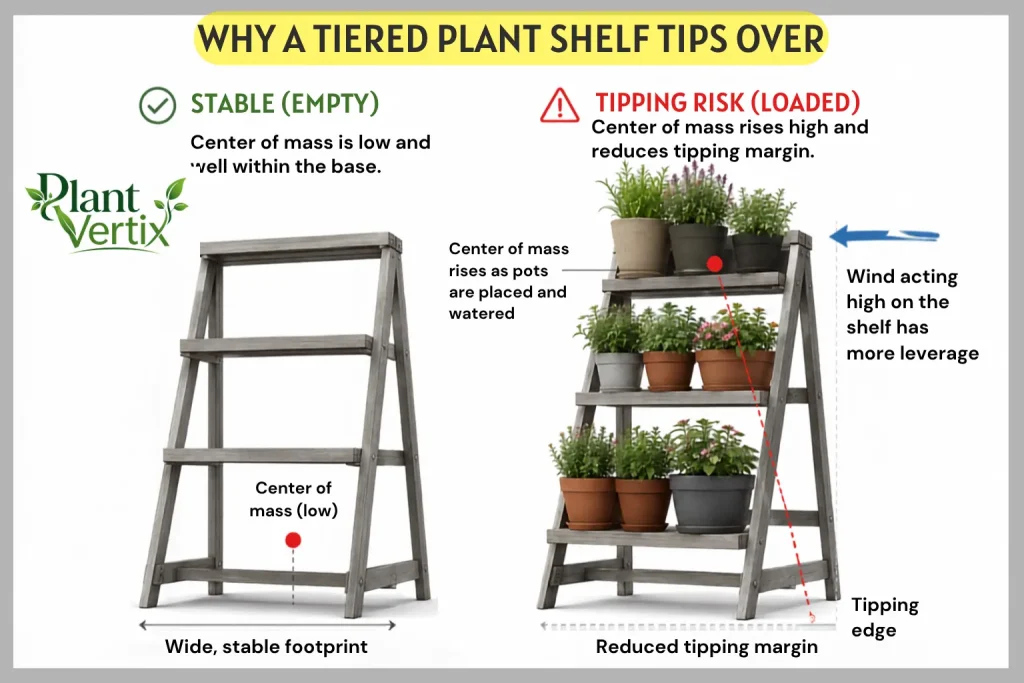
The load moves upward as you plant. Empty, these units are bottom-heavy and hard to knock over. Loaded, with the heaviest pots often placed on the top shelf because that is where they are visible, the mass has moved up. That is a different object mechanically from the one you assembled.
Water is heavy, and it arrives after you have decided the layout. A US gallon of water weighs about 8.34 pounds, and a liter weighs one kilogram. Saturated growing medium weighs substantially more than the same medium dry, so every pot on the shelf gets heavier on watering day, and the upper shelves gain the same proportion as the lower ones.
Wind acts over the whole height. Foliage on an upper shelf is a sail with a long lever arm. A gust that would not budge a pot on the ground can overturn the same pot at chest height on a stand. This is why tall, narrow plant theaters are the type that most often end up on their side after a storm.
The ground is rarely as flat as it looks. One foot on a slightly soft patch of lawn, one on a decking board with give, one on an uneven paving joint, and the unit already leans. Anything leaning tips at a much smaller push than anything plumb.
Then there is the geometry that is specific to leaning ladder planters, and it is worth understanding because it is counterintuitive.
A leaning ladder is a triangle made of the frame, the wall and the floor, and it stays up because friction at the base stops the feet from sliding outward. Load the upper shelves heavily, and you increase the outward push at the base while doing little to increase the downward force holding the feet in place. On a smooth, wet surface, tile, sealed concrete, decking after rain, that is exactly the condition under which a leaning ladder slides out at the bottom and comes down. Load a leaning planter bottom-heavy, keep the feet on a surface with grip, and if the design offers a wall bracket, use it.
What actually fixes tipping
- Put the heavy things low. The largest pots, the wettest medium, the terracotta, all on the bottom shelf. Light trailing plants and small pots up top. This is free, and it is the highest-value change you can make.
- Stand it on something firm and level. A paving slab or a bearer board under the feet beats bare soil, bark or grass. Check it is plumb after the ground has been rained on, not just on the day you set it up.
- Use whatever restraint the design provides. Many units ship with an anti-tip strap or bracket. It exists because the manufacturer knows the unit can go over.
- Be honest, restraint means a wall fixing. This is the concession the category’s marketing avoids: strapping a shelf to a wall puts you back into anchors and substrate. The good news is the demand is far lower than for a hanging planter, because the wall is only resisting a sideways nudge rather than carrying the whole weight. The rules are the same, though: the fixing is only as strong as what it goes into, and plain drywall is not a substrate for anything structural. Find a stud, or use a masonry anchor matched to your masonry.
- Move it or strip it before a storm. These units are light, empty, and easy to relocate. Taking the top shelf off before a named storm is a five-minute job.
- Do not cite it where a fall matters. Not across a doorway, not at the top of steps, not beside glass, and not where a child or a pet plays. A loaded shelf coming down is heavy, and it is full of pots.
Problem Two: Point Loads, Which Nobody Mentions
“Floor load, not wall load” sounds reassuring until you look at how the load reaches the floor. It goes through four feet, and each foot may be an inch or two across. That concentrates the pressure at four small spots, and the surface underneath has to take it.
Where that shows up:
Timber decking. Small hard feet on a soft board dent it, and a dented spot holds water, and water is how decking rots. Feet placed mid-span between joists deflect the board and make it worse. Put the unit’s feet over joists if you can find them, or spread the load with a board or pad under the feet.
Lawn and soil. The feet sink unevenly, and the unit starts to lean, which takes you straight back to the tipping problem. Paving slabs under the feet solve it.
Balcony surfaces and waterproof membranes. Concentrated pressure plus grit is how a waterproof coating gets scarred, and a scarred membrane is a leak into the structure below. Use wide pads or a bearer board.
Any surface with a finish you care about. Rust marks from metal feet, staining from wet timber, and abrasion from anything that gets nudged around are all avoidable with a pad.
Wide feet, a bearer board across all four, or a slab underneath solves this problem entirely, and it takes about ten minutes.
Balcony Floor Loading is a Building Question
This needs saying plainly, because tiered shelves are extremely popular on balconies.
How much weight your balcony can carry is a structural question about your building, and it is not a gardening question. It depends on the structure, its age, its condition, how it was designed and the code it was built to, and there is no useful general figure. We do not publish balcony capacity numbers, floor load figures or anchor ratings on this site, and that is deliberate. Ask your building management, your landlord, or a qualified engineer, and ask them about your specific balcony.
What you can usefully do yourself: weigh what you are about to put up there. Fill one pot with the medium you intend to use, water it until it drains, weigh it on a bathroom scale, multiply by the number of pots, and add the shelf. Take that measured number to whoever can answer the structural question. A real number gets you a real answer. Our balcony vertical gardening guide takes the same approach and covers what else to ask.
Also worth checking: many buildings have rules about what may be placed near or against a railing, and about anything that could fall to a lower level. A tall shelf next to a balcony edge is exactly the item those rules exist for.
Reading a Shelf’s Own Weight Rating Honestly
Most manufactured stands state a capacity, usually per shelf. Read it, and read what it assumes.
A stated per-shelf capacity is normally a static figure for an evenly distributed load on a level surface, tested indoors. Your use is different in at least three ways: the load is not evenly distributed, because pots are point loads; it is not static, because it changes every time you water; and it is outdoors, where wind adds forces the test never applied. The number is a useful upper bound and a poor safety margin. Treat it as “do not exceed,” never as “this is fine.”
That is also why we will not give you a number of our own. We cannot see your unit, your surface or your weather.
Where An Outdoor Tiered Plant Shelf is the Right Answer
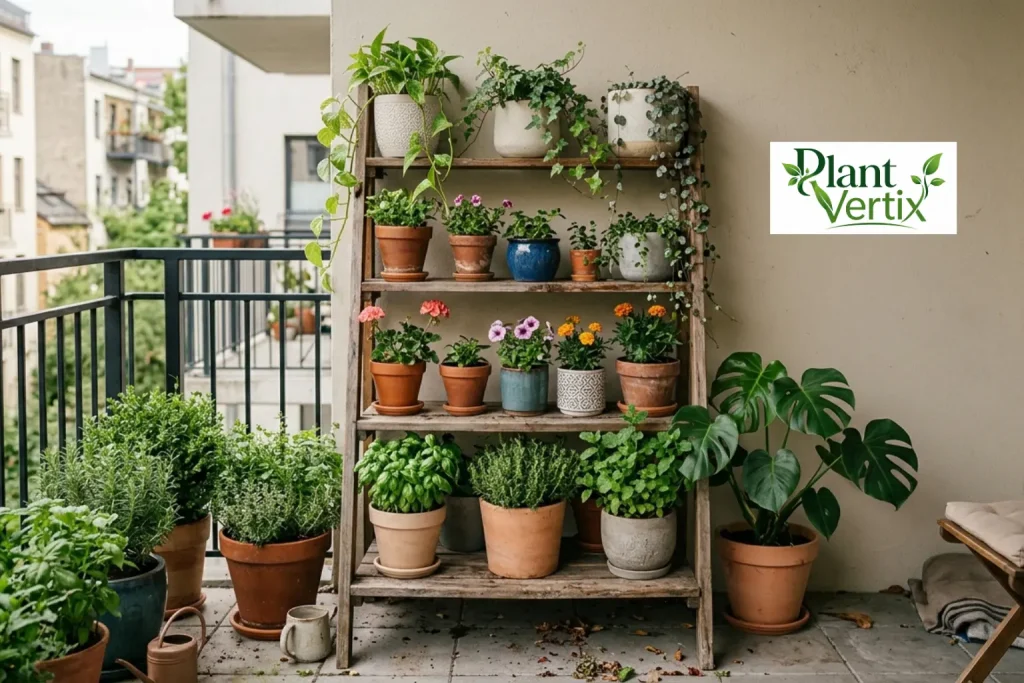
You cannot drill. Renting a managed building, a wall you must not touch. A shelf is the least intrusive vertical system available.
You want reach and flexibility. Every pot comes off individually, so you can move a plant that is failing, bring one in for winter, or reorganize seasonally. That is a real advantage over any fixed system, and it is why shelves stay in use for years while planted panels often do not.
You want a mixed collection. Different pot sizes, different depths, different plants, no proprietary modules.
You want depth for roots. This is underrated. A shelf carries real pots, so you can have proper root volume for things a wall pocket cannot support. Best plants for vertical gardening by tier covers matching plants to position, and on a shelf you have far more freedom than on a panel.
Where it is the wrong answer: narrow balconies where the footprint matters more than the height, very exposed sites where wind is a constant, and anywhere the unit would stand somewhere a fall could injure somebody. In those cases a wall-mounted system, properly fixed by someone qualified, is genuinely the safer choice.
Materials, Briefly
Outdoors, the material determines the lifespan, and there is no need to overcomplicate it. Powder-coated or galvanized steel resists rust if the coating stays intact, so touch up chips. Naturally durable or pressure-treated timber handles moisture; untreated softwood does not, particularly where a foot sits in a puddle. Untreated MDF and particleboard belong indoors and nowhere else, which is why a repurposed indoor bookcase usually fails within a season. Whatever the material, the feet are the part that sits in water, and the feet are where these units start to go.
For a comparison against panels, towers and trellis, our neutral framework for vertical garden systems sets out the criteria, and choosing where to put a vertical garden involves reading a site before you commit to it.
FAQ
Is a tiered plant shelf safer than a wall-mounted planter?
It removes the fixings-pulling-out failure mode, which is the most common way wall systems fail, and it adds tipping over and point loading on the floor. On firm level ground, loaded bottom-heavy and out of the wind, a shelf is the lower-risk option for most people. On a windy balcony or soft ground, it is not, unless you deal with the base.
How do I stop my outdoor plant shelf from blowing over?
Load it bottom-heavy, with the biggest and wettest pots on the lowest shelf. Stand it on a firm level base so it does not lean. Use the anti-tip strap or wall bracket if the unit came with one. Move it or strip the top shelf before a storm, and never sit it where a fall would land on a person, glass or a walkway.
Can I put a tiered plant stand on a balcony?
Usually, yes, and it is a popular choice because nothing is fixed to the building. The weight your balcony can carry is a structural question for building management or a qualified engineer, not something a gardening article can answer. Use wide pads or a bearer board under the feet to protect the surface and any waterproof membrane, and check your building’s rules on items near the railing.
Will a plant stand damage my decking?
It can, because the whole load arrives through four small feet, and a dent in a board holds water, which is how decking rots. Put a pad, a wide foot or a bearer board under each leg, and position the unit over joists rather than mid-span where the board flexes.
Can I trust the weight limit printed on a plant stand?
Use it as a ceiling, not a comfort. A stated per-shelf capacity is normally a static, evenly distributed figure measured on a level indoor surface. Pots are point loads, watered medium is a changing load, and outdoors wind adds forces that the test never applied. Stay well under it.