Balcony Railing Planter: How the Fixing Actually Works
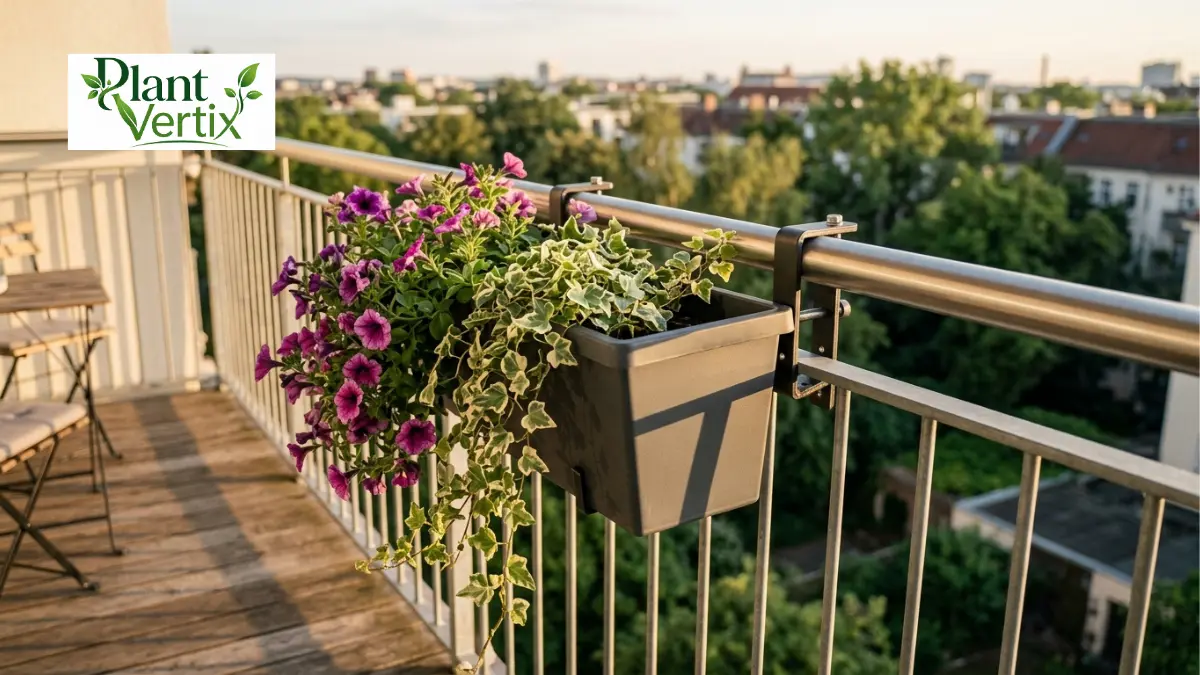
A balcony railing planter is a growing structure mechanically fixed to a railing rather than one that simply rests on a ledge, and the fixing is the whole question. Brackets, straddle hooks, screws, or rope and zip ties each attach differently and ask different things of the railing itself.
Because the structure typically hangs or cantilevers outward past the rail, it puts more leverage on its fixing point than the same weight would on a flat wall, and a saturated, wind-loaded planter can work a marginal fixing loose over time rather than all at once.
No general weight figure applies to every railing, so the right first step is reading what your specific bracket or planter reports as its own rated capacity, checking what the railing is made of, and, in a shared or managed building, asking before you attach anything.
What Makes a Balcony Railing Planter Different From a Planter Resting on a Ledge
A pot resting in the gap of a railing or hooked loosely over the top rail is not what this covers. A railing-mounted vertical system is bolted, clamped, or bracketed to the rail as an actual fixing, carrying its own weight as a structure rather than balancing under gravity alone.
That distinction matters because a fixed structure fails differently than a resting one: a resting pot can be nudged off, while a fixed structure comes loose at its fixing point, usually gradually, as hardware works free under repeated wind and watering cycles rather than all at once.
How Railing Planters Actually Attach
Four attachment methods cover most of what is on the market and what people build themselves:
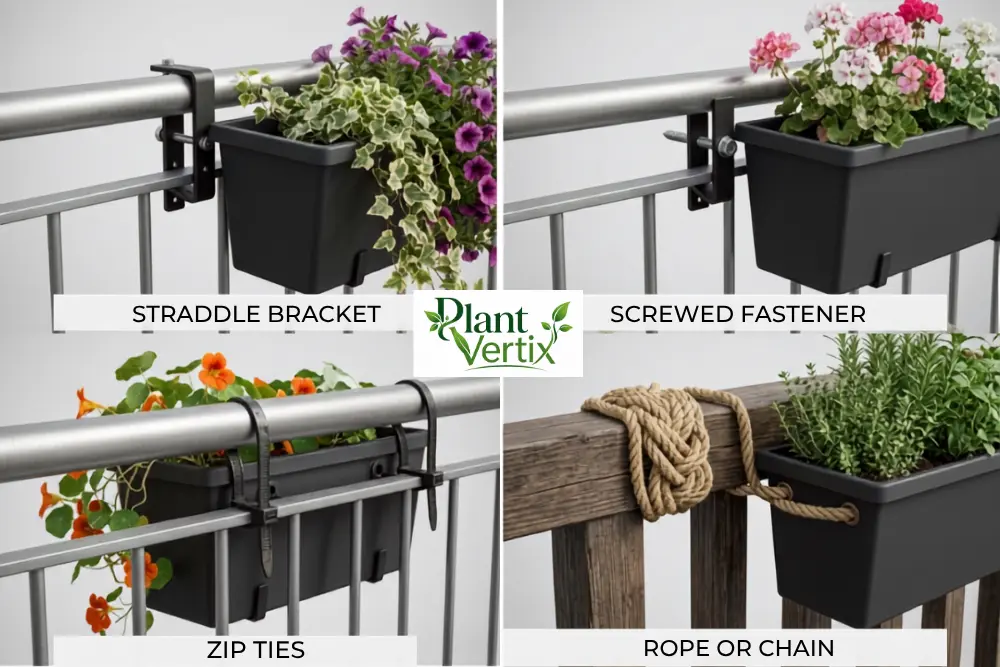
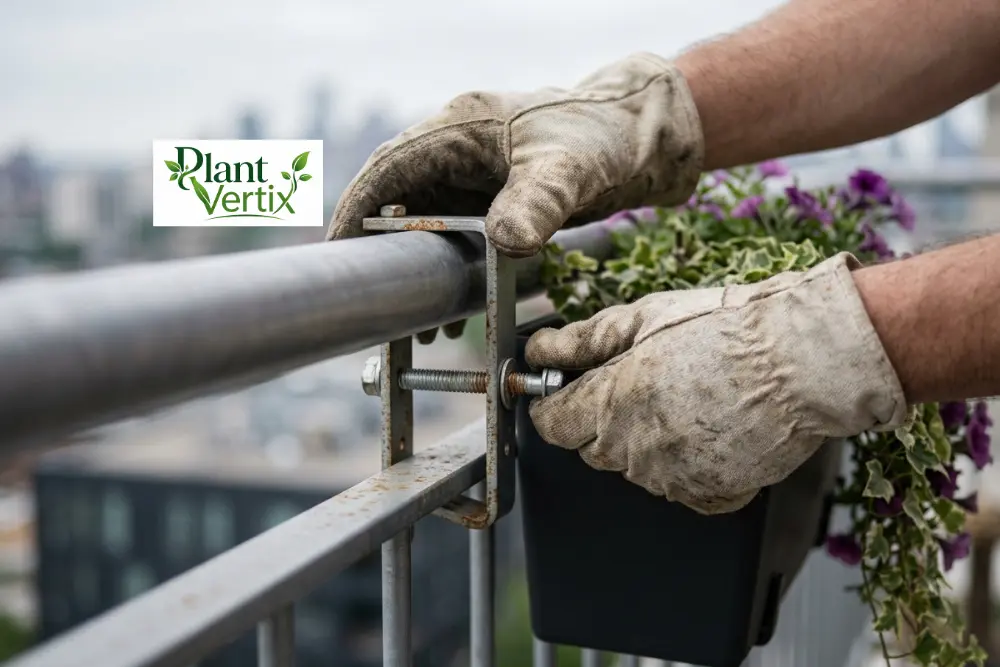
- Brackets that straddle the rail, hanging planters on one or both sides, held by a screw or clamp mechanism tightened against the rail itself. This is the most common manufactured option and generally the most secure of the four when matched to the rail’s thickness.
- Screws or self-tapping fasteners driven directly into the railing are appropriate only where the railing material and ownership situation genuinely allow permanent modification, which rules it out for most rentals and many condo or HOA-managed balconies.
- Zip ties, threaded through a bracket’s mounting holes and around the railing, are a fast and fully reversible option for metal rails, but one that should be checked and replaced periodically since UV exposure makes plastic zip ties brittle over a season or two outdoors.
- Rope or chain, wrapped around the rail and through the planter’s own mounting points, a traditional no-drill method that depends entirely on the knot or fastening staying tight under repeated wind movement.
Choose brackets sized to your railing’s actual thickness and to the base dimensions of your planter, not a generic “fits most” claim, since a bracket that is loose on an undersized rail defeats the point of using a bracket at all.
What the Railing is Actually Being Asked to Carry
The fixing method only matters if the railing itself can carry the load, and that depends on what the railing is made of, which is not something a gardening guide can answer for every case:
- Metal tube or pipe railings are generally the most forgiving for clamp-style brackets, since the round or square profile gives a bracket something consistent to grip.
- Wood railings vary enormously by species, age, and weathering, and a screw-in fastener is only as good as the wood it bites into, which can be softer or more rotted than it looks from outside.
- Cable railings are designed to resist tension along their length, not a hanging point load perpendicular to the run, and most manufacturers do not recommend hanging planters directly from the cable itself.
- Glass panel railings typically have no rail surface at all to clamp onto below the top cap, which narrows attachment options to whatever the top cap itself is rated to carry.
If a bracket or planter states its own weight rating, that figure is the manufacturer’s reported capacity for their hardware under their tested conditions, and it is worth reading closely for what it assumes (empty or loaded, static or in wind) rather than treating it as a guarantee for your railing.
We do not publish a general weight-capacity number of our own here, because no number could account for every railing type, age, and condition, and a wrong number on a fixing that hangs above open space is worse than no number at all.
The Leverage Problem: Why Hanging Outside the Rail is Not the Same as Hanging on a Wall
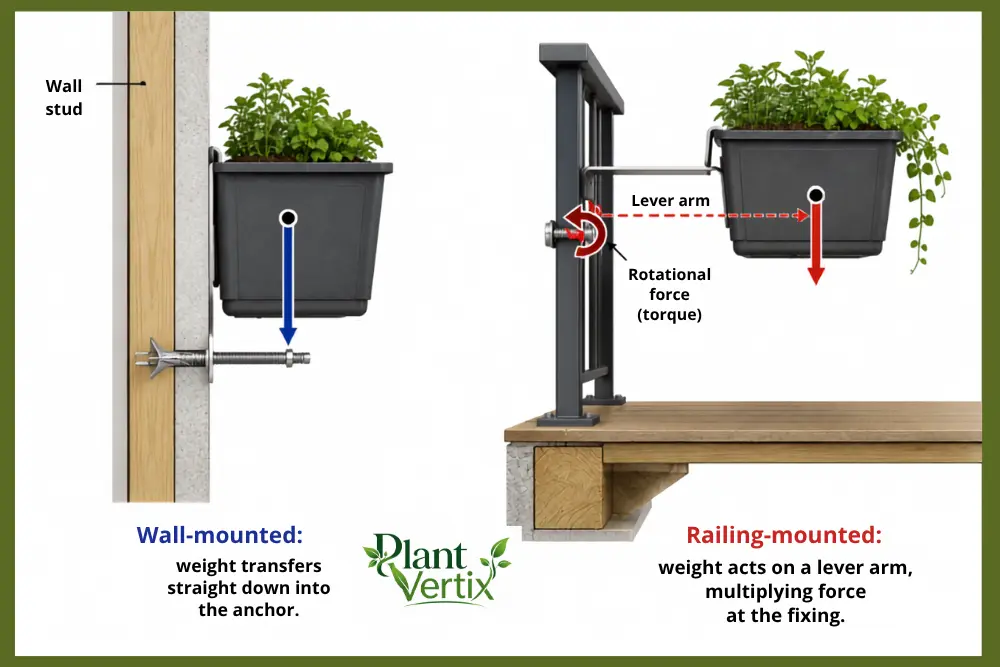
This is the mechanical detail almost every railing planter guide skips. A planter mounted flush against a flat wall transfers its weight almost straight down into the anchor. A railing planter that hangs or cantilevers out past the rail line, which is how most of them are designed to sit, puts the weight at a distance from the fixing point instead of directly beneath it.
That distance is leverage: the further the loaded planter sits from the rail, the more force the fixing has to resist, for the exact same weight of soil and plants. A bracket rated for a certain hanging weight straight down is not automatically rated for the same weight held out on a lever arm, which is one reason manufacturer instructions for railing brackets are worth reading in full rather than skimming past the diagram.
Wind Adds a Moving Load On Top of a Static One
A railing sits at the edge of a balcony, which is exactly where the wind is least obstructed and most turbulent. A loaded railing planter presents foliage and soil mass to the wind at the point furthest from the fixing, the same leverage problem as above, but now as a repeated, swinging or rocking force rather than a steady one.
That cyclical load is what tends to work a marginal fixing loose over a season, even if it looked solid on the day it went up. Favor two fixing points over one wherever the bracket design allows it, since a second point resists exactly the twisting and rocking motion a single point cannot.
What Happens Below Matters, Structurally
A structure fixed above open space carries a different consequence if the fixing fails than one on solid ground, since anything that comes loose has somewhere to fall. This is a reason to check hardware periodically and to favor redundant, well-matched fixings over the fastest option, not a reason to avoid railing planters altogether.
If your balcony sits above a walkway, a shared entrance, or any space people pass through below, that is worth factoring into how conservatively you choose and maintain the fixing, alongside everything above about matching the bracket to the rail and checking it over time.
When to Check With a Landlord, Building Manager, or Professional
- Before drilling or permanently fastening anything to a railing you do not own outright. Many leases and condo bylaws treat the railing as part of the building’s shared structure, not a tenant’s to modify, even where the balcony floor itself is treated differently.
- If your railing is glass, cable, or an unusual profile that the common bracket designs are not built for.
- If you notice any looseness, corrosion, or movement in an existing fixing. Outdoor hardware corrodes, and a bracket that gripped tightly when installed can loosen as metal parts weather or wood parts shrink and swell with the seasons.
- If you are unsure what your specific railing was built to carry. That is a structural question about your building, not a gardening question, and it belongs with whoever manages the property or a qualified contractor, not a general guide.
For the mounting principles that apply to every fixed vertical structure, not just railings, see our comparison of vertical garden systems. If a railing planter is not the right fit for your balcony, a tension-rod or over-the-door system and a tiered hanging planter mounted to a confirmed ceiling joist are both worth comparing before you commit to a railing fixing. Our broader balcony vertical gardening guide covers wind, water, and permission together for the whole balcony, not just the railing.
FAQ
Can a balcony railing planter fall off?
A properly matched, well-maintained fixing is designed not to, but any mechanical fixing can loosen over time from wind, weather, and repeated watering cycles. Check brackets, screws, zip ties, or knots periodically, favor two fixing points over one where the design allows it, and replace or retighten hardware that shows looseness or corrosion.
What kind of railing bracket is strongest?
There is no single answer that applies to every railing, since a bracket’s real-world strength depends on matching it to your railing’s actual thickness and material, not just the bracket’s own build quality. A clamp-style bracket sized correctly for a metal tube railing is generally more secure than a generic strap fastener on an oddly shaped or oversized rail.
Is it safe to hang planters on a rented apartment’s balcony railing?
Check the lease first. Railings are frequently treated as part of a building’s shared structure, which some leases and condo rules restrict even when balcony floor space is treated more flexibly. A reversible attachment method, such as zip ties or a clamp bracket that does not require drilling, is the safer choice in a rental until you have confirmed what is allowed.
Why does a railing planter feel less stable than a wall-mounted one for the same weight?
Because it usually hangs or cantilevers out past the rail line rather than sitting flush against a flat surface, which puts the weight on a lever arm instead of straight beneath the fixing. The same weight exerts more force on the fixing point the further out it sits, which is why manufacturer weight ratings for railing brackets are worth reading closely rather than assumed.
Does wind matter more for railing planters than for other vertical systems?
Generally, yes, because a railing sits at the exposed edge of a balcony where wind is least blocked, and the leverage from hanging outside the rail line turns that wind into a repeated rocking force on the fixing rather than a steady push. Favor redundant fixing points and check hardware more often in exposed, high-wind locations.