Balcony Vertical Garden: Start Here
A balcony is the most constrained space in vertical gardening, so the constraints should choose the structure rather than the other way around. Four of them decide almost everything before you look at a single planter:
- Wind, which is stronger and more turbulent at height than at ground level, and which rewards open frames over solid panels;
- Water, which has to be contained on a surface that was never designed to hold it;
- Permission, because a balcony floor, railing, and wall are frequently shared building elements rather than yours; and
- Reach, because a tall structure in a narrow space has tiers you will not be able to service.
Work through those first, and the shortlist of structures that actually suit your balcony is usually two or three items long.
The Short Answer: What Actually Works on a Balcony
Most balcony vertical gardens that survive are one of four things.
A freestanding tiered frame or tower, standing on the floor against a wall, fixed to nothing. It is the most widely available answer for renters and for anyone in a managed building, because it needs no permission to attach anything.
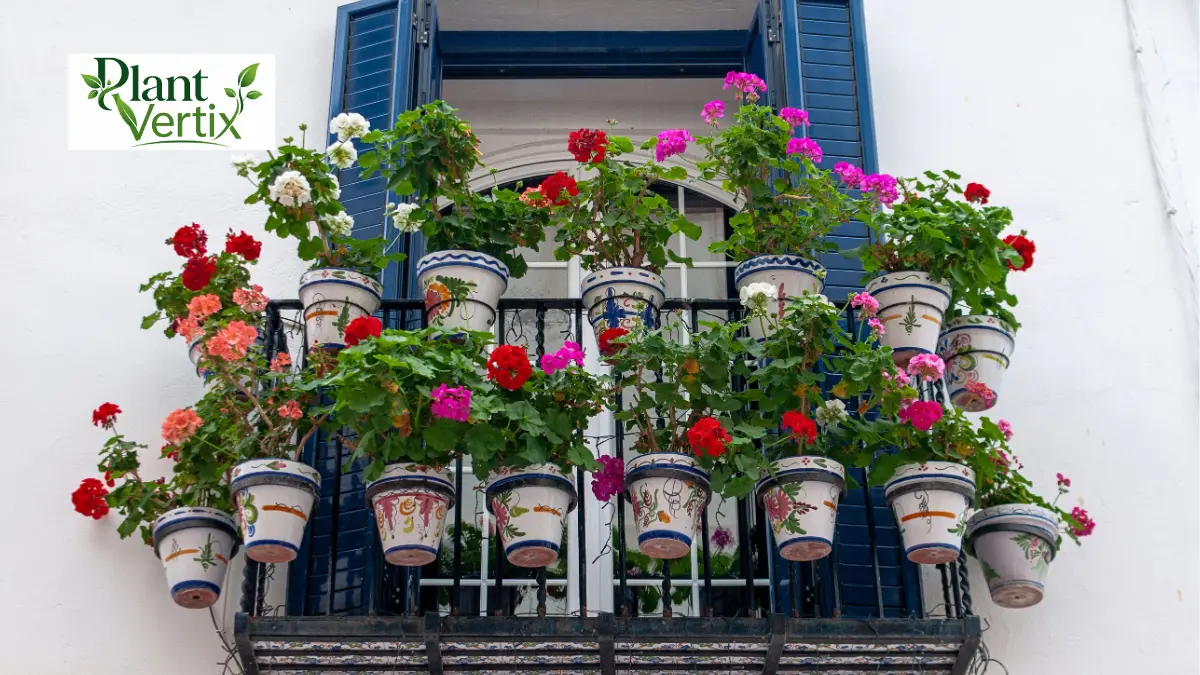
A railing-mounted structure, where a frame is mechanically fixed to the railing itself and braced so it cannot rotate or lift.
A wall-mounted panel or set of rails, where the balcony has a solid wall belonging to the property, and you are permitted to fix it into it.
A trellis or climbing frame, braced against the railing or standing in a heavy planter, carrying vining plants rather than pockets of growing medium. This is the lightest option by a distance, and it is consistently underrated.
Which of the four is available to you is decided by the constraints below, not by preference. The general comparison of these structure types on drilling, weight path, and renting is in vertical garden systems compared.
Four Constraints That Decide Everything Before You Choose a Structure
Almost every balcony gardening article opens with ideas and closes with a short caution about checking the rules. On a balcony, that ordering is backwards, because the caution is what removes most of the ideas.
- Wind. Higher, faster, and much more turbulent than at ground level, with gusts that come off building corners in directions the prevailing weather does not explain.
- Water. A balcony is a hard, sloped, exposed surface with an edge. Water that leaves your structure does not soak away.
- Permission. The railing is usually a building element. The floor is often a shared structural slab. The exterior wall is frequently part of the facade. What you may attach to any of them is a rules question, not a hardware question.
- Reach. Balconies are narrow. A structure you can only service by standing sideways is one you will stop servicing.
Nothing in that list is about plants, and that is the point.
Wind at Height, and Why it Changes the Shape of What You Build
Wind is the constraint that most balcony gardening content underplays, and it does not just knock pots over. It decides the shape of what you should build.
Solid surfaces act as sails. A densely planted panel, a solid-backed shelf unit, or a filled pocket wall presents a continuous face to the wind. An open trellis, a wire frame, or a slatted structure lets air through. Two structures of the same size can put very different loads on their fixings in the same gust, and the open one is almost always the better choice on a balcony.
Tall and top-heavy is the wrong geometry. A freestanding tower with its heaviest, wettest planting at the top and a small base is exactly the shape that tips. If you use a floor-supported structure on a balcony, keep the mass low, give it the widest base the space allows, and put the heaviest plantings on the lower tiers.
Turbulence is not directional. Air coming off a building corner can push a structure toward the railing on one gust and away from it on the next. Bracing that only resists one direction is not bracing.
Things that are not fixed will move. Loose trays, lightweight empty pots, plant labels, covers, and anything hanging free will eventually leave the balcony. On an upper floor, that is a safety matter, not a tidiness matter.
The practical shape of all this: prefer open frames to solid panels, keep the center of mass low, brace against movement in more than one direction, and secure or remove anything loose before weather arrives.
Weight: The One Question This Site Will Not Answer for You
A loaded vertical structure is heavy, and it gets heavier every time you water it. On a balcony that has a weight that lands on a structural slab and, if you use the railing, on a building element that was designed for people leaning on it rather than for a planted system hanging from it.
This site publishes no balcony capacity figure, no load standard, and no safe-load number of any kind, and it will not do so. That is a deliberate position, for two reasons.
The first is that the real number is a property of your building, not of gardening. It depends on the structure, its age, its condition, its design, and what else is on it. A figure quoted from a code, a forum or a product listing tells you nothing about the balcony you are standing on.
The second is specific to what we are putting on it. Ratings printed on hardware describe dry, static loads in tested conditions. A planted structure is neither dry nor static, and no manufacturer rates hardware for a saturated planter. Extending a package figure to a watered growing system would be inventing a number, and this site does not do that.
What to do instead is ask the people who can actually answer, and ask them well. Building management, the managing agent, the landlord, or a qualified professional. It helps enormously to arrive at specifics rather than a general question.
- The approximate footprint and height of what you want to install, and roughly where on the balcony it would stand or be fixed.
- That the load is continuous rather than occasional, and that it increases when watered.
- Whether the balcony has any recorded restriction on additional load, and whether anyone has asked before.
- Whether anything may be attached to the railing at all, and if so, how.
- Whether anything may be fixed into the balcony wall or ceiling.
- Whether there are rules about what may be positioned against or above the railing line.
Two of those are worth asking even if you plan to fix nothing, because “may I stand a heavy freestanding tower here” is a different question from “may I drill this railing,” and buildings answer them differently.
If the answer is that nothing may be attached and heavy loads are discouraged, the honest response is a light structure: a trellis with vining plants in one properly sized floor pot weighs a fraction of a filled pocket wall and produces a genuine harvest. Vertical vegetable gardening in small spaces covers what grows well on that setup.
Where the Water Goes
On a balcony, water that leaves your structure lands on a hard surface with a fall on it and an open edge. Plan for that on day one.
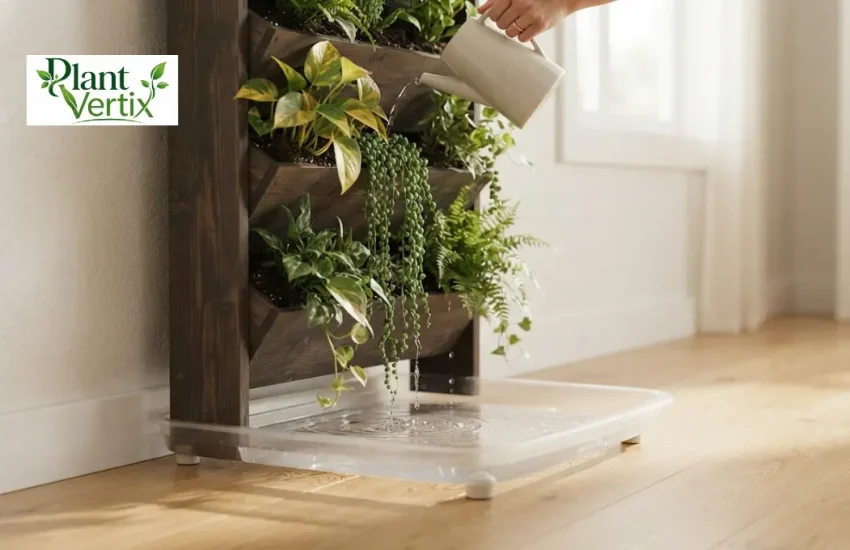
Give the structure a catch point. A tray, a gutter, or a base container that collects what drains out of the lowest tier. This is the single most useful thing you can add to a balcony vertical garden, and it is the thing most setups lack.
Size it for a bad day. The tray that copes with a careful watering is not always the tray that copes with the day a pocket clogs and the water channels straight through.
Do not let runoff leave the balcony. Water crossing the edge is a matter for your building’s rules and, in many buildings, an explicit prohibition. If you are unsure what applies where you live, ask building management. Containing runoff at the base of your own structure keeps you clear of the question entirely.
Watch what the wet strip does to the balcony surface. A permanently damp line along a wall or floor edge is worth noticing early, particularly on timber decking and painted surfaces.
The tier-by-tier watering routine that stops you from overwatering in the first place is how to water a vertical garden.
Structures That Suit a Balcony, and What Each One asks of the space
Freestanding tower or tiered frame. Asks for floor area and a stable base, and asks nothing of the railing or wall. Best where you may attach nothing. Watch the tipping geometry and keep the mass low.
Trellis or climbing frame. Asks for one well-sized floor pot and a way to brace the frame. The lightest real option, and the best value per unit of weight, because the plant does the filling rather than the growing medium.
Railing-mounted frame. Asks for permission first, and then for a fixing method that resists lifting and rotation rather than just hanging on. Only worth considering if the railing is genuinely yours to attach to.
Wall-mounted panel or rails. Asks for a solid wall you are permitted to fix into, a moisture barrier behind the structure, and the professional load conversation above. The most space-efficient and the most demanding.
Suspended tiers from above. Asks for an overhead fixing whose construction you know, and for wind tolerance, since a hanging column swings. Frequently ruled out by building rules on upper floors.
Permission, in More Detail Than Most People Expect
Three separate permissions can apply to one balcony, and people usually think about only the first.
Your lease or your landlord governs whether you may drill, fix, or alter anything.
Building or association rules, which frequently govern the railing, the facade, and what may be visible from outside, and sometimes govern additional load on the balcony independently of your lease.
Fire and access requirements, which in many buildings restrict what may block a balcony’s escape route, a door, or a dividing panel between balconies. This one is missed constantly, and it is worth asking about specifically, because it can rule out an otherwise perfect position.
Asking all three at once, before buying anything, takes one email and saves a project.
Reach and Maintenance: The Tier You Will Stop Watering
Stand on your balcony and act it out before you commit.
Can you reach the top tier with a full watering can without stretching over the railing? Can you see into the top pockets to tell whether they are dry? With the structure in place, is there still room to stand, open the door, and use the balcony as a balcony?
If the honest answer to any of those is no, build shorter. A three-tier structure you maintain beats a five-tier structure whose top two tiers die by August. And never plan a maintenance routine that involves leaning over or standing on a railing.
For choosing which of your candidate positions is the right one, choosing where to put a vertical garden has the full siting checklist, and the overall build order is in how to build a vertical garden for a small space.
Frequently Asked Questions
Can I put a vertical garden on a rented balcony?
Usually, yes, in the form of a freestanding structure that is fixed to nothing. Attaching anything to the railing, wall or ceiling is a permission question for your lease and your building, and the answer varies enough that it is worth asking rather than assuming.
What is the safest vertical structure for a windy balcony?
Generally, an open frame rather than a solid panel, with a wide base, its heaviest planting low, and bracing that resists movement in more than one direction. Open structures let wind through instead of catching it.
Do I need permission for a balcony vertical garden?
For a freestanding structure, often not, though building rules on additional load and on fire escape routes can still apply. For anything attached to the railing, wall, or ceiling, assume yes and ask first.
What happens to a balcony vertical garden in a storm?
Whatever is not secured moves. Before forecast high winds, bring in loose trays, empty pots, and anything hanging free, and if a structure is freestanding and tall, consider laying it down or moving it against a sheltered wall.
How much weight can my balcony hold?
That is a question for your building management, the managing agent, or a qualified professional, and it depends on your specific building rather than on anything a gardening article can tell you. This site does not publish capacity figures, and any number you find online was not written about your balcony.