Wicking and Reservoir Systems: Watering From Below
Can the planter water itself from a tank? Yes, and the mechanism is genuinely elegant. It also solves one problem and creates three, and the third one is the reason this article carries the weight warning it does.
How Wicking Works
Water moves through a porous material against gravity, drawn by capillary action, the same effect that makes a paper towel pull water up its own length.
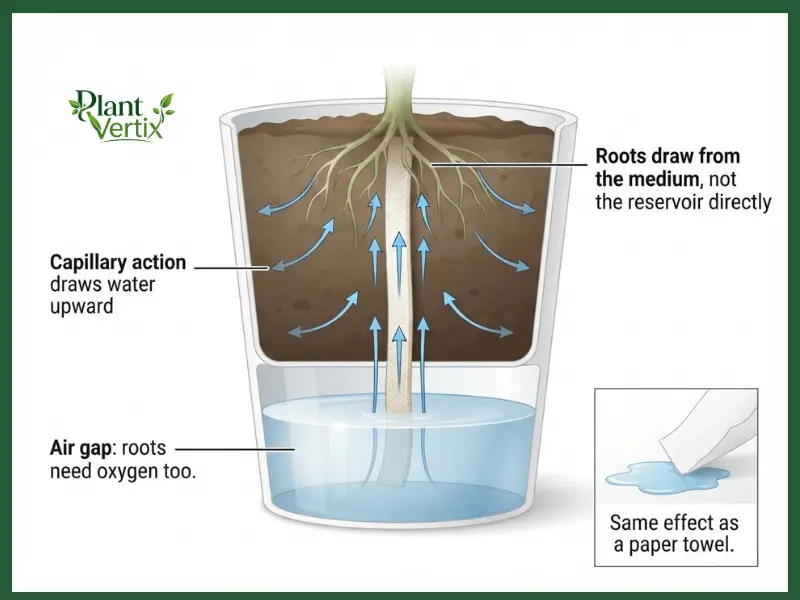
In a wicking planter, a reservoir sits below the growing medium. A wick, or the medium itself in contact with the water, draws moisture upward. The plant’s roots take what they need from the medium, the medium draws more from the reservoir, and the rate is set by how fast the plant is using it.
That last part is the appeal. A plant using more water on a hot day draws more; a plant using less in winter draws less. The system self-regulates in a way a timer never does.
What it Solves, Which is Real
The uneven-watering problem, partly. Every vertical system has a gradient in it: the top dries fast and the bottom stays wet, for four separate reasons that are covered separately on this site. A wicking arrangement gives each container its own supply rather than passing water from one to the next, which removes the largest single cause of a rotted bottom row.
The interval problem. Refilling a reservoir is less frequent than watering a shallow pocket, which is the difference between a system you can leave for a weekend and one you cannot.
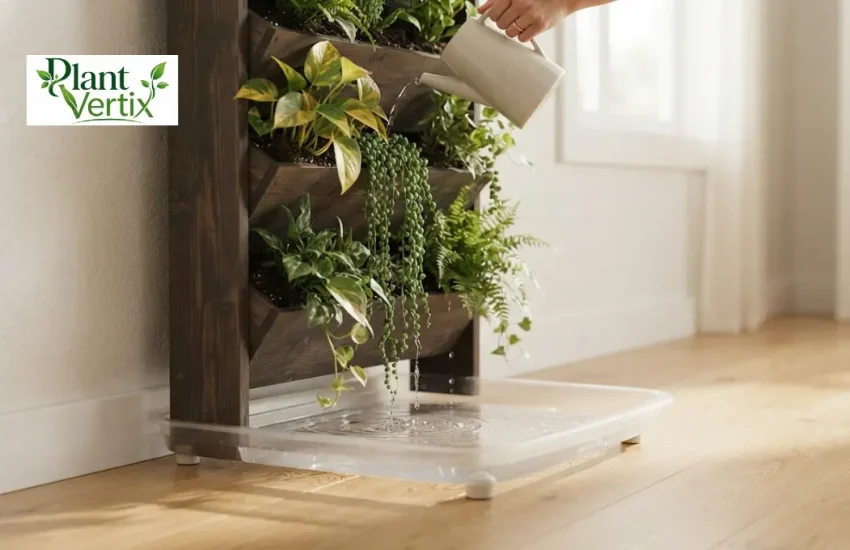
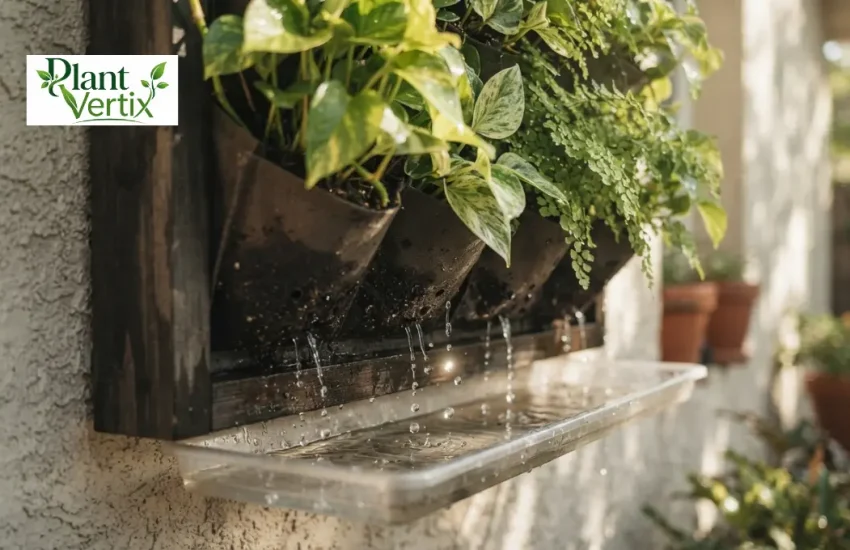
The runoff problem. A closed system has no runoff, so there is no tray to empty, nothing running down the wall, and no water reaching the floor. For an indoor system, that is a substantial advantage, and it is why our article on protecting the wall behind a mounted system matters less for a properly closed design.
And the too-fast-through problem. Watering a shallow pocket from above often runs straight past the medium and out the bottom. Watering from below wets the medium properly, by definition.
The Three Things it Introduces
1. Weight, permanently
This is the one that changes what you can build, and it is the reason this article exists on a site with a load cluster.
A reservoir is water, and water is the heaviest single component in most planted systems. Unlike the transient weight of a watering, which arrives and drains away, a reservoir’s weight is there all the time, by design.
It is also the one weight in this whole subject that is not in dispute, because a volume of water has a known weight and the arithmetic is exact. If you know what your reservoir holds, you know what it adds, and you should do that multiplication before you mount anything.
Our article on what a vertical garden actually weighs sets out why the planter’s own rated capacity and the wall’s capacity are two separate questions, and this site publishes no safe-load figure and does not publish one here. A reservoir system is a heavier proposition than the same planting without one, and that is a structural question for building management or a qualified professional rather than for a website.
The practical consequence: reservoir systems suit freestanding structures better than mounted ones, and where they are mounted, the reservoir is the component that decides the answer.
2. Salt accumulation
A closed system never flushes.
Every watering brings dissolved minerals from your tap water, plus anything you feed. In an open system, those pass through and out. In a closed one, they stay and concentrate over time, and the result is a white crust on the medium surface and, eventually, plants that decline for no visible reason.
The management is periodic flushing, meaning watering generously from the top and letting it run through, which temporarily turns the closed system into an open one. That means it needs somewhere for the water to go on those occasions, which is a drainage question you have to answer even for a system that normally has no runoff.
3. Root problems, in the wrong plants
Roots sitting permanently in a wet medium is the correct condition for some plants and fatal for others.
Wicking suits plants that like consistent moisture. It suits Mediterranean herbs, succulents and anything that wants to dry out between waterings very badly indeed, and putting those in a wicking pocket is a reliable way to lose them.
So the plant list narrows. That is not a defect; it is a constraint, and it is one to know before you build rather than after. Our guide to choosing plants by tier position covers the general version of matching plant to condition.
What Determines Whether it Works
Three variables, and getting any of them wrong produces a system that looks right and does not function.
The medium has to wick. Not all do. A very coarse, open mix breaks the capillary path, and the water stops partway up. A dense, compacted one wicks slowly and stays sodden at the base. This is the most common cause of a wicking system that simply does not deliver water.
The distance has to be short. Capillary action has a practical limit, and it is shorter than people expect. A deep container with a reservoir at the bottom may never wet the top few inches, which is exactly where the roots of a newly planted seedling are.
There has to be air. Roots need oxygen as well as water, and a medium saturated all the way through has none. Well-designed reservoir systems keep an air gap between the water surface and the medium, with only the wick in contact. A system where the medium sits directly in standing water is not a wicking system; it is a bucket.
Where it Fits, and Where it Does Not
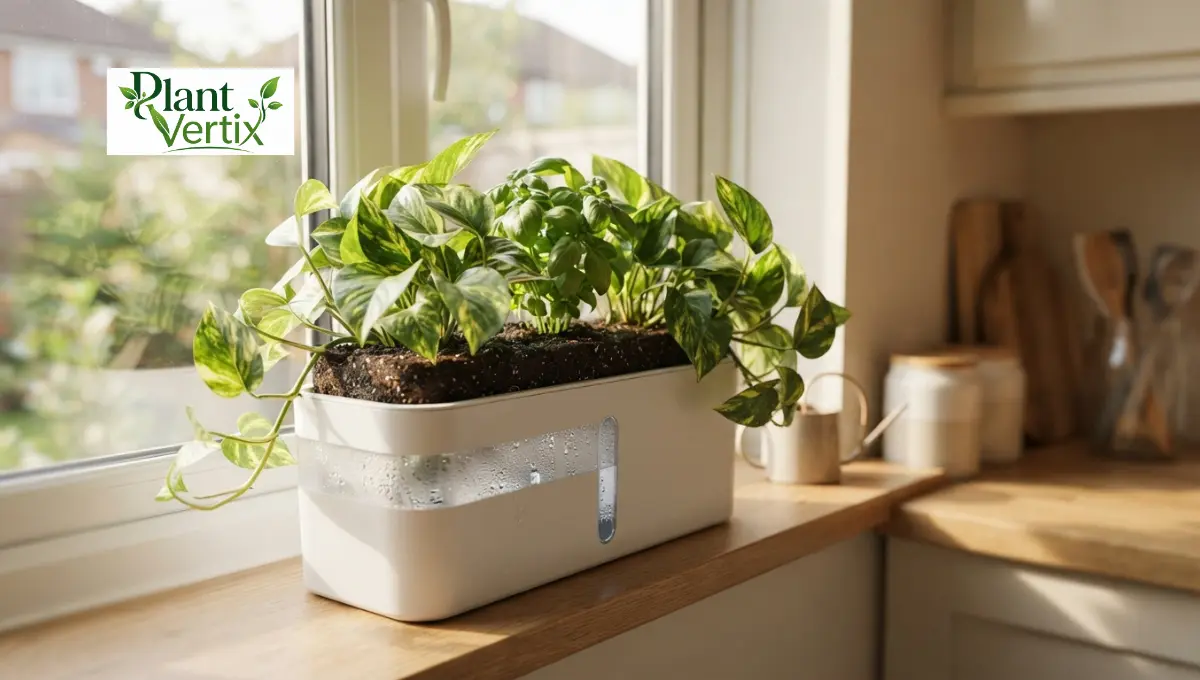
Good fit: indoors, freestanding, moisture-loving plants, shallow containers, somebody who travels, and any situation where runoff onto a floor is unacceptable. Our guide to self-watering vertical planters covers the commercial versions of this arrangement.
Poor fit: mounted on a wall where the reservoir weight is a question nobody has answered; outdoors where rain overfills it; plants that need to dry out; deep containers where the wicking distance is too great; and anywhere in freezing conditions, because a full reservoir freezing is a container under pressure from the inside.
FAQ
How does a wicking planter water itself?
A reservoir sits below the growing medium, and a wick, or the medium itself in contact with the water, draws moisture upward by capillary action, the same effect that makes a paper towel pull water up its own length.
The roots take what they need from the medium, the medium draws more from the reservoir, and the rate is set by how fast the plant is using it. That is the appeal: a plant using more on a hot day draws more, a plant using less in winter draws less, and the system self-regulates in a way a timer never does.
Can I mount a wicking planter on a wall?
Treat that as a structural question rather than a gardening one. A reservoir is water; water is the heaviest single component in most planted systems, and unlike the transient weight of a watering that arrives and drains away, a reservoir’s weight is there all the time by design.
This site publishes no safe-load figure, and a reservoir system is a heavier proposition than the same planting without one, so the answer for a mounted installation comes from building management or a qualified professional. What you can do yourself is the arithmetic: a volume of water has a known weight, so if you know what your reservoir holds, you know what it adds, and that multiplication belongs before anything goes on a wall. In practice, reservoir systems suit freestanding structures better, and where they are mounted, the reservoir is the component that decides the answer.
Do wicking systems need flushing?
Yes, periodically, because a closed system never flushes itself. Every watering brings dissolved minerals from your tap water along with anything you feed, and in an open system those pass through and out, while in a closed one they stay and concentrate.
The signs are a white crust on the surface of the medium and, eventually, plants that decline for no visible reason. Flushing means watering generously from the top and letting it run through, which temporarily turns the closed system into an open one, so it needs somewhere for that water to go on those occasions, even though it normally produces no runoff.
Which plants suit a wicking planter?
Plants that like consistent moisture. Roots sitting permanently in a wet medium is the correct condition for some plants and fatal for others, and Mediterranean herbs, succulents and anything that wants to dry out between waterings all do very badly in one. Putting those in a wicking pocket is a reliable way to lose them. The narrower plant list is a constraint rather than a defect, and it is worth knowing before you build rather than afterwards.
My wicking planter is not delivering water. What is wrong?
Usually one of three things. The medium may not wick: a very coarse, open mix breaks the capillary path so the water stops partway up, while a dense, compacted one wicks slowly and stays sodden at the base, and this is the most common cause.
The distance may be too great, because capillary action has a practical limit that is shorter than people expect, so a deep container with a reservoir at the bottom may never wet the top few inches where a new seedling’s roots are. Or there may be no air: roots need oxygen as well as water, well-designed systems keep an air gap between the water surface and the medium with only the wick in contact, and a medium sitting directly in standing water is not a wicking system, it is a bucket.
The Check to Run in the First Month
Is water actually arriving at the root zone? Feel the medium at planting depth a day after filling the reservoir. If it is dry while the reservoir is full, the wicking path is not working, and no amount of refilling will help.
Is the reservoir emptying at all? A reservoir that never goes down is not being drawn from.
And how heavy is the system when the reservoir is full? That is the number that matters for anything mounted, and it is a measurement rather than an estimate: weigh it empty, weigh it planted, and weigh it again with the reservoir full.
For where all of these decisions belong, which is before anything is planted, our vertical garden planning checklist is the place to make them.