Vertical Garden Wall Protection: Barrier, Air Gap and What Waterproof Covers
A sheet of plastic taped to the wall is the answer most people reach for, and it is the answer most likely to make things worse. Wall protection behind a planted system is two jobs, not one: stopping liquid water and stains reaching the surface, and letting whatever moisture does arrive dry out again. A barrier alone does the first and actively defeats the second, because it traps damp air against the wall with nowhere to go. The thing that solves both is a gap.
Three Different Things Are Attacking The Wall
They arrive by different routes, and a solution that stops one may not touch the others.
Liquid water is the obvious one: overflow, runoff, splash, and the drip that appears at the bottom of a pocket you thought was sealed. It is also the easiest to see and the easiest to catch, because it obeys gravity and every watering has to end up somewhere.
Water vapor is the one that damages walls quietly. A planted system is a permanently damp object held flat against a surface, and the air trapped between the two stays at a much higher humidity than the room. Paint, wallpaper, wood and gypsum board all respond to sustained high humidity, and nothing about that process is visible until it has been going on for a while.
Physical contact is the third and the most ignored: staining from wet fabric or wet soil, mineral deposits left where water evaporates, tannins from bark and wood, and abrasion from a structure that moves slightly every time it is watered and dries.
Why an Air Gap Beats a Barrier
If you take one thing from this article, take this one.
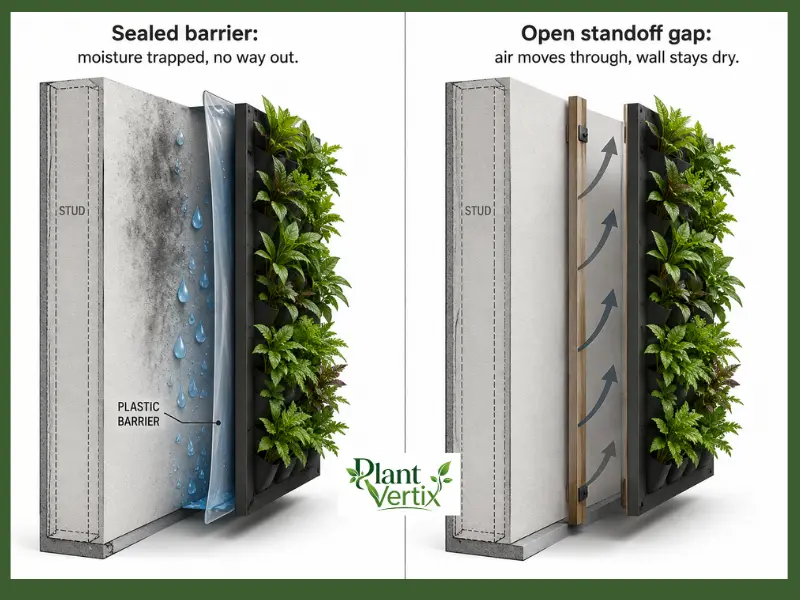
A barrier pressed flat against a wall keeps water off the wall and keeps moisture in. Whatever gets behind it, and something always does, has no route out. That is the classic failure: the wall is fine for a season, and then a patch appears exactly where the sheet was most thoroughly sealed.
A gap turns the same space into a drying path. Air moves through it, evaporation happens, and the wall behind spends most of its time dry even though the system in front of it is permanently wet. The usual way to make one is to stand the system off the surface on vertical strips fastened into the framing, so the space behind is open at the top and the bottom.
Vertical strips matter more than the material of the strips. Horizontal ones create shelves that trap water and block air movement, so the drainage path has to run down and out, not into a pocket. This is the single most useful difference between a system that ages well and one that leaves a mark, and it is especially true of a felt panel that holds water against whatever it is pressed onto.
What a Waterproof Backing Claim Actually Covers
Product listings say waterproof backing, sealed back, or moisture barrier. Those phrases describe a material, and a wall is protected by an assembly.
The material is rarely the failure point. The failures are at the edges: the top, where water can run in behind; the seams, if there is more than one piece; and every fastener hole, each of which is a deliberate puncture through the thing that was supposed to be continuous.
So the question to ask a product page is not whether the backing is waterproof, but what the manufacturer says about the top edge, the seams and the fasteners. Some say a good deal; some show a photograph and say nothing at all. Which of those you are looking at is genuinely informative, and it costs nothing to find out before buying. That applies as much to a rigid panel system with a closed back as it does to fabric, because a closed back with an open top edge simply routes the water somewhere you cannot see it.
And a claim about the product is not a claim about your wall. A backing that keeps water off the panel’s own rear face still leaves the humidity question untouched, which is what the gap is for.
Which Surface You Are Protecting Changes the Answer
The wall’s own construction decides how much of a problem this is.
Painted gypsum board is the least forgiving common interior surface. Its paper faces and its core both respond to sustained damp, and the damage is usually well established before it shows.
Plaster over masonry, and masonry itself, tolerate more moisture but are not indifferent to it, and they hold and release it slowly, which changes how long a wet patch stays wet.
Wood, whether paneling or trim, is dimensionally sensitive and will move, mark and eventually decay if it is kept damp against a wet object.
Any wall with an unknown construction is a wall to be more careful with, not less, and the honest step there is to find out what it is before hanging a permanently wet thing on it.
Catch the Water Before it Needs to Be Blocked
Protection at the wall is the last line. The cheaper interventions are upstream.
Water the system in a way that does not produce runoff in the first place. Slower, smaller and more often puts less through the system than a single flood, and it is the difference between a drip tray that copes and one that overflows.
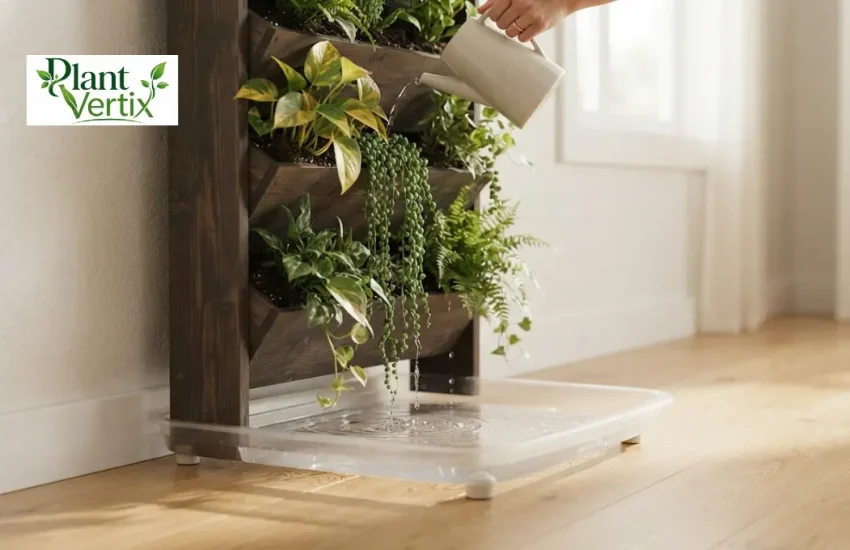
Give the bottom somewhere to drain to on purpose. A tray, a gutter, or a channel at the base of the structure, sized for the whole system rather than for one pocket, means the water leaves where you decided instead of where gravity found a gap.
Use a liner inside the planter rather than only behind it. Stopping water leaving the container is more effective than catching it after it has left, and it keeps soil and tannins inside the system where they belong.
Outdoors, The Wall is a Building Envelope
This is where the stakes change, because an exterior wall has a job beyond looking clean.
Siding, cladding and exterior sheathing are designed as drainage systems. They shed water outward and, in most modern assemblies, expect a drainage and drying path behind them. Pinning a permanently wet panel flat to that surface interferes with the thing the wall was built to do, and the consequences are structural rather than cosmetic.
So the air gap is not optional outside, it is the point, and an exterior wall or fence is a different assembly from an interior partition in every respect that matters here: what it is made of, how it drains, and how expensive it is to repair.
Where the wall is part of a building you do not own or do not fully understand, that is a question for building management or a qualified professional before anything is fastened to it. This site does not tell you that a particular assembly will be fine.
If You Rent, The Wall is Also a Document
Two separate questions, and people usually only think about the first.
The physical one: a mark left by a mounted system is often a stain or a moisture shadow rather than a hole, and stains are harder to make good than holes. Protection is worth more to a renter than to an owner, for exactly that reason.
The permission one: whether you may fasten anything to the wall at all is answered by your lease and by your building management, not by a gardening article, and asking first costs nothing compared with finding out at the end of a tenancy.
When to Stop and Get Someone in
If the wall behind a system is already soft, discolored, blistered or smells of damp, take the system down and stop. Do not cover it, do not seal it, and do not treat it as a protection problem, because at that point it is a building problem.
Suspected mold, persistent damp, or any sign that water has traveled into the structure is a matter for a qualified professional and, if you rent, for building management immediately. This article covers what goes between a planter and a sound wall. It does not cover diagnosing or fixing a wall that is already wet, and nothing here should be used as a reason to delay that call.
FAQ
Do vertical gardens damage walls?
They can, and the mechanism is usually sustained humidity trapped between a permanently damp system and the surface rather than a single leak. A standoff gap that lets that space dry is what prevents it.
Is a plastic sheet enough to protect the wall?
On its own it usually makes the humidity problem worse, because it traps moist air against the wall with no drying route. A barrier plus a ventilated gap behind the system is the combination that works.
How big should the air gap be?
This site publishes no dimension for it. What matters mechanically is that the space is continuous, open at the top and bottom, and formed by vertical rather than horizontal strips so water and air can both move down and out.
Does a waterproof backing mean I do not need anything else?
It covers the panel’s own back face. The top edge, the seams and every fastener hole are the places these assemblies actually fail, so the useful question is what the manufacturer says about those three.
What if the wall is already damp behind my system?
Take the system down, stop, and treat it as a building problem rather than a protection problem. Persistent damp or suspected mold goes to a qualified professional, and to building management if you rent.