Self-Watering Vertical Planters: How the Mechanism Works
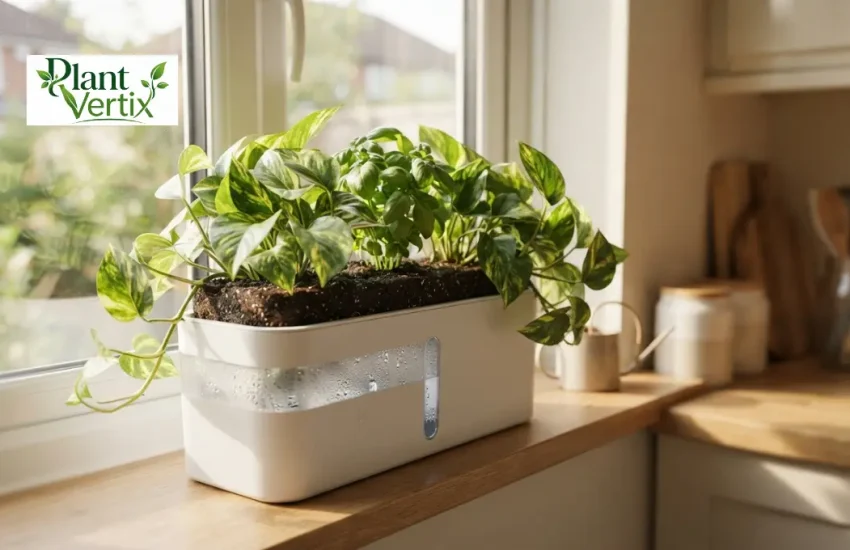
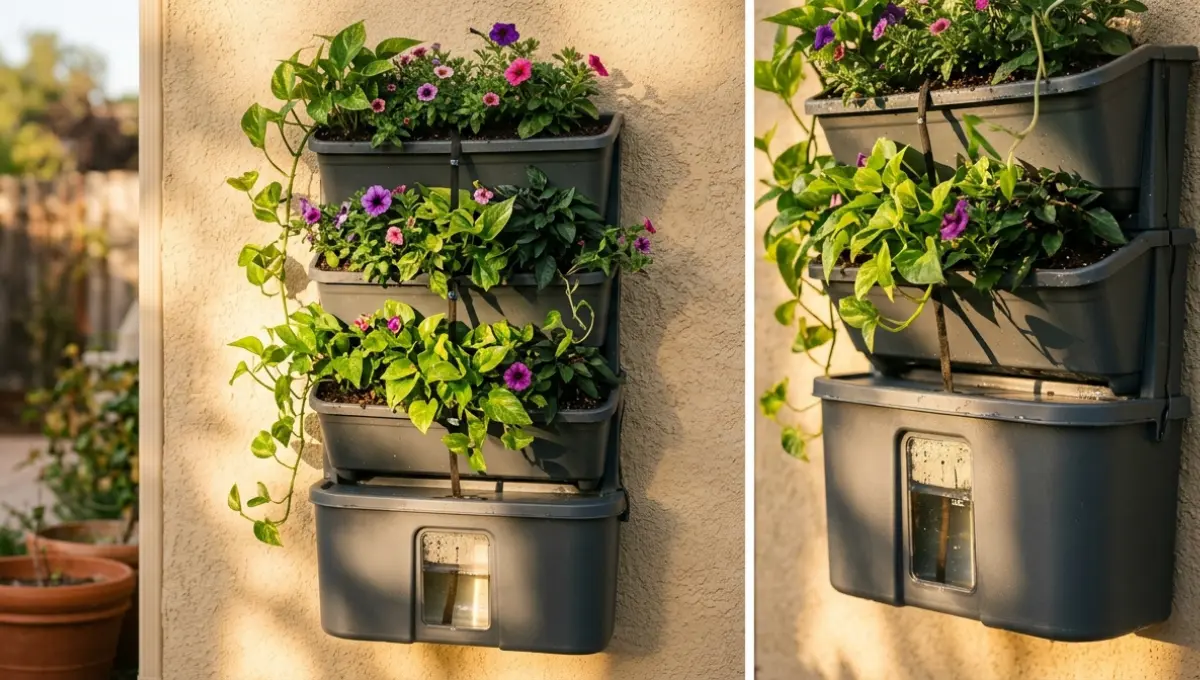
A self-watering vertical planter is real, not marketing, and the mechanism is simple: a sealed reservoir sits below or beside the growing medium, and a wick, a cord, or a stack of drainage holes moves water from that reservoir into the medium as it dries, using capillary action — the same pull that draws a spill up a paper towel.
You still do the watering. You are just filling a reservoir every week or two instead of watering the surface every day or two, and the plant draws what it needs in between. The part worth knowing before you buy one: a full reservoir is weight your mounting carries all the time, not just on watering day.
The Two Mechanisms, and They Are Genuinely Different
Wicking (capillary) systems. A cord, a strip of absorbent fabric, or a column of growing medium itself bridges the reservoir and the root zone. Water climbs the wick as the medium above it dries, the same physics that pulls ink up a fountain pen nib. This is the more common mechanism in single-pot self-watering planters and in some vertical tower systems, where a central wicking core runs the height of the tower.
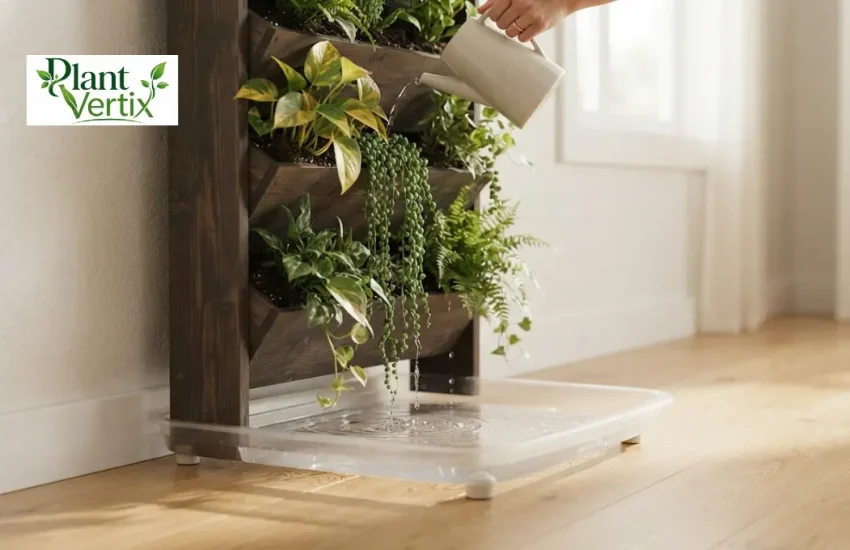
Drip-through or overflow-tier systems. Water fills a top reservoir or funnel, and gravity pulls it down through each tier’s growing medium in turn, with any excess draining into an overflow that either returns to a lower reservoir or exits the system entirely. This is closer to how most stacked or tiered vertical towers actually water themselves: each tier gets a turn, and what a tier does not hold moves on to the next one down.
Both mechanisms solve the same problem in a vertical system specifically: gravity pulls water down through a tall structure unevenly, so hand-watering from the top tends to overwater the bottom and underwater the top. A working self-watering system is built to correct for that, not just to save you a daily chore.
What “Self-Watering” Does Not Mean
It does not mean unattended indefinitely. Every reservoir has a limit, and once it runs dry the system behaves exactly like a normal planter with no buffer left, often worse, because the medium and the wick have both been calibrated around staying consistently moist rather than cycling dry and wet.
It also does not mean overwatering is impossible. A reservoir with no overflow path will keep accepting water past the point the medium can use, and the level can rise high enough to saturate the root zone from below, which suffocates roots the same way a drowned pot from the top does. This is a genuine, documented failure mode of self-watering pots generally, and it is worth checking for on any system before you plant it: is there a visible fill line, and is there somewhere for water to go once that line is reached.
Reservoir weight is retained, not occasional
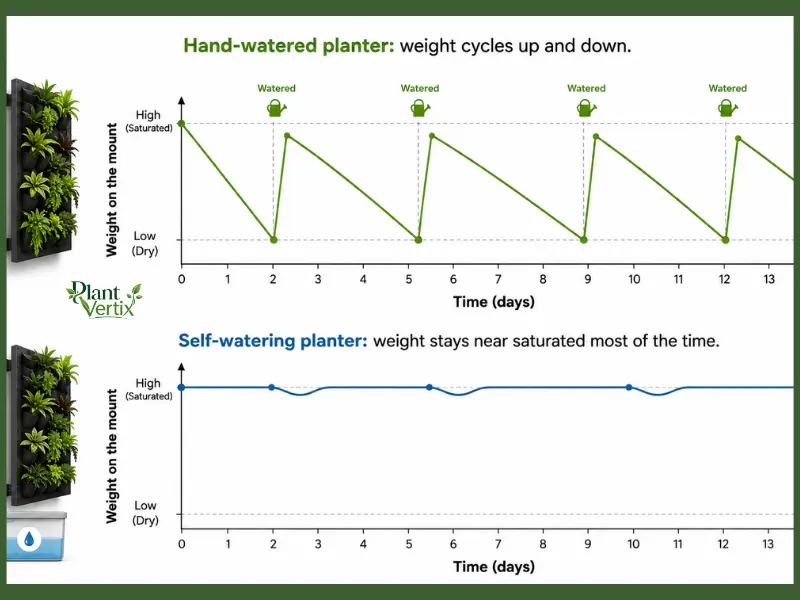
This is where a self-watering vertical planter connects directly to the load question the rest of this site treats as central. A hand-watered planter is at its heaviest right after you water it, and it loses some of that weight as it dries between waterings, so the load on your wall or your mount genuinely varies. A self-watering system is designed to work against that variation: you are meant to keep the reservoir topped up, which means the system spends most of its time near its saturated weight rather than cycling toward dry.
That is a feature for the plants. It is a fact worth knowing for the mount. If you are sizing a fixing for a self-watering vertical planter, the number to use is the system at a full reservoir plus saturated medium, not an average, and definitely not the dry weight printed anywhere on the box. What a vertical garden actually weighs works through that full calculation, and how much does wet potting soil weigh covers the growing-medium half of it specifically.
Water itself is the one number in this whole calculation you do not have to estimate: a liter of water weighs one kilogram, and a US gallon weighs about 8.34 pounds (3.79 kg), so a two-liter reservoir alone is roughly 2 kg (4.4 lb) that stays on your wall as long as it stays full.
Choosing One For a Wall-Mounted Setup Versus a Freestanding Tower
A wall-mounted self-watering system asks more of its fixing than a freestanding one, because a freestanding tower puts its full weight, reservoir included, on the floor, which is rarely a load concern indoors. A wall-mounted version puts that same reservoir weight permanently on whatever holds it to the wall.
If you are choosing between a self-watering wall panel and a freestanding self-watering tower and your wall is a genuine unknown, the freestanding option removes the wall-load question entirely, at the cost of floor space. Freestanding towers and wall-mounted planter rails are the two structural sides of that same decision.
Reading the Fill Line and the Overflow Before You Plant it
Do this before you add growing medium, not after:
- Find the fill line or the maximum water mark. If the system does not have one visibly marked, you are relying on guesswork for how full is too full.
- Find where excess water goes. An overflow hole, a drain plug, or a spillway that directs excess away from the wall. If you cannot find one, treat the system as if it does not have one and water conservatively.
- Check the wicking material, if the system uses one. A cord or strip that has gone stiff, moldy, or brittle will not move water reliably even with a full reservoir. This is a cheap, replaceable part on most systems, and worth inspecting each season.
What It Changes About Your Watering Routine, Not Just Your Workload
The routine shifts from “check the surface, water if dry” to “check the reservoir level on a schedule.” That schedule depends on the plant, the season, and the reservoir size, and it is genuinely shorter in hot weather and on a top tier that catches more sun and airflow.
A system that goes two weeks between refills in spring can need attention weekly once summer heat sets in. Watering a vertical garden covers the tier-by-tier watering pattern this is trying to automate, which is worth reading even if you are going the self-watering route, because it explains why gravity makes a tall structure behave differently from a single pot in the first place.
Frequently Asked Questions
Is a self-watering vertical planter actually better than hand watering?
For evenness across tiers, generally yes, because it corrects for the way gravity pulls water down through a tall structure. It does not remove the need to check it, and a neglected reservoir fails the same way a neglected pot does, just on a longer delay.
Can a self-watering system cause root rot?
Yes, if it has no overflow and the reservoir is kept overfilled, water can rise high enough to saturate roots from below. Confirm the fill line and overflow path before you rely on the system.
How often do I need to refill the reservoir?
It varies by plant, reservoir size, and season, commonly every one to two weeks in mild conditions and more often in hot, sunny periods. Check the level rather than working from a fixed schedule.
Does a self-watering vertical planter weigh more than a regular one?
At any given moment, generally yes, because the reservoir is designed to stay topped up rather than drying out between waterings. That sustained weight is what your mounting needs to be sized for, not the dry, empty weight of the unit.