Why a Watered Planter Defeats an Adhesive Weight Rating
The packet gives you a number. It is a real number, produced by a real test, and it is not a marketing invention.
It is also answering a question that is not yours, and the gap between the two is worth understanding before you trust it with something living.
What the Rating Actually Describes
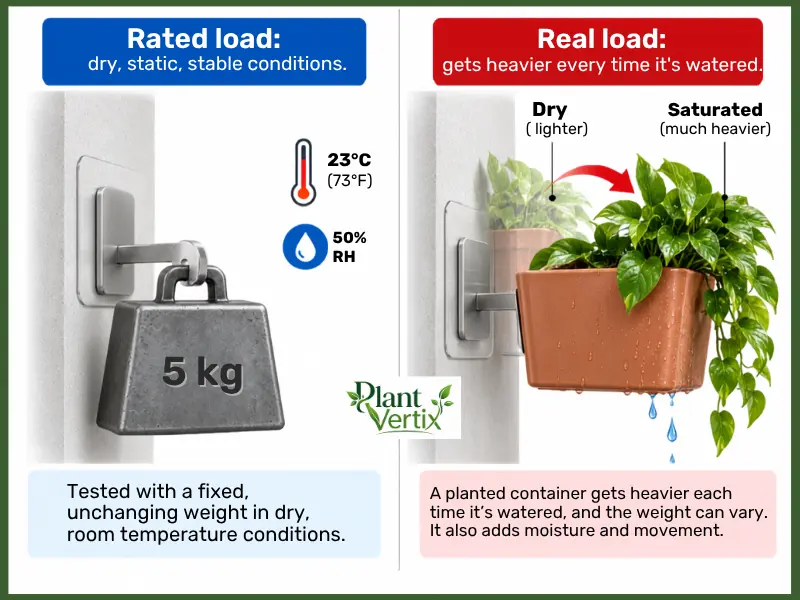
Every adhesive mounting product is rated under stated conditions. The specifics differ between products, and the shape is consistent: a defined surface, prepared in a defined way, within a stated temperature and humidity range, carrying a static load, hung correctly, after a stated setting period.
Read that list again, because each item is a condition, and a rating is only a claim about the situation where all of them hold.
None of those conditions describe a planted vertical garden, and the reasons are specific rather than general caution.
The Five Mismatches, in Order of How Much They Matter
1. The load is not static, and it is not constant
This is the largest one, and it is the reason this row exists.
A planted system weighs one thing dry and a heavier thing saturated. The change happens on a schedule you set, every time you water, and it is not a small proportion. Our article on what a vertical garden actually weighs sets out why the planter’s own rated capacity and the wall’s capacity are two separate engineering questions, and the piece on how much wet potting mix weighs covers why nobody publishes a reliable multiplier between the two.
A rating is a number for a load that does not change. The relevant number for a planted system is the maximum it will ever reach, which is the saturated one, and most people mount using the weight they can lift, which is the dry one.
2. The environment is humid, permanently
Adhesives are chemistry, and chemistry cares about the environment. Manufacturers state a temperature range and, in many cases, say their products are not intended for permanently damp conditions.
A planted system generates its own humidity at exactly the point where the adhesive meets the wall. Every watering puts moisture into that zone. That is not an edge case for this application; it is the normal condition.
3. The load moves
A rating describes a weight hanging still. A planted system is knocked when you water it, tugged when you harvest, moved when you rotate a container, and pushed by air if it is anywhere near a door, a window or outdoors.
Shock loading and repeated small movements are a different kind of stress from a constant hanging weight, and outdoors, wind is a load in its own right that grows with the sail area of a planted structure.
4. The surface is often not the tested surface
Ratings assume a smooth, clean, sound, non-porous surface. Real walls are painted, sometimes textured, sometimes recently painted, sometimes wallpapered, sometimes dusty at exactly the level nobody cleans.
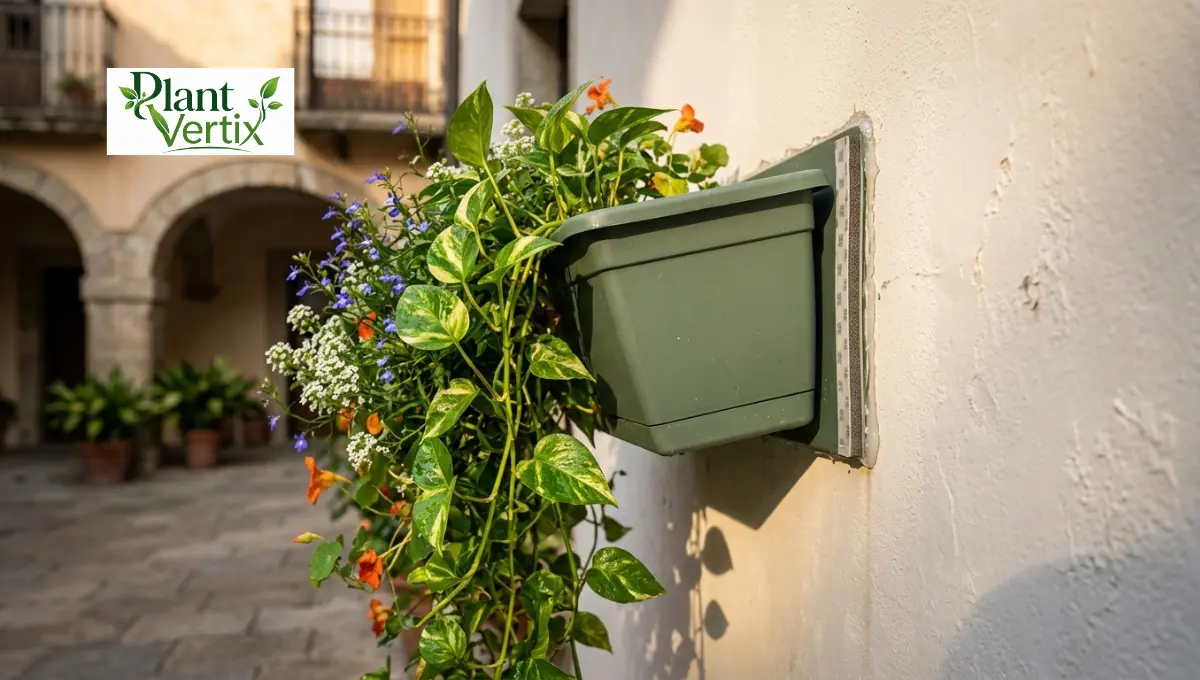
Paint is the quiet one. An adhesive can hold perfectly and take the paint off the wall with it, which is a failure by any definition a renter cares about, and it is a different failure from the adhesive letting go.
5. Failure is sudden
This is the property that matters most for how you should treat it.
A screw in a poorly chosen anchor tends to loosen visibly. An adhesive mount usually gives no warning and then releases all at once. There is no sagging phase during which you notice something is wrong.
That difference is why the same margin of safety is not equivalent between the two methods, and it is why the question “what happens when this fails” deserves an answer before you mount anything.
Why This Article Does Not Tell You to Divide the Number By Something
You will find advice suggesting you use some fraction of the rated capacity. That kind of rule is easy to remember, and it is not a safety factor, because a safety factor is a margin on a load that was measured under the right conditions.
Here the conditions themselves are wrong, in five separate ways. Applying a fraction to a number produced under conditions that do not describe your situation does not make the number apply; it makes an unsupported number look cautious.
This site publishes no load figure, no rating, and no fraction of one, on its own authority or anyone else’s. That is a standing rule here, and this row is exactly why it exists.
What to Do Instead
Use the manufacturer’s own guidance for your situation
The company that made the product is the only party that can tell you what it is rated for and where they say it should not be used. Many of them state explicitly whether a product is suitable for damp environments or outdoor use, and that sentence is more useful than the headline number.
If the manufacturer says their product is not intended for the conditions you are describing, that is your answer.
Move the load somewhere designed to carry it
The theme running through every renter-friendly option is that the safest ones do not use the wall at all. A floor-standing structure, a tension-braced frame, a leaning ladder, or a system hung on something already engineered to carry weight all put the load into a structure built for it. This site sets those out in order of how much load each can honestly carry, in its own guide to no-drill vertical gardening.
Design lighter, deliberately
Shallower containers, less medium, a lighter growing medium, plants that do not need constantly saturated conditions, and no reservoir where you can avoid one. Our article on how many plants a vertical garden can hold is the planning version of the same arithmetic.
Weigh what you are actually mounting
Empty, filled dry, and again after watering to saturation, on an ordinary scale. That third number is the load, and it is the number to take to whoever decides whether it can be carried: the product’s manufacturer, building management, your landlord, or a qualified professional.
A number you measured beats every number anybody publishes, because it is about your system rather than about a test.
FAQ
Does the weight rating on the packet apply to a planted container?
Not directly. The rating is a real result from a real test, and that test describes a dry, static load on a defined surface within a stated temperature and humidity range. A planted vertical garden fails to match those conditions in five separate ways, so the number is answering a different question from yours.
Can I just use a fraction of the rated capacity to stay safe?
That is not a safety factor. A safety factor is a margin applied to a load measured under the right conditions, and here the conditions themselves are wrong. Taking a fraction of a number produced under conditions that do not describe your situation does not make the number apply; it only makes an unsupported number look cautious.
Will an adhesive mount show signs before it fails?
Usually not. A screw in a poorly chosen anchor tends to loosen visibly, while an adhesive mount typically gives no warning and then releases all at once, with no sagging phase in between. That is why the question of what happens when it fails deserves an answer before anything goes on the wall.
What weight should I plan around?
The one you measure yourself. Weigh the system empty, filled dry, and again after watering to saturation on an ordinary scale. The saturated figure is the real load, and it is the number to take to the product’s manufacturer, building management, your landlord, or a qualified professional.
Can an adhesive mount damage the wall even if it holds?
Yes. An adhesive can hold the weight perfectly and still take the paint off the wall when it comes down, which is a separate failure from the adhesive letting go and one that matters a great deal to a renter.
Where adhesive mounting is reasonable
To be fair to the products, which are well made for their purpose.
Small, light, shallow containers. Indoors, on a sound and suitable surface, within the manufacturer’s stated conditions. Where a failure would drop something onto a floor and nothing else. Where you are prepared to check it periodically rather than mount it and forget it.
That is a real use case, and it is a narrower one than the aisle implies. The moment a system gets deep, heavy, watered generously or hung above anything that matters, the method has left the conditions its rating describes.