No-Drill Vertical Gardening: The Complete Set of Options
You cannot make holes. Either the lease says so, the wall is not yours to alter, or you would simply rather not.
That rules out the standard advice, and it does not rule out a vertical garden. What it does is change one thing: the weight has to be carried by something other than a fastener in your wall, and every option below is a different answer to where it goes instead.
The one thing to understand before choosing
A planted vertical system is a load that grows. Dry medium is one weight, saturated medium is a heavier one, and the difference arrives every time you water. Our article on what a vertical garden actually weighs sets out why the planter’s rated capacity and the wall’s capacity are two separate questions, and our piece on how much wet potting mix weighs covers why the dry number is the wrong one to plan against.
Every no-drill method has a limit, and the limit is not usually printed anywhere useful. So the honest structure of this decision is not “which method carries the most”, it is “which method puts the load on something that was designed to carry it”.
That reframing is why the freestanding options come first below, and the surface-mounted ones come last.
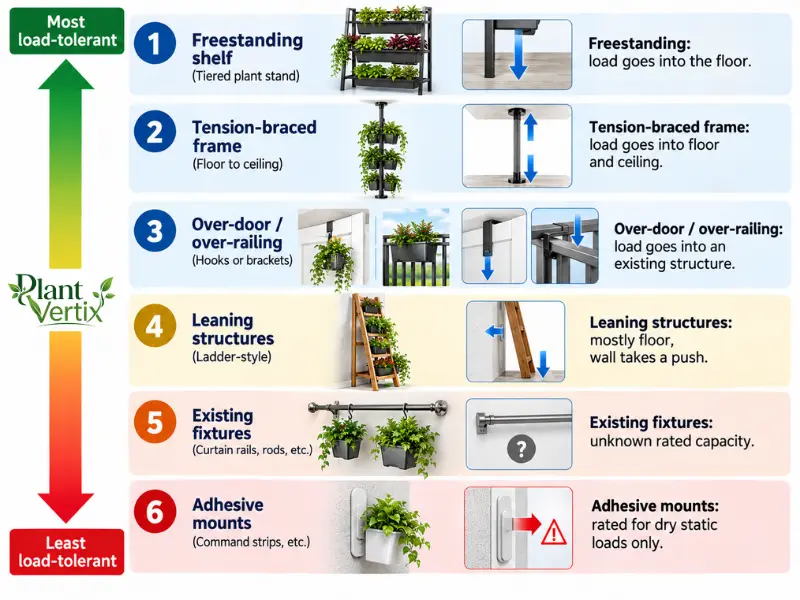
The six options, from most load-tolerant to least
1. Freestanding structures that stand on the floor
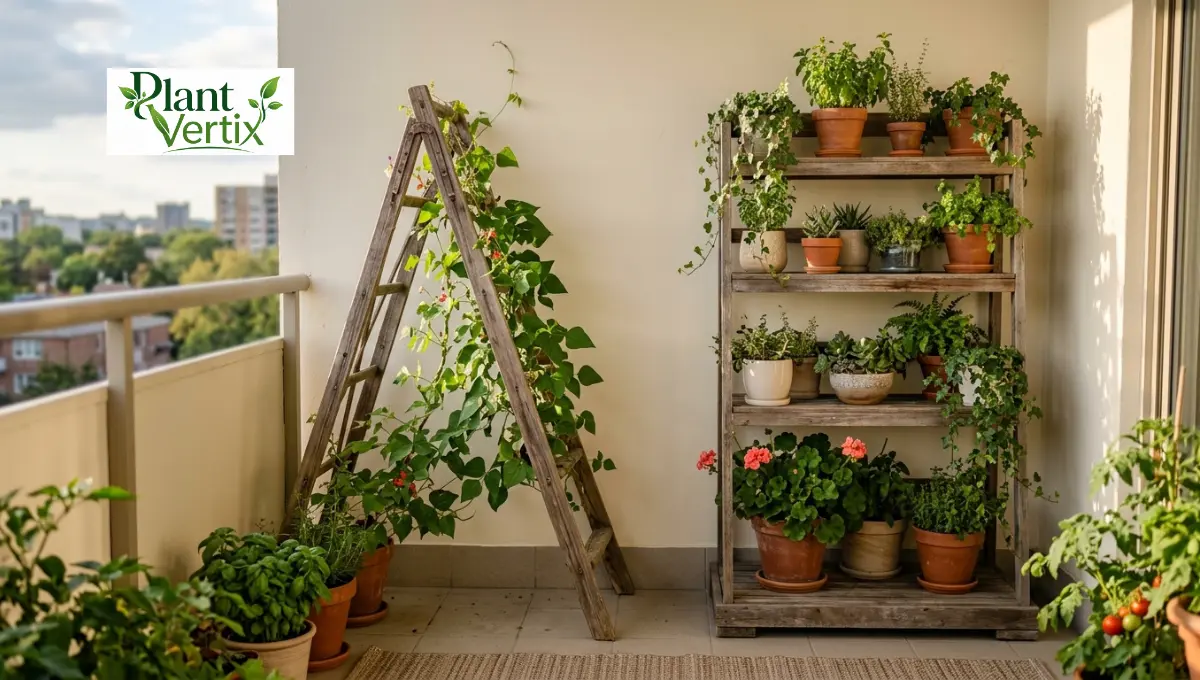
A shelf unit, a plant ladder, an A-frame, a tiered stand, a purpose-built tower. The floor carries the weight, which is what floors are for.
Why it is first: it removes the wall from the problem entirely. There is no fastener, no adhesive and no rating to interpret.
What it costs you: floor space, and stability becomes the question instead of pull-out strength. A tall unit with the heaviest planting at the top is a tipping problem, and that is genuinely the failure mode here.
What to get right: heaviest at the bottom, always. Check that it is level. If children or animals use the space, secure it against tipping, and if that securing means fixing to a wall, you are back in the drilling conversation and should say so honestly rather than half-doing it.
Our guide to tiered plant shelves for outdoor spaces and the piece on freestanding vertical garden towers cover the options in this group.
2. Tension-braced frames
A frame held in place by pressure between floor and ceiling, or between two walls.
Why it is second: the load path is still vertical, into the floor, rather than pulling out of a wall.
What it depends on entirely: the ceiling and floor being sound, parallel, and able to take the pressure. On a suspended ceiling, a lath-and-plaster ceiling, or a floor that flexes, this is not a suitable method, and the manufacturer of the tension system will say so.
This one has enough detail to need its own article, and it is covered separately on this site.
3. Over-door and over-railing hangers
Hardware that hooks over an existing structure: a door, a balcony railing, a fence rail. The existing structure takes the load.
Why it works: you are using something already engineered to carry a load, and adding nothing permanent.
What decides it: whether the host structure can take the addition. A balcony railing is a safety component and a growing system hung on it is a change to what it is carrying. That is a question for building management or the landlord, and it is not one this article answers.
Our articles on over-the-door plant hangers and railing-mounted planters cover each case, and both route the load question where it belongs.
4. Leaning structures
A ladder or trellis that rests against a wall at an angle, with its feet on the floor.
The load is mostly vertical into the floor, with a horizontal component pushing into the wall. The wall is being leaned on rather than pulled on, which is much easier for a wall to resist.
What to watch: the feet slipping, the top scuffing paint, and the whole thing being knocked. A leaning structure with a heavy top and light feet is a tipping risk in the other direction from a freestanding one.
5. Existing fixtures you did not install
Curtain rails, picture rails, an existing hook, an existing shelf. Someone else drilled, so you do not have to.
The question is what that fixture was installed to carry, and you almost never know. A picture rail was designed for a picture. A curtain rail was designed for a curtain. Neither was designed for a growing system that gets heavier when it is watered.
If you cannot establish what a fixture will hold, that is not permission; it is an absence of information. The route is the landlord, the building manager or a qualified professional, and this site does not publish a number in place of that.
6. Adhesive mounts
Last, deliberately, and this is not an arbitrary ranking.
Adhesive products carry ratings, and those ratings describe a specific set of conditions: a particular surface, prepared a particular way, in a stated temperature range, with a static load, dry. A planted system is a growing load in a humid microclimate, watered repeatedly, sometimes moving in wind. That is a different situation from the one the rating describes, and the gap between the two is the whole subject of its own article on this site.
They are not useless. They are the option where the mismatch between what is rated and what you are doing is largest, and that is why they are at the bottom of this list rather than at the top of it.
What every no-drill method has in common
A limit that is lower than the equivalent fixed installation. That is not a defect. It is the trade you accepted in exchange for not making holes, and the correct response is to design a lighter system rather than to push a method past what it was built for.
A dependence on something else being sound. A floor, a ceiling, a railing, a door frame, an existing fixture. In every case you are borrowing another structure’s capacity, and in every case somebody other than this website knows what that capacity is.
A failure mode you should picture before you build. Ask what happens when it fails, not whether it will. If the answer involves a person, an animal, a neighbour’s balcony below, or a drop onto something breakable, that changes what is acceptable.
Designing lighter, which is the actual skill
Because every no-drill method has a lower ceiling, the useful work is on the other side of the equation.
Fewer, shallower containers. Depth is volume, and volume is weight when it is wet. Our piece on how many plants a vertical garden can hold covers the planning version of this.
A lighter growing medium, chosen deliberately rather than by default.
Plants that do not need constantly saturated medium, which lowers the peak weight rather than the average one.
And no reservoir where you can avoid one. Water is the one weight in this whole subject that is not in dispute, and a tank of it is the heaviest single component most systems have.
FAQ
Can I have a vertical garden if my lease does not allow drilling?
Yes. What changes is not whether you can grow vertically; it is where the weight goes. Every option in this article carries the load on something other than a fastener in your wall: the floor, a ceiling-to-floor brace, a door frame, a railing, or the wall being leaned on rather than pulled on.
Which no-drill method holds the most weight?
This article does not rank the methods by capacity, because the capacity of your floor, ceiling, railing or door frame is not something a website can know. The ordering here is by where the load ends up, and freestanding structures come first because the floor was built to carry weight.
Can I hang a planter from a hook or curtain rail that was already there?
Only if you can establish what that fixture was installed to carry, and usually you cannot. A picture rail was designed for a picture and a curtain rail for a curtain, neither for a growing system that gets heavier every time it is watered. An absence of information is not permission, so ask the landlord, building management or a qualified professional.
Are adhesive mounts a reasonable option for a planted system?
They are last on this list for a reason. Adhesive ratings describe a dry, static load on a prepared surface within a stated temperature range, and a planted vertical garden is a growing load in a humid microclimate that gets watered and sometimes moves in wind. They are not useless, but the gap between what is rated and what you are doing is largest here.
How do I make a no-drill vertical garden lighter?
Fewer and shallower containers, since depth is volume and volume is weight once it is wet. Choose the growing medium deliberately rather than by default, pick plants that do not need constantly saturated medium, and avoid a reservoir wherever you can, because a tank of water is usually the heaviest single component in the system.
Where this article stops
It does not tell you what any wall, railing, ceiling, door or adhesive mount will hold, and it does not publish a number you could use as permission. Those are answered by the manufacturer of the product, by building management, by your landlord, or by a qualified professional, and on a rented property the first conversation is usually with the landlord anyway.
What it does is tell you which methods put the load where the load belongs, so that the question you take to them is a sensible one.