How Much Does Wet Potting Soil Weigh? The Real Number
Wet potting soil weighs noticeably more than dry potting soil, and the difference is almost entirely water held in the mix’s pore space, not any change in the solid material itself. The bag’s printed weight was measured at whatever moisture the mix had when it was bagged, not at the saturation it reaches the day you water it on the wall.
If you weighed a filled planter dry and are using that number to judge what a fixing can hold, you are working from the wrong number. How much heavier wet gets depends on the specific mix’s composition and how well it drains, which is exactly why this article ends with a five-minute test rather than a single number to memorise.
Why the Bag’s Weight is Not the Number You Need
A bag of potting mix is weighed and labeled at the manufacturer, at whatever moisture content the mix happened to hold that day, which is neither bone dry nor saturated. Once that mix is in a planter and watered on a schedule, it moves through a range from just-watered (its heaviest) to nearly dry (closer to, but usually still above, the bag’s moisture) and back again, every cycle.
For a vertical structure specifically, this matters more than it would for a pot on a shelf, because the fixing holding it to the wall does not get a lighter day. It carries whatever the planter weighs at the moment, and the heaviest moment recurs every time you water.
What is Actually Adding the Weight
It is not the solid particles in the mix changing weight. It is water filling the pore space between and inside those particles. A well-drained mix, heavy on perlite and coarse bark, holds less water at saturation than a mix built around fine peat or coir, because the coarse materials leave larger air gaps that drain rather than hold.
That is also why two bags labeled “potting mix” from different manufacturers can behave differently once wet, even at similar dry weights: their water-holding capacity, not their dry density, is what varies most.
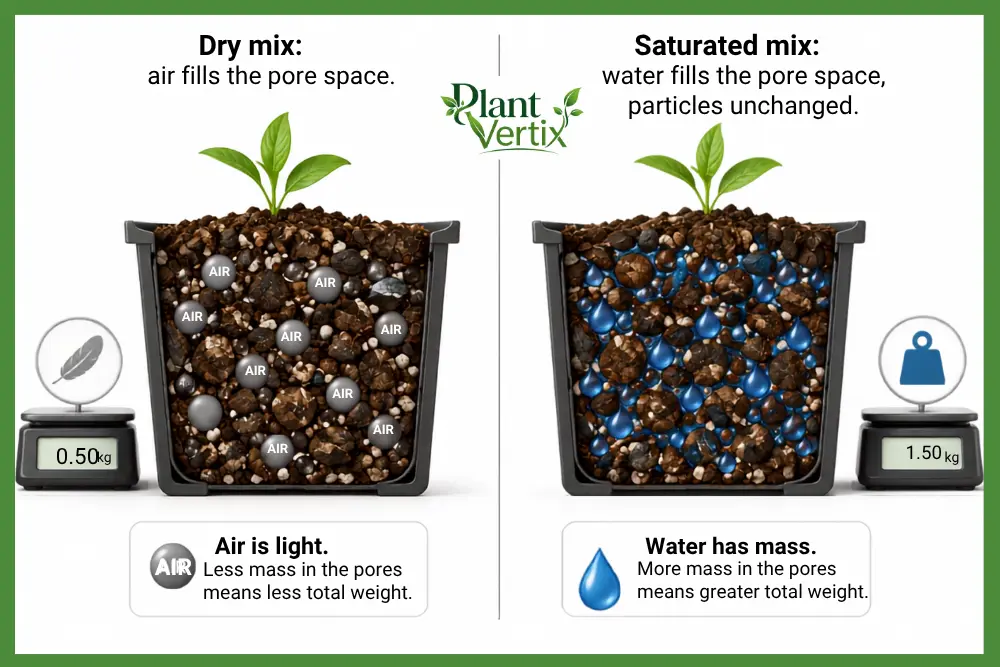
Water itself is the reliable part of this equation. One liter of water weighs one kilogram. A US gallon of water weighs about 8.34 pounds (3.79 kg). Those are fixed physical facts, and they mean you can compute the water component of any container’s weight exactly, if you know how much water it is actually holding, which is precisely what the weigh test below gives you.
Named Reference Points, and a Number I am Not Going to Repeat
No single figure applies to every mix and every system, so treat the following as reported reference points rather than a number to design your own build around:
| Source | What it reports |
|---|---|
| Florafelt (living wall panel manufacturer) | Its felt panels weigh about 1.5 lb per square foot (7.3 kg/m²) unplanted and dry; roughly 5 lb per square foot (24 kg/m²) planted and fully wet, a little over three times heavier |
| Green roof industry guidance (FLL-compliant saturated growing media, an analogous planted medium) | Roughly 6 to 8 lb per square foot per inch of depth (29 to 39 kg/m² per 2.5 cm), fully saturated |
You will also find a widely repeated claim, on gardening sites and forums, that saturated potting mix weighs roughly double its dry weight. It shows up often enough to look established, and it is directionally reasonable given how the two sources above behave, but I could not trace it to a study, an extension service, or a manufacturer’s own testing, and the pages repeating it do not cite one either.
So I am not repeating it as a fact you should plan around, the same way I would not hand you an anchor rating I could not source. If you need a real multiplier for your own mix, the weigh test below gives you one directly, in about half an hour.
What a vertical garden actually weighs walks through how this figure fits into the full load calculation, including the planter and hardware weight this article does not cover.
The Weigh-it-yourself Method
This is the only way to get a number specific to your own planter and mix:
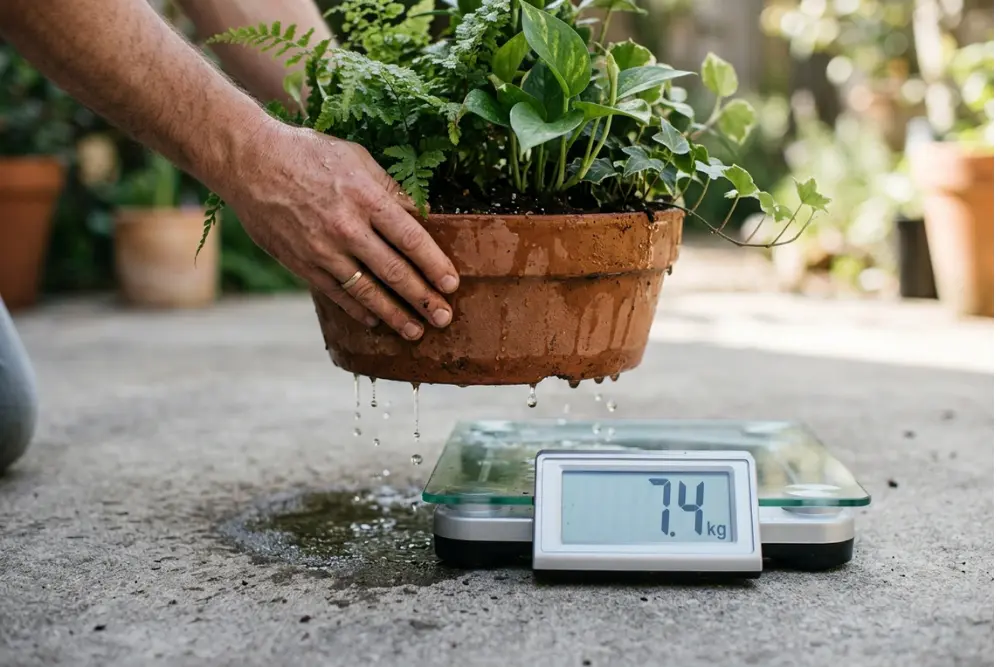
- Weigh the empty planter or panel on a bathroom or luggage scale, dry.
- Fill it with your growing medium and weigh it again. This is your dry, filled weight, close to what a bag-weight estimate would suggest.
- Water it thoroughly, the way you actually would once it is planted and mounted, and let it finish draining, typically 20 to 30 minutes for a well-drained mix.
- Weigh it a third time. This saturated figure, not the number from step 2, is what your fixing needs to be sized for, because it is what the wall is actually carrying most of the time the system is in use.
Do this with the specific planter, medium, and system you plan to mount, not a generic equivalent. A mix heavy on coir behaves differently from one heavy on bark, and the only way to know your own system’s real number is to weigh your own system.
Why This Belongs to the Fastener Question, Not Just the Plant Question
A reader searching this exact question is usually trying to answer a different one underneath it: is this going to come off the wall.
The honest sequence is: get your saturated weight from the test above, add the planter and frame’s own weight, add any retained reservoir water if the system has one, and give that total, not the dry weight, to whoever is confirming your fixing’s rated capacity. What a vertical garden actually weighs covers that full total and the wall-type-to-professional routing in detail.
The Weight is Not Constant, and That is Worth Planning Around Too
A planted structure’s weight moves through a range, not a fixed number, and design decisions should account for the top of that range, not the average. A system on a fixed watering schedule reaches its saturated weight predictably.
A self-watering system is built to keep the reservoir topped up, which means it spends more of its time near the saturated end of the range than a hand-watered planter does, a detail worth knowing if you are choosing between the two for a wall-mounted setup.
What This Means in Practice
Do not use a bag’s printed weight, or a dry weigh-in, to judge whether a fixing is adequate for a planted, watered vertical structure. Use the saturated figure from your own weigh test, and treat named manufacturer or industry figures as sanity checks rather than substitutes for measuring your own.
Vertical garden mistakes covers what happens when a structure is mounted using the dry, empty weight instead. How to build a vertical garden for a small space puts this weigh step ahead of choosing hardware, rather than after.
Frequently Asked Questions
How much heavier is wet potting soil than dry?
It varies by mix composition and drainage, enough that this article deliberately does not give you a single multiplier. Some systems, particularly thin felt-based panels, have been reported by their manufacturer at more than triple their dry weight once fully saturated. Weigh your own planter for a specific number.
Does the bag’s weight tell me anything useful?
It tells you the dry, as-packaged weight at the manufacturer’s moisture content, which is a reasonable floor but not the number your mounting needs to be sized against. The saturated weight, measured after you water it, is the number that matters.
Why does a vertical structure care about this more than a pot on the floor?
A floor-standing pot’s weight is carried by the floor, which is rarely a load concern indoors. A wall-mounted or railing-mounted structure passes that same weight, at its heaviest, through a fixing rated by its own manufacturer for a specific number, which makes the saturated figure directly relevant to safety rather than incidental.
Does the weight stay the same once the mix is fully saturated, or does it keep increasing?
It levels off once the mix cannot hold more water and excess starts draining or overflowing. Continuing to add water past that point does not add weight to the mix, though it can add weight to a reservoir if the system has one and lacks a proper overflow.