Vertical Garden Tower: Does Freestanding Work?
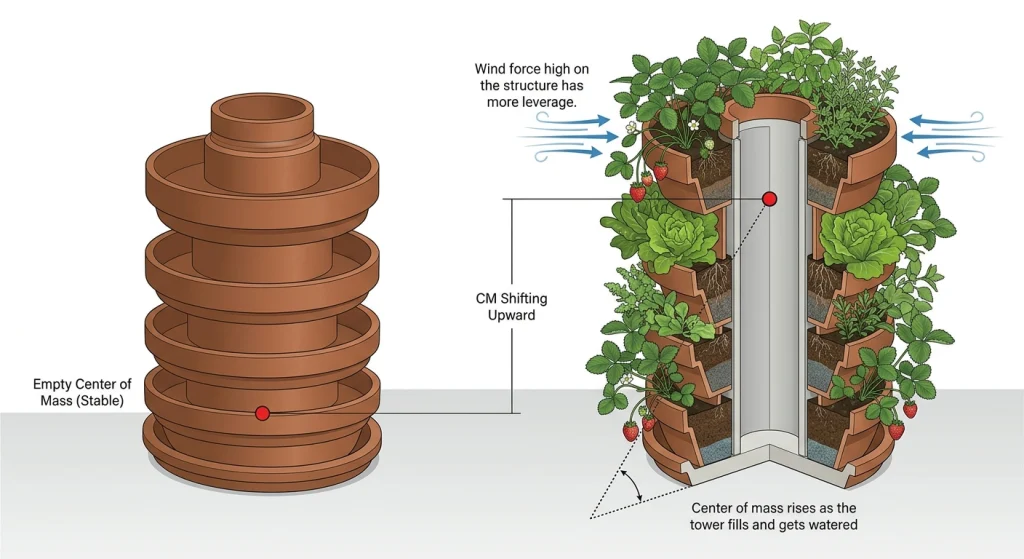
Yes, a vertical garden tower works, and it is the right answer for anyone who cannot drill a wall. What it does is move the engineering problem rather than remove it. A wall-mounted system can be pulled out of a wall. A freestanding tower cannot, because it touches nothing, but it can tip over, and the moment it is most likely to tip is the moment it is most heavily loaded: a windy afternoon just after you watered the top tier. A tower is a tall object with a small base whose center of mass rises as you fill it. Understand that one sentence, and every practical decision about towers follows from it.
The second thing worth knowing before you buy: a tower does not save floor space the way a wall system does. It concentrates the growing area into a small footprint, which is not the same thing.
What Counts as a Vertical Garden Tower
Several different builds are sold under this heading, and they behave differently.
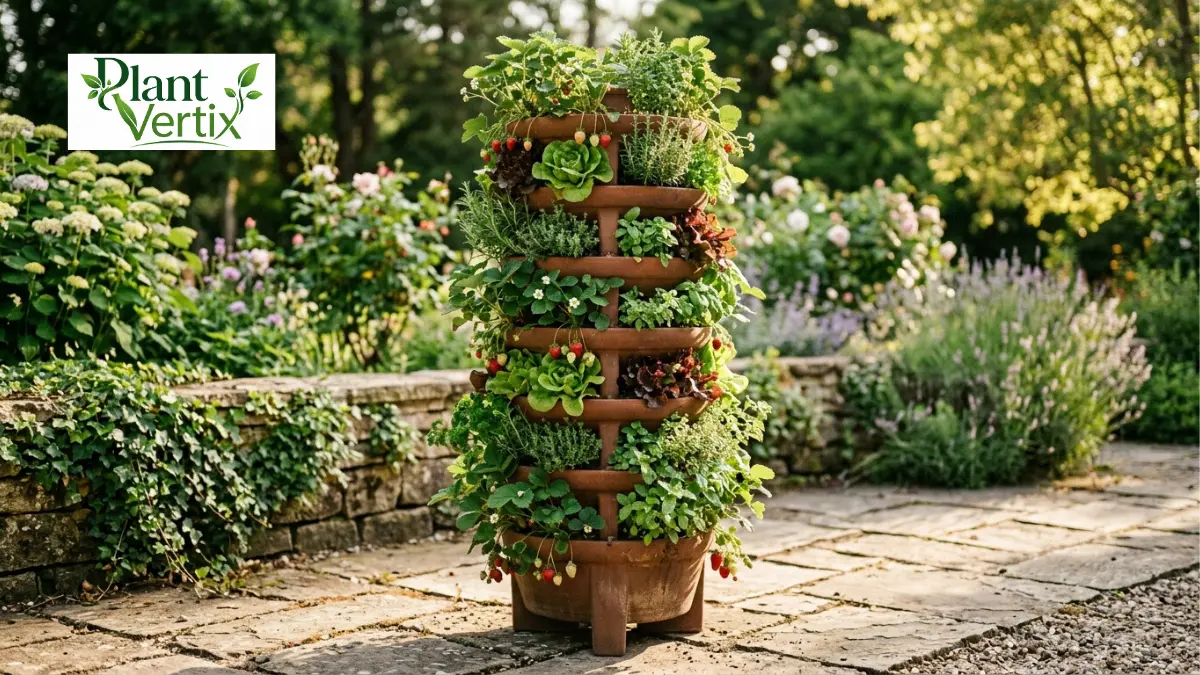
Stacking planters. Identical modules that sit on top of each other, each with planting pockets around its sides, usually with a central channel so water poured into the top works its way down. The most common version is the easiest to buy and take apart.
Column planters. A single tall vessel with holes cut in the sides, planted through the openings. Includes most of the DIY pipe and barrel builds.
Rotating or composting towers. A column with a central chamber, sometimes for compost or worms, sometimes mounted on a bearing so the whole thing turns.
A-frames and ladder towers. A freestanding frame carrying trays or pots at several heights. Wider at the base and easier to keep upright, but with a genuinely larger footprint.
Pole and tension frames. A vertical member braced between the floor and ceiling, or into a heavy base, carrying pots on arms.
We do not recommend products, name brands, or carry affiliate links on this site. What follows is how each type behaves, so you can judge one yourself.
The Tipping Problem, Reasoned Properly
The wall-mounted world talks about anchors. The freestanding world should talk about overturning, and it mostly does not.
Four facts drive it:
1. The center of mass rises as you plant upward. An empty tower is bottom-heavy and hard to knock over. The same tower, with every tier filled with saturated growing medium, has moved a large share of its mass to the upper half. That is a different object, mechanically.
2. Water is heavy and arrives at the top. A US gallon of water weighs about 8.34 pounds, and a liter weighs one kilogram. On a top-fed tower, that weight lands in the highest tier first and works down. The tower is at its most top-heavy in the minutes after watering.
3. Wind acts on the whole planted height, not on the base. A tower covered in foliage is a sail on a stick. Force applied high up produces far more overturning leverage than the same force applied low down, which is why a tower that is fine at ground level in a courtyard can be a problem on an exposed ninth-floor balcony.
4. The base is only as good as what it stands on. Soft soil, bark mulch, a lawn, a decking board with a soft spot, or an uneven paving slab will all let one edge of the base sink, and a tower that leans a little tips a lot more easily than one that stands plumb.
The practical consequences:
- Put it where a fall does not matter. Not above a stairwell, not next to a doorway, not where a child or a pet plays, not against glass, not over a balcony edge where anything could fall to a lower level. This is the single highest-value decision you will make about a tower.
- Stand it on something firm and level. A paving slab, a bearer board, or a proper level base beats bare soil every time.
- Weight the base if the design allows it. Some towers have a base reservoir or cavity precisely so it can be filled. Use it.
- Restrain it if it is tall or exposed. A single tie back to a rail, post, or wall bracket converts an overturning problem into a much smaller one. A restraint is not the same as mounting the system on a wall, and it needs far less from the fixing, but it still has to go into something real.
- Take the top tier down for winter storms, or empty and store the whole thing. A tower is easy to dismantle, and that is one of its advantages.
If the tower is going on a balcony, the weight it puts on the floor is a building question, not a gardening question. We do not publish balcony capacity numbers or load figures of any kind, because they vary by structure, by age and by jurisdiction, and being wrong about one is not a gardening mistake. Ask your building management or a qualified engineer. Our balcony vertical gardening guide takes the same position and explains what to ask them.
Self-shading: The Problem a Tower Has and a Wall Does Not
A wall-mounted system is shaded by its own upper tiers, but it also has a wall behind it that never receives sun anyway. A freestanding tower is a cylinder in open space, and that produces a specific effect: at any moment, one side of the tower faces the sun, and the other side is in its own shadow.
Over a day, the sun moves, and the shadow moves with it, so the deficit is partly evened out. It is not evened out fully. In the northern hemisphere, a tower’s north-facing plants will consistently see less direct light than its south-facing ones, and the difference is visible within weeks as uneven growth and stretching on the shaded side.
Two responses work.
Rotate it. A quarter turn every week or two, or every few days in high season, is the standard fix, and it works well. This is why rotating bases and bearings exist as a feature. It is also why the tower’s weight matters practically as well as structurally: a tower you cannot turn is a tower you will not turn.
Plant to the aspect. Put the sun-hungry crops on the bright face and the shade-tolerant ones on the dim face, and accept that the tower has two climates. That suits a fixed installation better than rotation does.
Our guide to how much growing space you actually gain by going vertical covers why self-shading eats into the theoretical plant count on any vertical structure.
Watering a Tower, and Why the Bottom is Not the Problem
On wall panels, the usual complaint is that the bottom stays soggy. On towers with a central feed channel, the failure is often the opposite and more interesting: water takes the path of least resistance down the central column and exits at the base without ever moving sideways into the outer pockets.
Whether that happens depends on the design of the internal channel and on how firmly the growing medium is packed against it. Signs you have it: the base drains almost as fast as you pour, and plants in the outer pockets are dry a few inches down while the tower is visibly wet.
What helps: water slowly rather than in one pour, water in two or three passes with a pause between them, top the medium up as it settles so there are no voids around the channel, and check individual pockets with a finger rather than trusting that the tower “has been watered.” Watering a vertical garden covers the general principle that a vertical system is never one watering zone.
What a Tower is Genuinely Good for
Renting, or any situation where you cannot make a hole. This is the strongest case. No fixings, no lease question, no wall repair when you leave.
Concentrating the growing area into a small footprint. A tower turns roughly one square yard of floor into several stacked planting levels, which is a real and useful multiplication for herbs, salad greens, strawberries and compact crops.
Reach and ergonomics. Most of a tower is at a comfortable working height. No bending, no ladder.
Portability. Follow the sun across a season, move it out of a storm, or take it with you when you move.
Simple ownership. Nothing is fixed to the building, so nothing can damage the building.
What it is Not Good for
It does not free up floor space. A wall system leaves the floor empty. A tower occupies a floor, plus the walking space you need around it to rotate and harvest. On a truly narrow balcony, the real estate a tower consumes can be the deciding argument against it.
It does not suit deep-rooted crops. Tower pockets are shallow. Herbs, greens, strawberries and compact ornamentals do well. Tomatoes, peppers, squash and root vegetables want root volume that a pocket does not have. Grow those in a large container with a trellis above them instead, as covered in vertical vegetable gardening for small spaces.
It is exposed. A tower has no wall behind it to block wind or radiate stored warmth, so it dries faster and takes more weather than a wall-mounted system in the same yard.
It is not automatically cheap. Manufactured stacking systems are a real purchase, and prices move around by region and season, so compare in your own currency rather than trusting a number in an article.
Judging a Vertical Garden Tower Before You Buy
| What to check | The good answer | Why |
|---|---|---|
| Base width relative to height | Wide, and wider still if it is exposed | The single biggest factor in overturning |
| Ballast provision | A fillable base or reservoir | Lowers the center of mass exactly where you want it |
| Rotation | A bearing, castors, or light enough to turn by hand | A tower you cannot turn will grow unevenly |
| Pocket depth and volume | Stated in dimensions, not adjectives | Depth is the drought buffer and the root run |
| Watering path | A described route from top to bottom, and a way to check each level | Central channels can bypass outer pockets |
| Drainage at the base | A defined exit, plus a tray if it stands on a deck or indoors | Standing water stains decking and rots timber |
| UV stabilization | Stated explicitly | Unstabilized plastic embrittles outdoors |
| Dismantling | Comes apart in tiers by hand | Storm prep, winter storage and moving all depend on it |
| Anchoring option | A designed tie-down or restraint point | Turns an exposed site from a no into a yes |
Ignore plant-count headline claims when comparing. A tower advertising a large number of planting holes is telling you how many holes it has, not how much growing medium each plant gets, and the second number is the one that decides whether the thing survives August.
For a side-by-side view against wall panels, fabric pockets, shelves and trellis, our neutral comparison of vertical garden systems sets out the criteria without recommending a product.
FAQ
Do vertical garden towers tip over?
They can, and the risk peaks when the upper tiers are freshly watered and the wind gets up. A tower’s center of mass rises as you plant upward, and wind acting on the planted height has a lot of leverage. Stand it on a firm level base, use any ballast the design provides, tie it back if the site is exposed, and never site it where a fall could hurt someone.
Can I put a vertical garden tower on a balcony?
Usually, it is the best system for a balcony because nothing is fixed to the building. The load that a filled tower puts on the balcony floor is a question for your building management or a qualified engineer, not for a gardening site, and we do not publish capacity figures. Also, check whether your building has rules about items near or above the railing.
Do I need to rotate a vertical garden tower?
If you want even growth, yes. A freestanding tower shades one side of itself at any given moment, and over a season, the consistently shadier face grows noticeably weaker. A quarter turn every week or two solves it. If rotating is impractical, plant sun-lovers on the bright face and shade-tolerant plants on the dim one.
What can you grow in a stacking tower planter?
Shallow-rooted, quick-turnaround plants do best: lettuce and salad greens, herbs, strawberries, spinach, compact ornamentals and many succulents. Fruiting crops such as tomatoes, peppers and squash, and any root vegetable, need more root depth than tower pockets provide.
Why is the bottom of my tower soaked, but the plants are still dry?
Water is probably running straight down the central channel and out of the base without moving sideways into the pockets. Water in two or three slow passes rather than one pour, top up the medium so there are no voids around the channel, and test individual pockets with a finger instead of assuming the whole tower got watered.