
Wall Anchors for Heavy Planters: Reading the Packet Honestly
An anchor’s packet number describes a test, not your wall. It was measured in one specific material, at one specific thickness, pulled one specific way, usually as a dry static load, and usually with a safety factor already applied or not applied, depending on the maker.
Your planter is a wet load that gets heavier every time you water it, hanging off whatever is genuinely behind your particular wall. Those are two different questions, and this article is about the gap between them, not about which number to trust.
This site publishes no anchor rating, no safe-load figure and no verdict on whether a fastener will hold. That is deliberate, and the reason is the whole point of the article.
Why a Planter is Not the Load the Rating Describes
Read an anchor rating literally, and it turns into a conditions statement.
It says: this anchor, installed in this material, at this thickness, with a hole this size, loaded in this direction, held this much before it failed in our test. Every one of those conditions is a variable in your wall, and the moment one of them differs, the number is describing something other than your situation.
A planted vertical system differs on more of those conditions than most household loads do. It is not static: it is heaviest right after watering and lightest before, so the fastener sees the load cycle every few days for years. It is not dry. It grows: roots fill the medium, plants gain mass, and a system that was comfortable in spring is heavier by late summer. And it is usually pulling and levering at once, because the planter stands off the wall, so the top fasteners are being pulled out while the bottom is being pushed in.
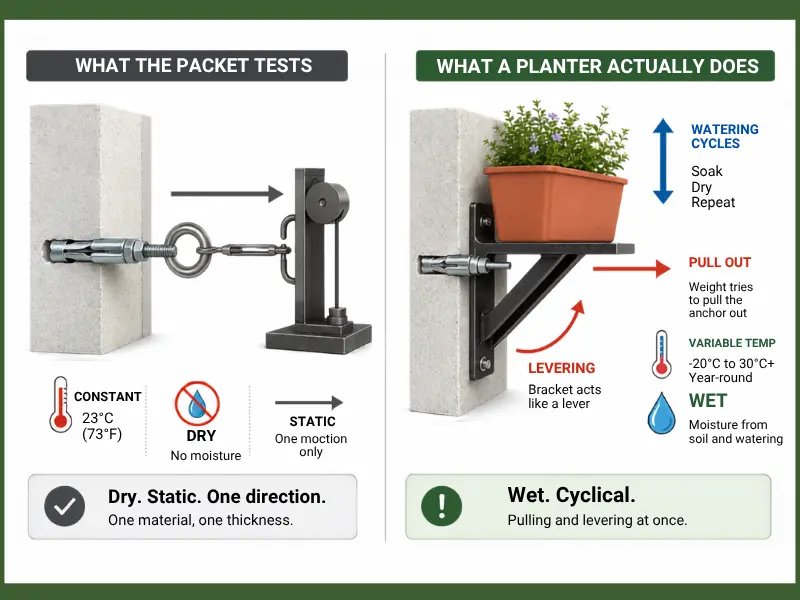
That combination is not what a packet number was measured on, and it is precisely why a load that grows every time you water it deserves more caution than a shelf of the same stated weight.
The Anchor is Chosen Last, Not First
Most people arrive here with a planter and a bag of anchors, which is the wrong order.
The wall decides the fastener. The fastener does not rescue the wall. What is behind the surface is the fact that everything else follows from: solid timber framing, a hollow cavity behind a board, plaster over masonry, solid brick, poured concrete, block, or an exterior cladding with a structure of its own somewhere behind it. Each of those wants a different family of fastener, and no fastener turns one into another.
So the sequence is: establish what the wall is, then find out what that wall type’s appropriate fastener family is from the fastener manufacturer’s own instructions, then check the total load you are about to hang against that. Choosing the wall before choosing the anchor is not a stylistic preference; it is the step that decides whether the project is possible at that spot at all.
The total hanging load is the growing medium at its saturated weight, plus any water the system holds, plus the planter and frame themselves. That number is yours to work out and yours to hand to whoever confirms the fastener.
What Each Anchor Type is Actually Designed toDo
Anchors are usually sold by claimed weight. They are better understood by mechanism, because the mechanism tells you where each one stops working.
- A screw straight into solid timber framing does not rely on an anchor at all. The screw’s threads engage wood along their whole length. This is the strongest of the common household options and the one every guide steers you toward, which is why finding the framing matters so much.
- Toggles, in their various forms, work by opening out behind a hollow board and bearing against its back face. Their limit is not the toggle; it is the board: the load is being carried by the material the toggle is pressing against.
- Expanding sleeve and plug anchors work by being squeezed outward against the sides of a drilled hole, generating friction. Their limit is the hole and the material around it, which is why the drill bit size in the instructions is not a suggestion.
- Self-drilling threaded anchors for hollow board cut their own coarse thread into the board. Their limit is the same board, and they are generally intended for light loads.
- Masonry and concrete anchors, including screws designed to cut into masonry and sleeve types that expand in it, depend on the specific masonry: solid brick, perforated brick, block and poured concrete are not interchangeable.
Which family you need is the manufacturer’s answer, not ours, and the fasteners you will actually use are the ones you should list before buying anything else. That is why they belong on the fasteners that belong on the materials list rather than being picked up as an afterthought at the checkout.
Finding the framing, and the honest limit of the tool
A stud finder is the right tool and it is not a certainty machine.
Use it to build a picture, not to get an answer. Sweep horizontally in both directions from several heights, mark every edge it reports, and look for members repeating at a consistent spacing. A single beep in isolation tells you almost nothing; a series of hits at a regular interval across the wall is a pattern worth trusting more.
Then confirm the pattern against things the building already tells you. Trim, outlet and switch boxes, and the corners of the room all attach to something. A detector that also flags live cable and metal is worth having, because it distinguishes some of what it finds.
And know the limit: a detector reports density change, not identity. It cannot tell you what a member is made of, whether it is full depth, or whether the thing it just found is structural or a pipe. Where the detector’s picture and your plan disagree, the detector is not the tie-breaker.
Before you drill, and this paragraph is not optional
Walls have services in them, and the drill does not know that.
Assume there is electrical cable and plumbing in the cavity until you have reason to believe otherwise. Look at both faces of the wall and above and below your intended line. An outlet, a switch, a light fixture, a thermostat, a faucet or a water heater tells you that something runs to it, and runs commonly travel vertically from the fitting and horizontally between fittings. The zones directly above and below anything electrical or plumbed are the worst places to make a hole.
If the bit meets anything that is not what you expected, stop. Do not push through to find out what it was, and do not widen the hole to look. Anything that turns out to involve a circuit is work for a qualified electrician, and anything that turns out to involve a pressurised water line is work for a qualified plumber. Neither is a decision to make with a drill in your hand.
Spreading the load instead of increasing the anchor
When the arithmetic looks uncomfortable, the instinct is to buy a bigger anchor. There is usually a better move.
Spreading the same load across more fasteners, and across more of the wall, changes the problem rather than the hardware. A wood cleat or mounting rail fastened into framing at several points, with the planter hung from that rail, moves the load off a small number of concentrated points and into the structure at intervals. This is the reason a felt pocket panel spreads its weight along a mounting rail rather than hanging from two hooks, and it is the same logic behind any rail-mounted system.
Splitting one large system into two smaller ones does the same thing at the design level, and has the side benefit that each half is light enough to lift into place safely.
Standing the structure on the floor and using the wall only to stop it tipping removes the question almost entirely. If the floor can take it, the floor is free, and the wall is not.
Where this article stops
We do not tell you that a fastener will hold your system, and no article can. The honest chain is: the fastener manufacturer’s own published specification for the material you actually have, checked against the total saturated load you have worked out, applied by someone who has confirmed what is really behind your wall.
If you rent, the wall is not only a structural question. Holes, and repairing them later, are a matter for your building management or your landlord and for the document you signed, and that conversation is cheaper before the holes than after.
If the answer at any point is “I am not sure what this wall is”, that is the answer. It means the next step is a qualified professional looking at the actual wall, not a heavier anchor chosen from a shelf.
FAQ
Can I hang a vertical planter on drywall without hitting a stud?
Only within whatever the anchor manufacturer states for that board type and thickness, and a saturated planted system is a heavier, wetter, more cyclical load than most hollow-wall anchors are described for. Where the load is meaningful, the framing is the target.
Do anchor weight ratings include a safety margin?
Whether a stated figure is an ultimate test value or already reduced varies by manufacturer, and the only place that is answered is that manufacturer’s own documentation. It is one of the things worth checking before comparing two packets against each other.
Is a toggle stronger than a plug?
They fail differently rather than ranking against each other. A toggle bears against the back of a board, so the board’s strength is the limit. A plug grips the sides of a hole, so the hole and the material around it are the limit.
How do I know if my stud finder found a stud or a pipe?
You often cannot tell from the detector alone, because it reports a density change rather than an identity. Build a picture from repeated readings at a consistent spacing and check it against trim and outlet positions, and where the picture is unclear, do not drill on the assumption.
What if I am renting?
Ask your building management or landlord before making holes, and check the document you signed. A freestanding or floor-supported structure that leans on the wall rather than hanging from it avoids the question completely.