What Vertical Gardening Actually Is
Vertical gardening is growing plants on a structure that carries their weight off the floor, rather than spreading them across floor space. That is the whole definition, and the useful part of it is the structure, not the plant.
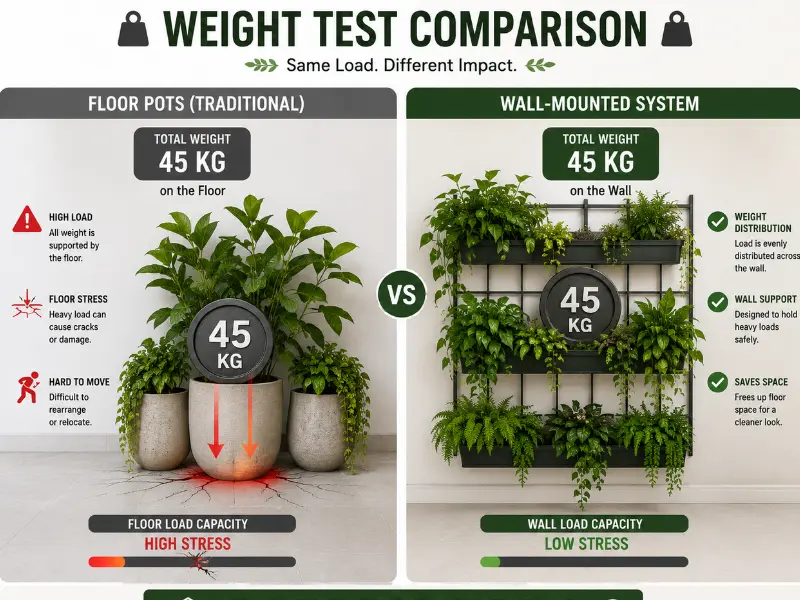
A trellis, a wall panel, a stacking tower, a tiered shelf, and a hanging pocket system are all vertical gardens. A row of pots standing on a balcony floor is not, even if the plants in them are tall. The test is simple: if you removed the structure, would the growing weight land on the floor? If yes, you have a vertical garden. If the weight was already on the floor, you have containers.
The Short Definition And the Test That Goes With It
Almost every guide you will read defines vertical gardening as “growing up instead of out,” then moves straight to a list of benefits. That definition is correct, and it is also not usable, because it never tells you where the boundary sits. Plenty of readers arrive at the term with three pots on a shelf and genuinely cannot tell whether they are already doing it.
Here is the boundary, stated the way this site uses it throughout.
A vertical garden is present when a structure is holding growing weight off the floor.
Growing weight means the whole loaded system: the container, the growing medium, the water in that medium, and the mature plant. That combination is what a structure has to carry, and it is what makes vertical growing a different problem from container growing, rather than just a prettier version of it.
Two things follow from that test immediately, and they run through every article on this site.
First, the risk in vertical gardening lies in the structure, not the plant. A plant that dies is disappointing. A loaded panel that comes off a wall is a different category of problem.
Second, the weight is not fixed. It changes every time you water. A structure holding a dry growing medium and the same structure an hour after watering are carrying different loads, and the design has to survive the heavier one.
Growing Up, Not Out: What Actually Changes When the Weight Leaves the Floor
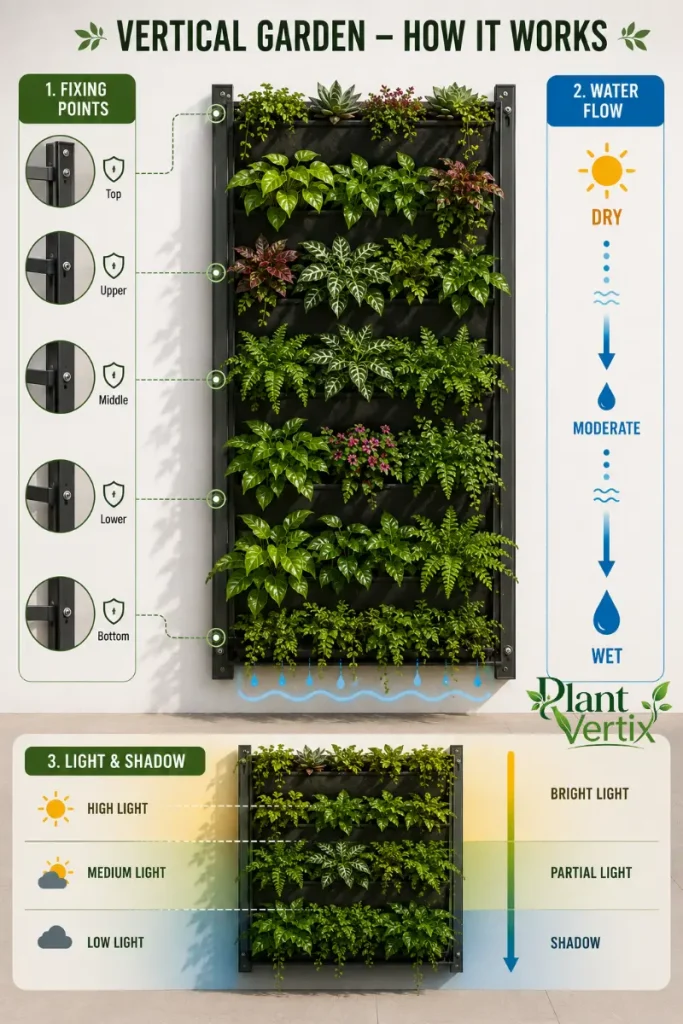
When plants sit on the floor, the floor takes the load, and you never think about it. Lift that same growing system onto a wall, a railing, or a frame, and four things change at once.
- The load has to go somewhere specific. A floor spreads weight over a large area. A mounted structure concentrates it into a small number of fixing points, or into the feet of a frame. Where those points are and what they are fixed into becomes the first real design decision, ahead of which plants you like.
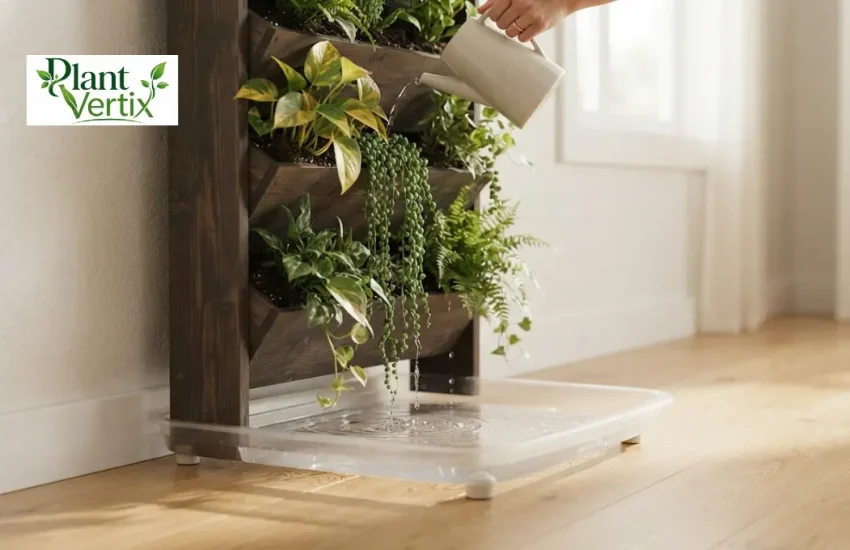
- Water starts moving through the system. Gravity pulls moisture downward through a stacked or tiered structure, so the top tends to dry first, and the bottom tends to stay wettest. That is a mechanical property of vertical systems, not a plant problem, and it is covered in full in how to water a vertical garden without damaging the wall or drowning the bottom tier.
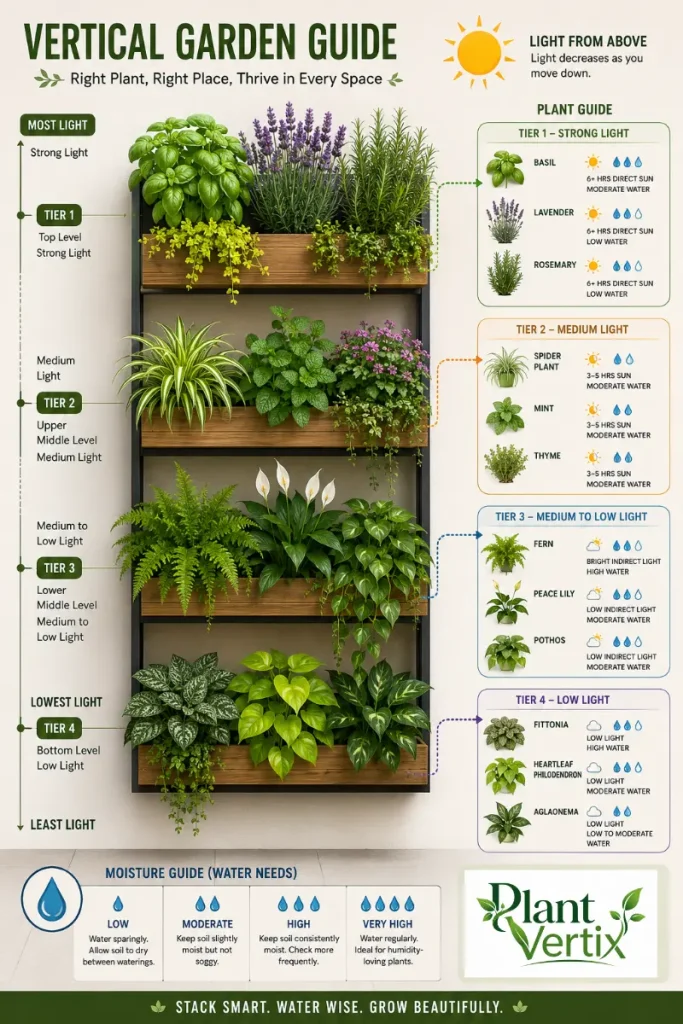
- Light stops being uniform. A vertical structure casts a shadow on itself. Upper tiers take more direct light than lower ones, which is why the same plant behaves differently at different heights on the same frame.
- Root volume gets smaller. Vertical systems win floor area by making each planting pocket shallower and narrower than a comparable pot. That is a real trade, and it decides which plants belong where. Matching plants to tier position exists because of it.
None of these four is a downside exactly. They are the terms of the exchange. A reader who plans for them gets a system that works, and a reader who expects vertical growing to behave like container growing on a wall gets a crispy top tier and a rotting bottom one.
The Three Families of Vertical Growing Structure
Nearly everything sold or built as a vertical garden falls into one of three families, and the family tells you more about what you are taking on than the material or the brand does.
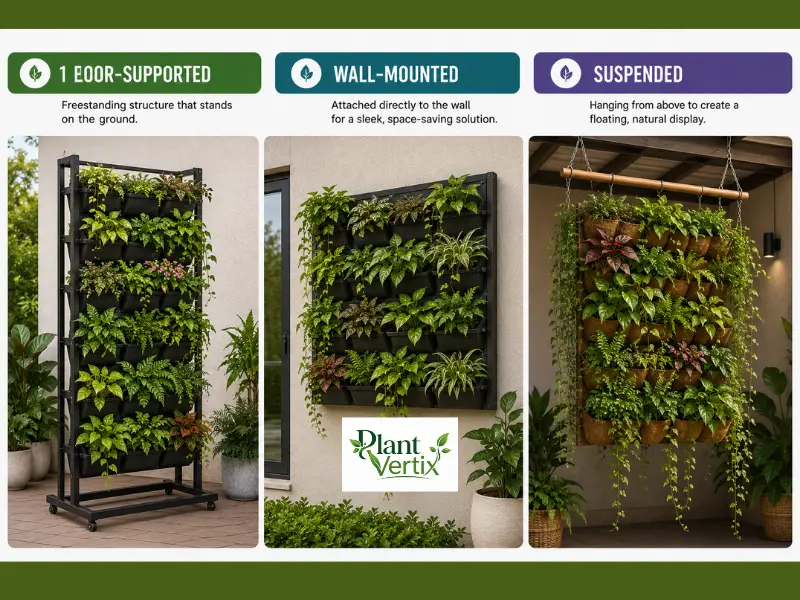
1. Floor-supported structures put the whole load onto the ground: freestanding towers, stacking planters, tiered shelves, ladder planters, and frames that lean against a wall without being fixed to it. The floor carries the weight, so the wall question mostly goes away. What replaces it is a stability question, because a tall, top-heavy, floor-supported structure can be tipped by wind or knocked by a person.
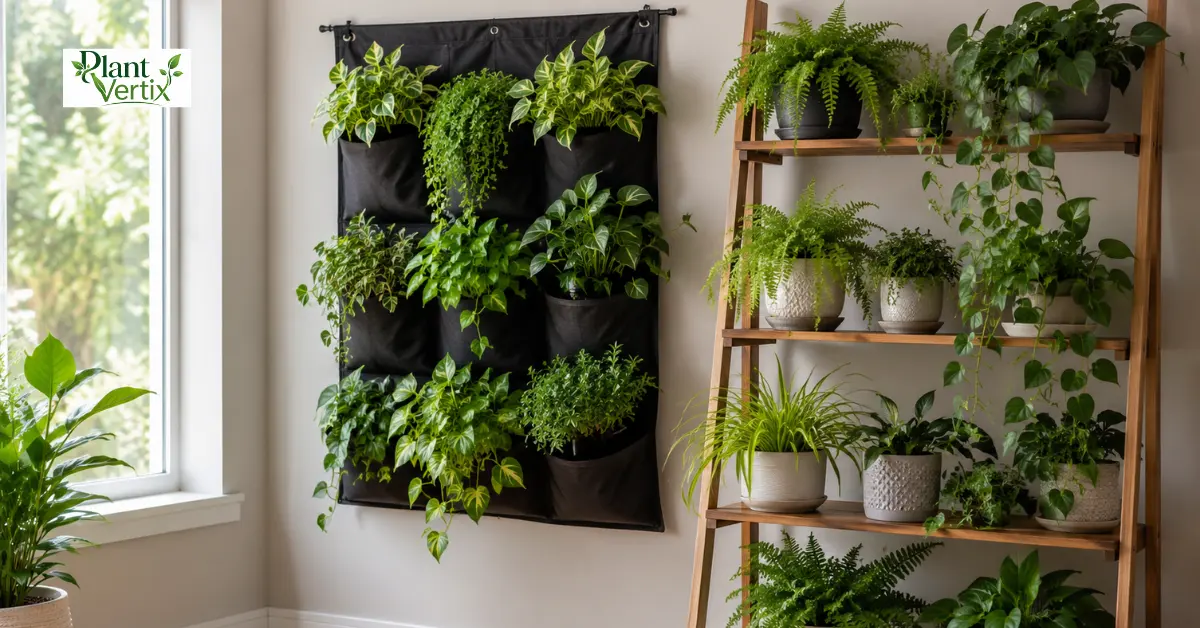
2. Surface-mounted structures transfer the load into a wall, fence, or railing: wall panels, pocket walls, mounted pot rails, and railing-fixed frames. These are the most space-efficient and the most demanding, because now the surface behind the system is structurally involved, and so is whatever the surface is made of.
3. Suspended structures hang the load from above: tiered hangers, columns of baskets, over-the-door systems. The load path is short and obvious, but every fixing carries the full weight of everything below it, and a suspended system swings in the wind in a way the other two do not.
If you want to see how the individual system types inside these families compare on drilling, weight path, and renting, that is the whole subject of vertical garden systems compared.
Is a Shelf of Pots a Vertical Garden? The Honest Boundary
This is the question people actually arrive with, so here is a direct answer rather than a definition.
A shelf of pots is a vertical garden if the shelf is carrying the pots off the floor and the shelf is part of your growing plan. A wall-mounted shelf holding six planted pots is a surface-mounted vertical system, and it raises exactly the same questions as a fabric pocket panel: what is the shelf fixed into, what does the whole thing weigh when the pots are watered, and what does moisture do to the wall behind it over a few years?
A freestanding bookcase you happen to keep plants on is closer to a floor-supported system. The floor is carrying the load. Your real questions are stability, whether water can escape onto the shelf surface, and how much light the lower shelves are actually getting.
A single hanging basket is not a vertical garden. It is one suspended container. It becomes a vertical system when it is part of a column or a set that is planned and loaded together, because at that point the fixing above is carrying several containers rather than one.
A tomato staked in a pot on a balcony floor is not a vertical garden. The plant is going up, but the weight never leaves the floor. That is trellising a container, which is a genuinely good technique and a different topic. If it reads the same way with the plant on the floor, it is not really a structural question.
The reason to be strict about this line is not pedantry. It is that the three families above each carry a specific risk, and calling something a vertical garden when the floor is doing all the work will send you looking for answers to problems you do not have.
What Vertical Gardening is Not
A few adjacent things get filed under the term and are worth separating out.
- It is not automatically a living wall. A living wall usually means a densely planted, continuous surface, often with an irrigation system built in, designed to read as a wall of foliage. Every living wall is a vertical garden. Most vertical gardens are not living walls, and the difference matters because a continuous planted surface is heavier, wetter, and more demanding than a set of separate pockets.
- It is not a growing method. Vertical is a geometry, not a technique.
- You can grow vertically in soil, in a soilless medium, indoors or outdoors. The structure is the subject here; what goes in the pockets is a separate decision.
- It is not inherently low-maintenance. Smaller root volume and faster drying at the top usually mean a vertical system needs attention more often than the equivalent plants in large pots, not less.
- It is not only decorative. Real food grows on vertical structures, and the case for it is covered in vertical vegetable gardening in small spaces.
What the Term Does Not Tell You, and What to Check Next
Knowing that you want a vertical garden settles almost nothing on its own. The three questions that actually decide your build are the ones the definition never touches.
Where is the weight going? Floor, wall, railing, or a fixing above. Answer this before choosing a structure, not after. It rules out entire families in some spaces.
Are you allowed to fix anything? Renting, a shared wall, a managed building, or a structure you cannot drill all narrow the field considerably, and there are genuinely good answers within that narrower field.
What can the surface you are fixing to actually take? This site does not publish safe-load figures, anchor ratings, or capacity numbers, and that is deliberate. Those numbers depend on your specific wall, its construction, its condition, and what is behind it, and no article can know that. What a manufacturer prints on a package is a rating for a dry, static load in a tested material, and a planted structure is neither dry nor static. When the question becomes “will this hold on my wall,” it is a question for your building management, your landlord, or a qualified professional, and it is worth asking before anything is mounted.
The full sequence, in the order it should actually be done, is set out in how to build a vertical garden for a small space. If you are still weighing whether the space gain justifies the effort, how much growing space you actually gain by going vertical takes that question apart, honestly.
Frequently Asked Questions
Is a hanging basket a vertical garden?
One basket is a single suspended container. A planned column or set of baskets loaded on the same fixing behaves as a suspended vertical system, and should be treated as one.
Does a vertical garden have to be attached to a wall?
No. Floor-supported towers, tiered shelves, and freestanding frames are complete vertical gardens, and they are the standard answer for anyone who cannot fix into a surface.
Is a trellis a vertical garden on its own?
A trellis carrying a climbing plant is a vertical growing structure. Whether it is a vertical garden, as tested above, depends on where the plant’s container sits: if the pot is on the floor and only the vine is on the frame, the structural load is mostly still on the floor.
Is vertical gardening the same as a living wall?
No. A living wall is one type of vertical garden, generally the densest, heaviest, and most irrigation-dependent type. Most vertical gardens are simpler than that.
Can you grow vegetables vertically, or is it just herbs and foliage?
Vining crops such as beans, peas, and cucumbers take to vertical structures readily. Extension guidance is consistent that training crops upward improves light exposure and air circulation around the foliage, which helps with disease pressure and makes harvesting easier.