How Much Space Vertical Gardening Saves
Going vertical reliably gives you back floor area, and that gain is real and easy to picture: a structure with four planting levels occupies roughly the footprint of one, so three levels’ worth of floor is returned to you. What it does not automatically give you is a proportional increase in harvest.
Those are two different claims, and almost every article on this topic quietly merges them. Floor area is geometry, and it is dependable. Yield depends on light, root volume, and watering consistency, and a vertical structure changes all three, some for the better and some for the worse. This piece keeps the two apart so you can decide whether the trade suits your space.
The Short Answer: What Going Vertical Actually Gives You Back
The dependable gain is the floor under the structure. If a set of pots would have covered a patch of balcony or patio, and instead those same pots sit at four heights on a frame occupying one patch, the other three patches are yours again. That is not a marketing claim; it is stacking.
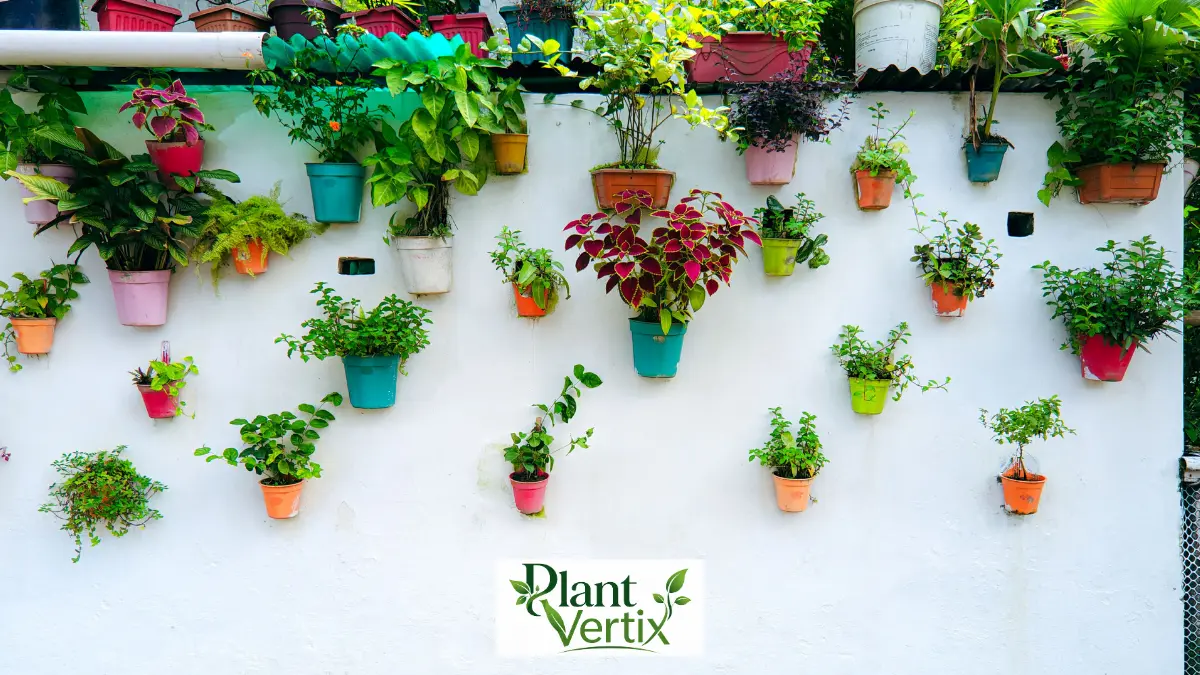
The second dependable gain is access to surfaces you were not using at all. A blank wall, a fence, a railing, and the air above a floor are all growing areas that a container garden never touches. In a genuinely small space, this is usually the larger of the two gains.
The third gain is less discussed and more real than people expect: vertical growing gives you an edge. Plants on a frame have air on more sides of them, and extension guidance is consistent that training crops upward improves light exposure across the foliage and air circulation around it, which reduces disease pressure and makes harvesting easier. That is a plant-health gain rather than a space gain, but it is the one that most often turns into an actual harvest difference.
Footprint Versus Yield, And Why the Difference Matters
Here is the distinction in one line.
Footprint is what the structure occupies. Yield is what the plants produce. Going vertical changes the footprint directly and yields only indirectly.
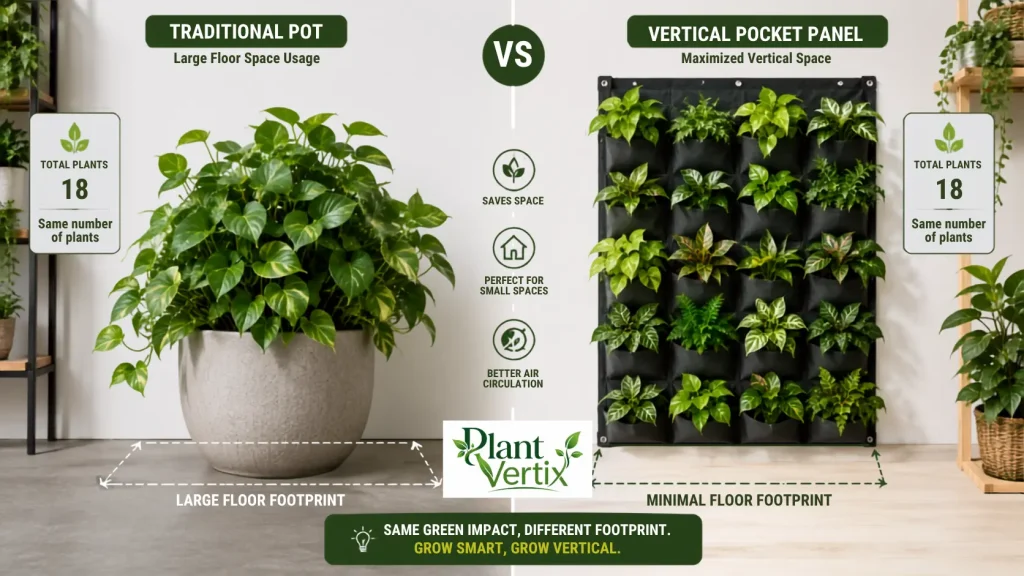
Why the indirect part is not automatic: a vertical structure buys its floor saving by making each planting position smaller. A wall pocket or a tower cell holds less growing medium than the pot the same plant would have had on the ground. Less medium means less root volume, less water held between waterings, and less nutrient reserve. Some plants barely notice. Others produce visibly less than they would in a large pot, and no amount of stacking recovers that.
So the honest framing is this. If you take twelve plants that were doing well in generous pots and move them into twelve small wall pockets, you have gained floor area, and you may well have lost yield per plant. If instead you use the recovered floor area to keep some plants in generous pots and add vertical positions for the crops that tolerate small root volume, you gain on both. The gain comes from the layout decision, not from the structure by itself.
Where The “10 Times More Produce” Figure Comes From, And Why This Site Will Not Repeat It
Search this topic, and you will meet the same numbers repeatedly: vertical gardens produce up to ten times more per square foot, and four square feet can grow fifty plants.
Those figures appear almost entirely on seed-vendor and growing-system-vendor blogs. None of the pages carrying their names a trial, a crop, a season, a growing method, or a source. A multiplier that does not say ten times more than what, growing what, under which conditions is not a measurement, it is a slogan.
This site does not publish figures it cannot attribute. That rule costs something here, because a number would be a satisfying answer. What you get instead is the reasoning, which travels better: the floor gain is proportional to the number of levels you stack, and the yield outcome depends on whether the plants you chose tolerate the smaller root volume you gave them.
The One Honest Comparison: Sprawling Crops vs. Vertical Ones
There is a single illustration circulating in this SERP that holds up, because it is geometry rather than yield.
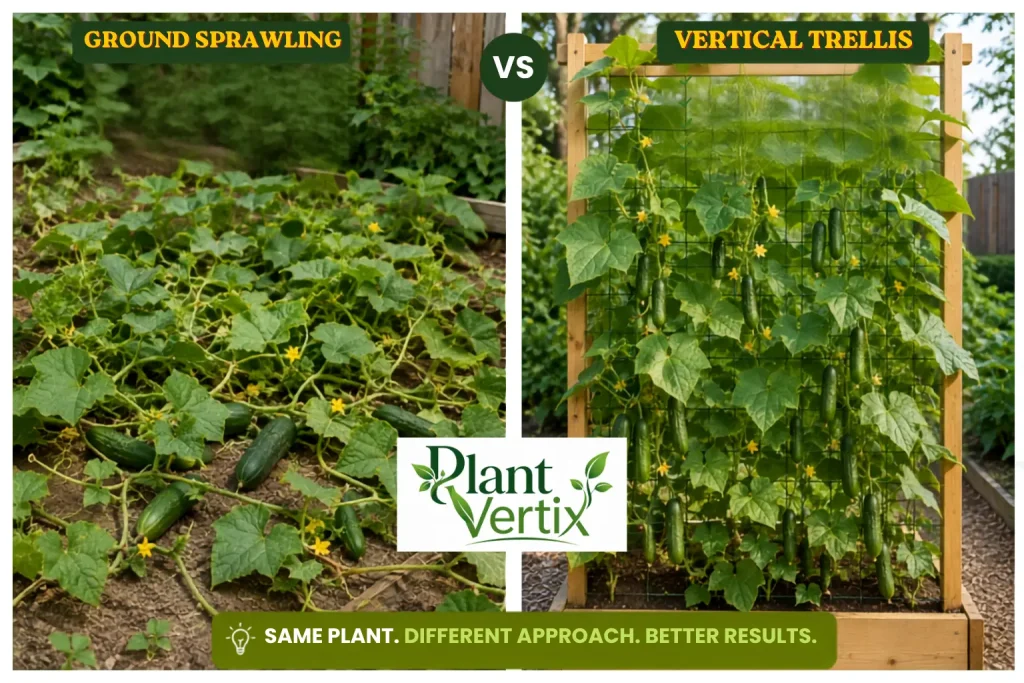
A sprawling vine crop, such as squash, left on the ground, spreads across a wide area of soil. Trained up and over an arched trellis, the same plant occupies a narrow strip at its base. The plant is the same size. The floor area it consumes is very different.
That is the mechanism in its purest form, and it explains why vertical gardening does most of its work on sprawling and vining plants and comparatively little on compact ones.
A basil plant occupies a small footprint, whether it is on the floor or a wall. A cucumber vine occupies an enormous one on the floor and a small one on a frame. If you want the space gain to be dramatic, put the sprawlers on the structure. The crops that thrive best in this climate are set out in vertical vegetable gardening in small spaces.
What You Give Up: Root Volume, Water Evenness, and Light on the Lower Tiers
Three costs, and all three are manageable if you know about them before you build.
1. Root volume. Each position on a vertical system usually holds less growing medium than a comparable pot. Shallow-rooted crops, most culinary herbs, leafy greens, and trailing plants handle that well. Deep-rooted and large-fruiting plants often do not, and putting them in a small pocket produces a stunted plant rather than a compact one.
2. Water evenness. Gravity pulls water down through the structure, so the top dries fastest, and the bottom stays wettest. This is the single most common way a vertical garden disappoints its owner, and it is entirely predictable and fixable. The full pattern and the routine that corrects it are in how to water a vertical garden.
3. Light on the lower tiers. A vertical structure shades itself. The top level takes the most direct light, and the bottom takes the least, which means the same plant performs differently at different heights on the same frame. That is not a flaw to be fixed; it is a gradient to be planted into, and matching plants to tier position is how you use it rather than fight it.
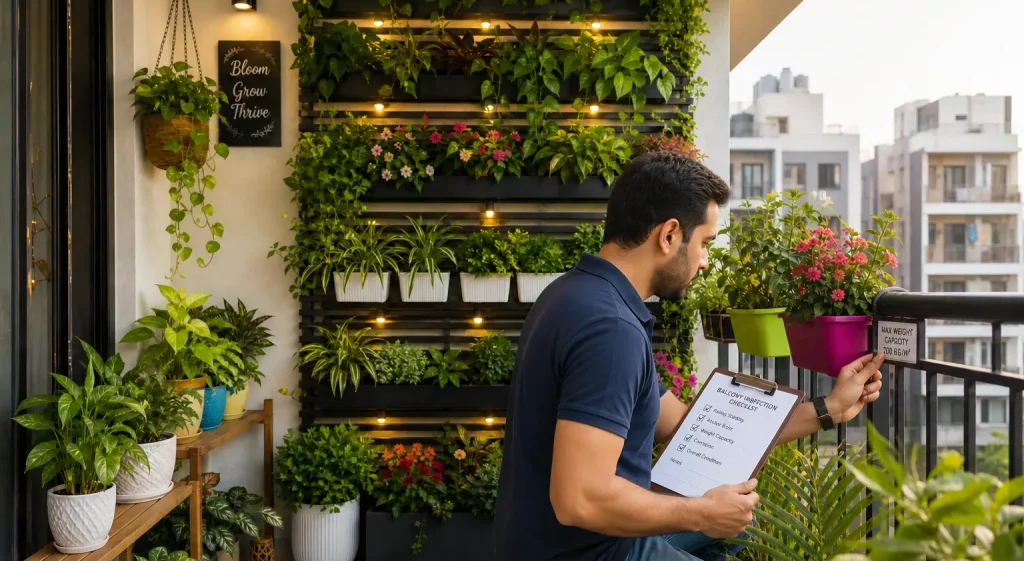
There is a fourth cost that is not about plants at all: the structure has to be carried by something. A stack of loaded planters concentrates weight into a wall, a railing, or a frame’s feet, and that weight rises every time you water. This site publishes no safe-load figures, anchor ratings, or capacity numbers, because the real number depends on your specific wall or floor and its condition. When the question becomes whether your surface will hold it, that is a question for your building management, your landlord, or a qualified professional. The order in which to work through it is how to build a vertical garden for a small space.
How to Estimate the Gain for Your Own Space Without Guessing
You do not need a formula. You need four honest answers.
1. Measure the floor area you are actually trying to recover. Not the whole balcony. The specific patch is currently holding the pots that you want back.
2. Count the usable levels, not the advertised ones. A structure’s bottom level is often at ankle height, where light is poor, and watering is awkward, and its top level may be above comfortable reach. Levels you will not maintain are not levels. Count the ones you will genuinely water, inspect, and harvest.
3. Decide which plants go up. Sort your list into sprawlers, compact plants, and deep-rooted plants. Sprawlers gain the most from going vertical. Compact plants gain a little. Deep-rooted plants generally should stay in a proper pot, and the recovered floor area is where they go.
4. Subtract the positions you will lose to the light gradient. If the lower third of your structure sits in shade for most of the day, it is not a full-value growing position for a sun-hungry crop. Plan it for something that tolerates shade rather than counting it as equal.
Do that, and you have a realistic picture: this much floor back, this many usable positions, these crops improved, these crops unchanged. That is a better answer than any multiplier.
When Going Vertical Genuinely Does Not Gain You Anything
Worth saying plainly, because the whole internet on this topic is enthusiastic, and the honest answer is sometimes no.
When your plants are already compact. A shelf of small herbs occupies very little floor space to begin with. Lifting them onto a wall panel is a decorating decision, which is fine, but it is not a space strategy.
When you have a floor area and no walls. If the constraint is that you have nowhere to fix anything and no room for a freestanding frame, the vertical option available to you may be smaller than the container option you already have.
When you cannot reach the top. A tall structure whose upper levels you cannot comfortably water and harvest will quietly become a shorter structure with dead plants above it.
When the surface cannot take it and cannot be replaced. If the only wall is one you may not fix into and there is no room for a floor-supported alternative, the honest answer is containers, well arranged.
If you are still deciding what going vertical even means for your setup, what vertical gardening actually is draws the boundary, and vertical garden systems compared work through which structure type suits which constraint.
Frequently Asked Questions
Does vertical gardening really produce more food per square foot?
It reliably produces more food per square foot of floor, because you are using levels, the floor measurement does not count. Whether it produces more food overall depends on whether the plants you chose tolerate the smaller root volume each vertical position gives them.
How many plants fit in a vertical garden?
That depends entirely on the structure and on how many of its levels you can actually maintain. Count usable positions rather than trusting a plants-per-square-foot claim, since those figures rarely say what crop or what conditions they assume.
Is a vertical garden worth it for herbs only?
For space reasons, usually not much: herbs are compact already. For access and convenience reasons, often yes, because herbs at eye level near a door get used, and herbs in a corner get forgotten.
Does going vertical reduce how much water plants need?
No, and it usually increases watering frequency. Smaller pockets hold less water, and the upper positions dry faster, so a vertical system typically needs attention more often than the same plants in large pots.