Indoor vs Outdoor Vertical Gardens
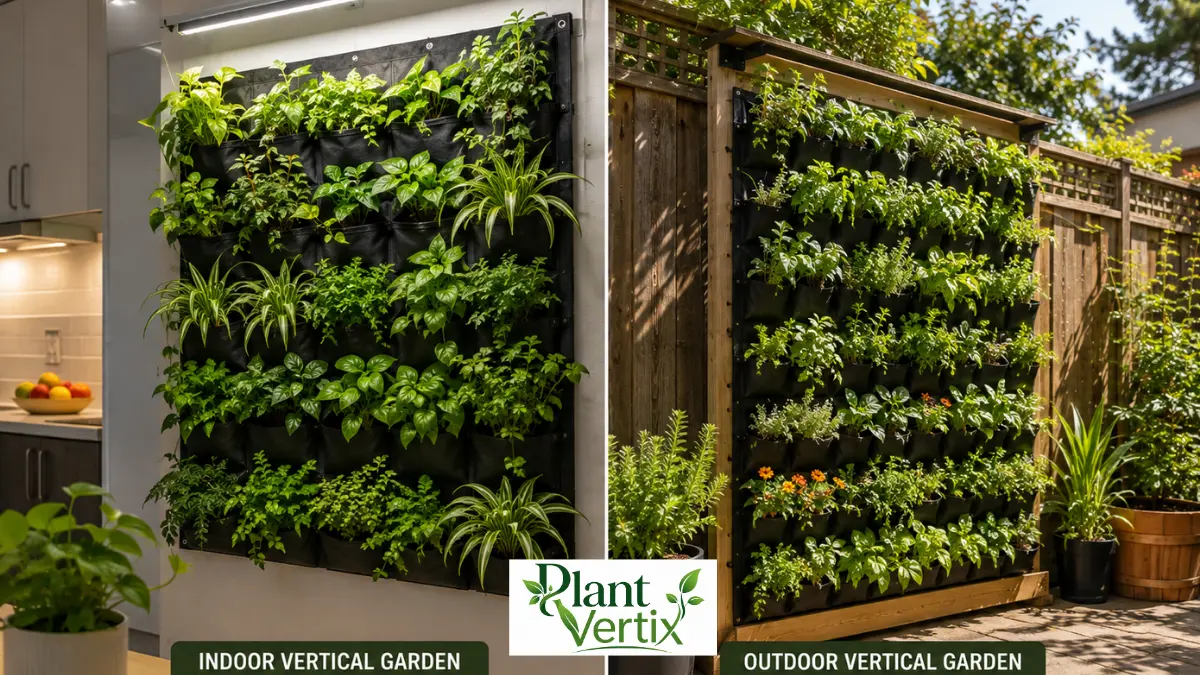
Most of a vertical garden is identical indoors and outdoors. The structure families are the same, the tier-by-tier watering gradient behaves the same way, and plants still need to be matched to where they sit.
Five decisions genuinely change:
- Where runoff goes,
- What sits between the structure and the wall,
- How the weight is carried in a finished interior,
- How much light does that wall actually have, and
- What materials do in a spot that never fully dries?
Get those five right, and an indoor vertical garden is not harder than an outdoor one. Ignore them, and the failure is not a dead plant; it is a stained wall you did not notice for six months.
The Short Answer: Five Decisions Change, The Rest Carry Over
Outdoors, a vertical garden is an open system. Rain arrives without being asked, excess water leaves through the bottom of the structure and disappears into the ground or a drain, wind dries the surfaces, and if a small amount of water runs down a masonry wall, nobody is harmed.
Indoors, it has to be a closed system. Nothing arrives that you did not bring, and nothing leaves except where you decided it would. That single shift is the parent of four of the five decisions below.
The fifth, light, is different in kind: it is not about containment, it is about the fact that an interior wall may simply not have enough daylight for what you want to grow there.
Decision 1: Where The Water Goes When It Leaves The Growing Medium
Outdoors, this is barely a decision. Indoors, it is the decision, and it has to be made before you choose a structure, because it rules some structures out.
Every drop you pour in either stays in the growing medium, evaporates, or leaves. The part that leaves has to arrive somewhere you chose in advance. There are three common answers, and each has a failure mode worth knowing.
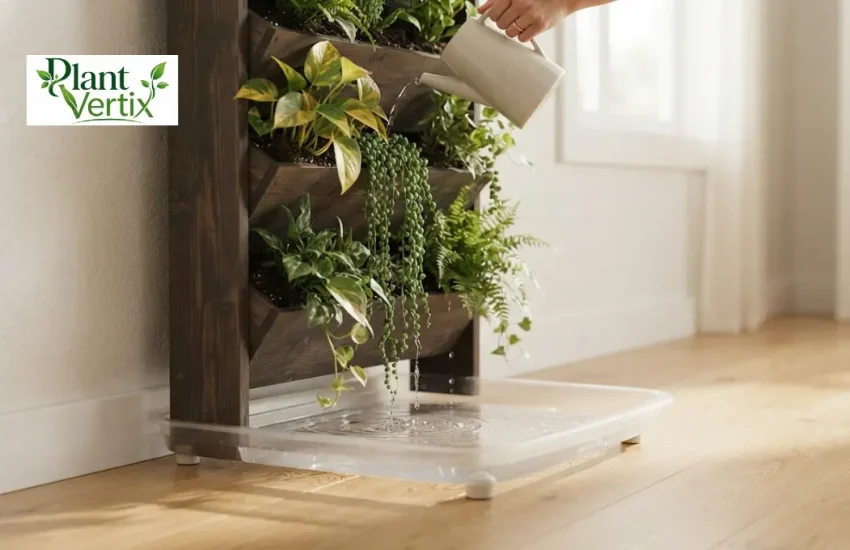
A catch tray or gutter at the base. Simple, visible, and the easiest to check. Its failure mode is capacity: on the day you overwater, or the day a pocket clogs and channels water faster than expected, the tray is what stands between the water and your floor. Size it for a bad day, not a normal one.
Rear-draining planters plumbed to a drain line. This is what purpose-built indoor living wall systems do, and it is the most reliable answer for a large installation. Its failure mode is that the plumbing is behind the panel, so a slow leak is invisible until the wall tells you.
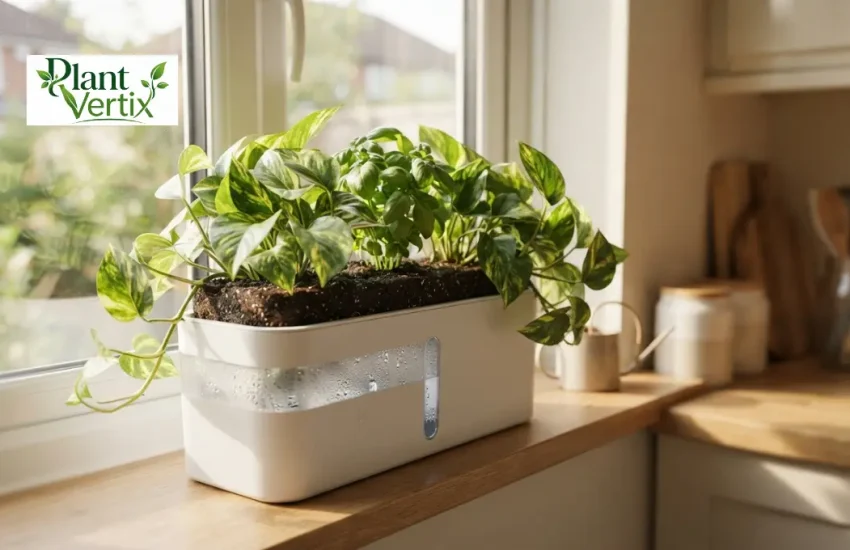
Sealed reservoirs with no drainage at all. Many wall planters designed for both uses ship with removable drainage plugs: out for outdoor use so rain can escape, in for indoor use so nothing reaches your floor. Plugged, they hold water rather than shedding it. The failure mode is overfilling, and the second failure mode is root rot, because a plugged planter gives roots no escape from standing water.
Whichever you choose, write down the answer to the question “on the day this overflows, where does the water go?” If you cannot answer it, the design is not finished. The tier-by-tier watering routine that keeps you well away from that day is in how to water a vertical garden.
Decision 2: What Goes Between The Structure And The Wall
Outdoors, a planted panel against masonry is usually tolerable, and where it is not, weather and airflow buy you time.
Indoors, a finished wall is painted plaster, drywall, wallpaper, or paneling, and none of those is designed to sit against something that is damp on a weekly schedule for years. The mounted structure needs a barrier and, wherever the structure allows, an air gap.
The barrier is a waterproof layer that stops moisture from reaching the wall finish. The air gap is a small standoff so air can move behind the structure rather than sitting still against the surface. The gap matters more than people expect: still, humid air trapped against a cool wall is a far more common cause of trouble than dripping water is, and it is the version nobody sees until it has been happening for a long time.
This site does not diagnose damp or mold in a building. If a wall behind a planted structure shows staining, softening, a persistent musty smell, or any change in the finish, that is a building question, and it belongs with a qualified professional or your building management, not with a gardening article.
Decision 3: Where The Weight Is Carried, And Who You Have To Ask
An interior wall is a finished surface with a structure behind it that you cannot see. Outdoors, you are often fixing into masonry, timber posts, or a railing whose construction is visible. Indoors, what is behind the plasterboard decides everything, and looking at the wall tells you almost nothing.
There is no number this site can give you here, and that is deliberate. We publish no safe-load figures, no anchor ratings and no wall capacity numbers. The reason is specific rather than cautious: a rating printed on a fixing package describes a dry, static load in a tested material.
A planted structure is neither dry nor static. Its weight rises every time you water it, it holds moisture against the fixing for years, and it grows. No manufacturer rates hardware for that, so extending a package figure to a watered structure would be inventing a number rather than citing one.
What you can do is establish what you are working with and then ask the right person. Find out what the wall is built from. Find out whether there is framing behind it and where.
If the structure is anything more than a couple of light pots, treat “will this hold” as a question for a qualified professional or your building management, and ask it before anything is mounted rather than after. If you rent, ask before you drill, because the answer sometimes changes the whole plan.
If fixing into the wall turns out to be off the table, that is not the end of the project. Floor-supported towers, tiered shelves, and freestanding frames put the entire load on the floor, and they are covered in vertical garden systems compared.
Decision 4: The Light Your Wall Actually Has
Outdoors, the light question is mostly about how much direct sun a wall gets and when. Indoors, it is about whether there is usable daylight at all.
Two things are worth knowing before you commit.
Light falls away from a window much faster than it looks like it does. A wall that seems bright to you may be receiving a small fraction of what a plant three feet from the window is getting. Your eye adjusts. Plants do not.
A vertical structure shades itself, and indoors, that compounds. If the daylight arrives from one side rather than from overhead, upper tiers and the tiers nearest the window take most of it, and the rest of the frame lives in a much dimmer gradient.
So the honest indoor answer has three branches. If the wall has genuine daylight, plant into the gradient and choose species accordingly. If the wall is dim, pick plants that tolerate low light and accept slower growth. If the wall has effectively no daylight, this is a lighting problem before it is a gardening problem, and the answer is supplemental lighting.
This site covers what the structure does to the light that already exists. It does not give grow light recommendations, distances, spectrums or run times. Those are separate and genuinely technical subject and they deserve a proper source rather than a paragraph here.
For how to read a wall’s light before you build on it, see choosing where to put a vertical garden.
Decision 5: Materials, And What A Permanently Damp Structure Does Indoors
Outdoors, materials get chosen for weather: rot resistance, UV stability, and rust. Indoors, the enemy changes. There is no rain and no sun, but there is also very little drying.
Untreated timber that would dry out between showers outdoors may stay damp indefinitely behind an indoor panel. Fabric pockets that stiffen and dry in outdoor air can stay permanently moist against an interior wall. Steel that would be fine on a shaded patio can develop rust marks that transfer onto a painted surface.
Two practical consequences. First, prefer materials that are indifferent to constant moisture rather than materials that merely survive weather. Second, build so that you can take the structure off the wall and look behind it. An indoor installation you cannot inspect is one you will not inspect.
What Carries Over Unchanged
It is worth saying what does not change, because the SERP tends to make indoor growing sound like a different discipline.
The three structural families are the same: floor-supported, surface-mounted, and suspended. The watering gradient is the same, with the top drying first and the bottom staying wettest.
The relationship between tier position and plant choice is the same, and is set out in best plants for vertical gardening by tier. The rule that weight rises when you water is the same. And the build order is the same: establish where the load goes, then the surface, then the structure, then the plants, exactly as in how to build a vertical garden for a small space.
If you have already decided that the structure is going on an interior wall, the detailed version of that build is in a vertical garden on an interior wall.
Frequently Asked Questions
Can you put a vertical garden on an interior wall without damaging it?
Yes, with a moisture barrier, an air gap where the structure allows one, a defined catch point for runoff, and the ability to remove the structure and inspect behind it. The damage cases almost always trace back to a missing barrier or a leak nobody could see.
Do indoor vertical gardens need a grow light?
It depends entirely on how much daylight the wall receives. A wall with genuine daylight can support plants chosen for that light level. A wall with effectively none needs supplemental lighting, which is a separate subject from structure design and is worth researching properly.
Are indoor vertical gardens harder to keep alive?
They are less forgiving rather than harder. Outdoors, rain, wind, and drainage cover for a lot of small mistakes. Indoors, nothing does, so the routine has to be deliberate.
Can the same structure be used indoors and outdoors?
Sometimes, many planters are sold for both with removable drainage plugs for exactly that reason. Check three things before moving one indoors: whether it can be sealed or drained to a catch point, whether its material will stay wet without deteriorating, and whether you can mount it with a barrier behind it.