Vertical Garden on a Fence: What Holds
A fence will carry a vertical garden if the load goes to the posts rather than to the panels, if the planting stays open enough that the fence does not turn into a sail, and if the fence is in good enough condition to be carrying anything at all. Almost every guide on this topic screws planters straight onto the panel, which is the one part of a fence specifically not designed to hold weight.
A panel is an infill spanning between posts. The posts and their footings are the structure. Get that one thing right, and most fence installations become straightforward; get it wrong, and the failure shows up as a bowed panel, a leaning post, or a section down after the first serious wind.
The Short Answer: Attach to the Posts, Keep it Light, Keep it Open
Three principles cover most of this topic.
Send the load to the posts. Either fix directly to a post, or span a horizontal rail or batten between two posts and hang everything from that. The rail spreads the load into the two posts rather than into the panel between them.
Keep it light. A fence is a boundary marker that resists wind. It is not a wall, and it does not have a wall’s reserves. Vining plants on a trellis weigh a fraction of what filled planting pockets weigh, and on a fence, that difference is the difference between a fine installation and a marginal one.
Keep it open. This is the one nobody mentions, and it matters more than the fixings do. See the next section.
Why a Fence Panel is the Wrong Thing to Hang Weight on
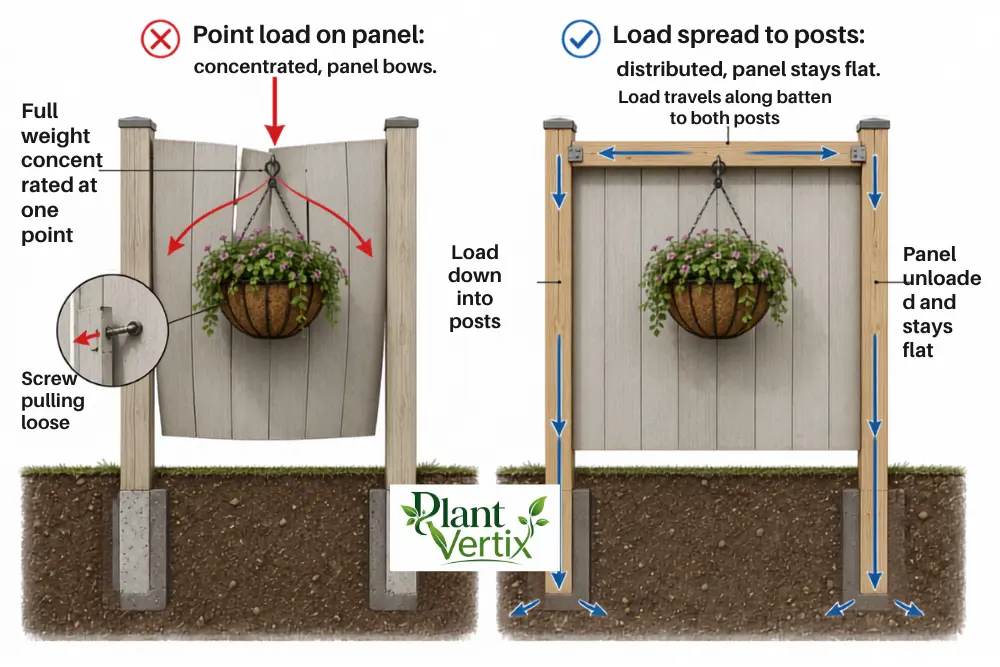
Look at how a fence is actually built. Posts go into the ground, usually set in concrete or driven, and they carry everything. Between them sits infill: featherboard, closeboard, lap panels, slats, mesh, or vinyl inserts. That infill is designed to fill a gap, resist wind pressure spread across its whole face, and stay light enough that the posts can hold it up.
Hanging a planter on that infill does three unhelpful things at once. It applies a concentrated point load to a thin member that was designed for distributed pressure. It applies that load in the direction the panel is least braced against, which is straight down and outward. And it does it continuously, so the panel creeps and bows over months rather than failing visibly on day one.
There is a fourth problem specific to growing: the load is not constant. A planter’s weight rises every time you water it and falls as it dries, so the panel is being cycled rather than simply loaded. Fixings loosen under cycling loads in a way they do not under static ones.
This site publishes no fence load rating, post spacing figure, wind rating, or anchor capacity, and that is deliberate. Fence construction varies enormously by region, age, material and installer, and no article can know how yours was built or how the posts were set. What a fixing package prints is a rating for a dry, static load in a tested material, and a watered planting structure is neither. If you are planning anything substantial, or if the fence is tall or exposed, the load question belongs with a qualified professional rather than with a gardening article.
The Sail Effect: What a Planted Fence Does in Wind
This is the most useful thing to know about growing on a fence, and it is missing from almost every article on the subject.
A fence resists wind. How much wind load reaches the posts depends on how much air the fence lets through. An open slatted or spaced fence lets a great deal through, and the posts see relatively little. A solid panel fence blocks air, and the posts see much more, which is exactly why solid fences fail in storms more often than open ones.
Now cover that fence with planted panels, filled pockets and dense foliage. You have not just added weight. You have made the fence more solid, which increases the wind load its posts and footings have to resist, in a structure that may already have been near its comfortable limit.
Three practical consequences.
Prefer open structures on a fence. Trellis, wire, mesh and spaced planters let air through. Continuous pocket panels and solid backboards do not.
Be especially careful when covering an already-solid fence. A closeboard fence is already blocking most of the air. Adding dense planting to it increases the load without any offsetting benefit in permeability.
Remember, the plants grow. A trellis that is open in May can be a solid green wall by August. Vining plants on a fence are the classic version of a structure whose wind profile changes across the season, and the first autumn gale is when that gets tested.
Fence Type by Fence Type: Where the Load Can Actually Go
Timber post and panel. The commonest arrangement is the one most guides get wrong. Fix to the posts, or span a rail between two posts and hang from the rail. Check the posts before anything: push firmly at the top of each one and look at the base where it meets the ground or the concrete, which is where timber posts rot.
Post and rail with slat or board infill. The horizontal rails are structural members running post to post and are a better target than the boards. Confirm what the rails are fixed to before loading them.
Chain link. Surprisingly capable in tension and useless in bending. Chain link handles light planters hung along its top rail or clipped across its mesh, and it is genuinely good for climbing plants because it is a ready-made trellis. Keep loads light and distributed rather than concentrated at one point.
Vinyl and composite panel systems. Frequently hollow, and often designed so that panels slot into posts without fixings. Do not screw into a hollow vinyl section and assume it holds. Follow the system’s own guidance, and if there is none, treat the posts as the only target.
Masonry boundary walls. Not a fence at all, structurally. A garden wall is a real wall and can usually carry considerably more than a fence, but its condition varies wildly, and freestanding garden walls are often thinner and less well founded than the walls of a building. Check the mortar joints, look for leaning, and treat any wall that is not plumb as a professional question rather than a mounting surface.
Exterior house walls. A different problem again, and generally the strongest option available outdoors. What matters is what the wall is built from, whether there is a cavity, and whether the outer skin is structural or cladding hanging on something else. Fixing a planted structure to cladding rather than to the structure behind it is a common and serious mistake. The full siting process involves choosing where to put a vertical garden.
Keeping the Fence Itself Alive Underneath
A planted structure changes the microclimate of the surface behind it, and a fence is more vulnerable to that than a wall.
Moisture. Timber that stays wet rots. A fence panel behind a watered planter has a permanently damp patch on it, and the damage happens quietly over seasons.
Airflow. Standing the structure off the fence rather than flush against it lets the fence dry between waterings. This is the single most effective thing you can do for the fence’s lifespan.
Staining. Runoff carrying growing medium marks timber, vinyl and painted surfaces, and on a boundary fence, the mark may be visible from the other side.
Access for maintenance. Fences need treating, repairing and eventually replacing. A permanently fixed planted structure across a fence panel means the panel underneath will not get treated, and when it does need replacing, the whole installation comes off first. Build it so it can be removed.
Is This Fence Even Yours?
Almost no article on this topic mentions it, and it causes real disputes.
Boundary fences are frequently owned by one neighbor, jointly owned, or subject to a maintenance obligation recorded in property documents. Which side of it you live on does not settle the question. Attaching a permanent structure to a fence you do not own, adding load to it, or causing staining or rot on the far side can all become a neighbour’s problem and then yours.
Two straightforward positions that avoid all of it. If the fence is clearly yours, proceed on the structural merits. If it is not clearly yours, either ask or use a freestanding structure that stands in front of the fence and touches nothing. A freestanding trellis or tiered frame gives you the same growing space with no ownership question at all, and the options are compared in vertical garden systems compared.
What to Do Instead if the Fence Cannot Take It
A fence that fails the checks above is not the end of the plan.
Stand a freestanding trellis or frame in front of it. The fence becomes a backdrop rather than a structure, and the load goes to the ground.
Use one heavy pot and a tall frame. A single well-sized container with a braced trellis carries vining crops with almost no load on the boundary at all. The crops that suit this are for vertical vegetable gardening in small spaces.
Repair the fence first. Resetting a loose post or replacing a rotten one is often a short job, and it turns a no into a yes.
Move to a wall. An exterior house wall is usually a far better structural proposition than any fence, subject to the identification and permission steps in the siting guide.
Whatever you choose, the build order is the same as everywhere else on this site: settle the load path first, then the surface, then the structure, then the plants. That sequence is set out in full in how to build a vertical garden for a small space, and the watering routine that follows is in how to water a vertical garden.
Frequently Asked Questions
Can a fence hold a vertical garden?
Many can, if the load goes into the posts rather than the panels, the planting stays light and open, and the posts and footings are sound. A fence in poor condition, or one already struggling with wind, is not a candidate.
Will planters rot a wooden fence?
They can, by holding moisture against the timber. Standing the structure off the fence so air can move behind it, and being able to remove it for inspection and treatment, prevents most of it.
Can I hang planters on my neighbour’s side of the fence?
Not without asking. Fence ownership is a property question rather than a gardening one, and adding load, moisture or staining to a fence that is not yours creates a dispute you do not need. A freestanding frame in front of the fence avoids the issue entirely.
What is the lightest way to grow on a fence?
Climbing plants on an open trellis or mesh, rooted in a container on the ground. The fence carries the plant rather than the growing medium, which is a small fraction of the load a filled pocket panel puts on it.
Does a planted fence catch more wind?
Yes. Dense planting makes a fence less permeable to air, so its posts and footings resist more wind load than they did bare. Open structures and open planting reduce that effect, and it is worth reviewing before the windy season rather than after.