
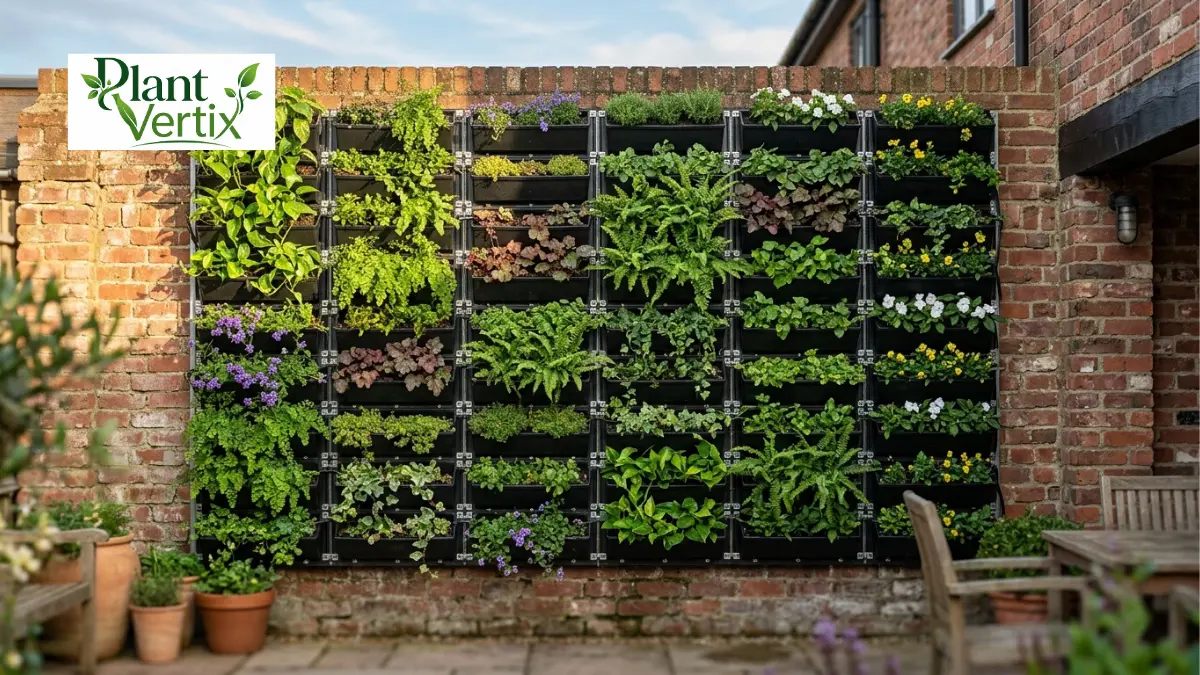
Modular Vertical Garden Panels: When Rigid Wins
Rigid modular vertical garden panels are worth their extra cost for two reasons, and neither is the one they are sold on. The first is the load path: a rigid panel spreads its weight across a frame and into fixings distributed over the wall, instead of hanging everything off a top edge the way a fabric sheet does.
The second is serviceability: when one plant dies in year two, you pull one module, replant it, and put it back, without taking the wall apart. Everything else the marketing emphasizes, the tidy look, the integrated irrigation, the “expandable to any size” claim, is real but secondary. If you want a wall that still looks intentional after three years, buy for the load path and the replaceable unit.
What Modular Vertical Garden Panels Actually Are
The category covers several genuinely different builds that are all sold under the same phrase.
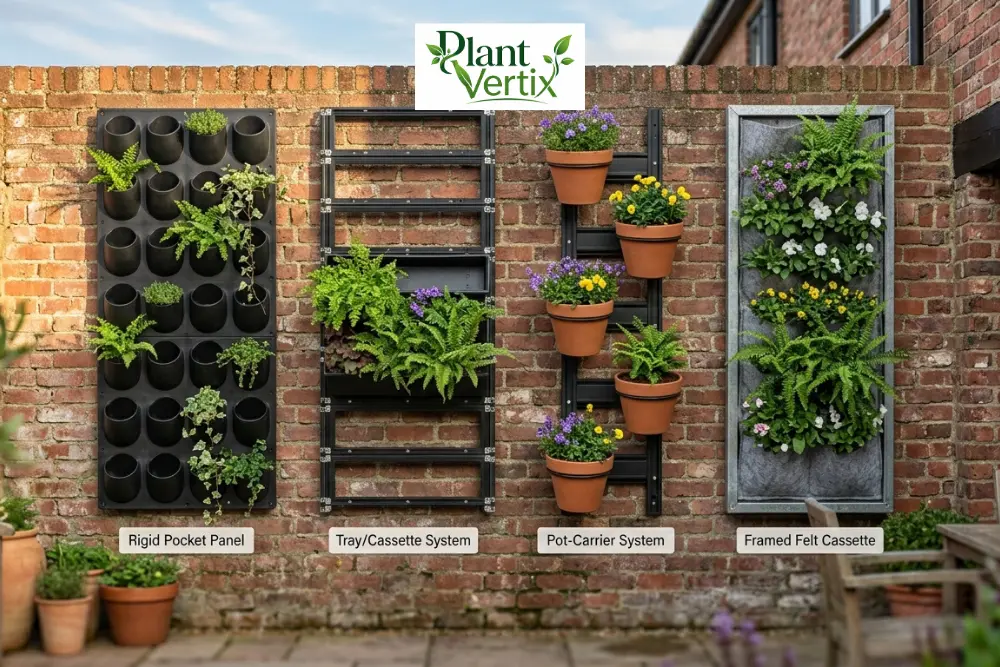
Rigid pocket panels. A molded or formed panel with fixed planting cavities, mounted flat to a wall or to a supporting rail, usually stacked in a grid to make a larger wall.
Tray or cassette systems. A structural backing rail or frame is fixed to the wall, and individual planting trays clip, hook or slide into it. The trays come out. This is the type that serves well.
Pot-carrier systems. A bracket or rail carries individual pots. The pots are ordinary containers; the modularity lives in the mounting hardware, and you can change pot sizes as you go.
Framed felt cassettes. A rigid frame containing a felt or fiber growing layer, so you get fabric’s rooting behavior in a unit that mounts and demounts like a panel.
These behave differently enough that “modular panels” as a single recommendation is not useful. What is useful is a short list of properties to test each one against, which is the rest of this article. We do not recommend products, name brands, or carry affiliate links here.
Why The Load Path is the Real Argument for Rigid
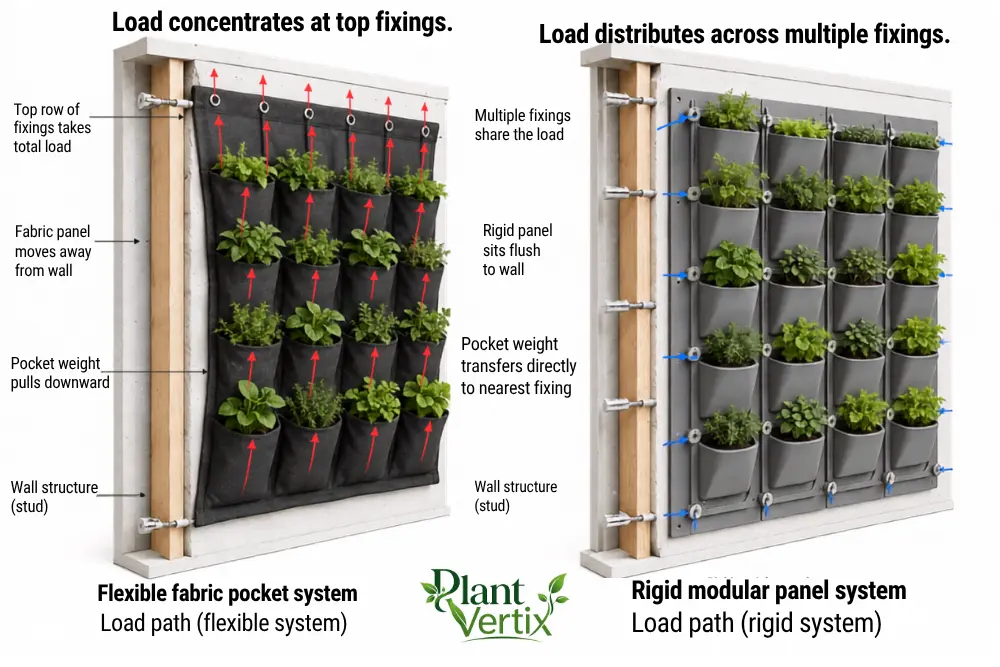
A fabric panel is a flexible sheet. Every filled pocket transmits its weight upward through the material to the fixings at the top edge, so the top row of fixings carries the whole system and the sheet stretches under permanent load.
A rigid panel does not work that way. The panel or its frame is a structural member, and it can be fixed at multiple points spread across its height and width. The load from a pocket near the bottom goes into the nearest fixings rather than traveling to the top of the wall. That is a straightforwardly better arrangement, and it is why rigid systems scale to larger walls while fabric panels tend to stop at one sheet.
Two things follow that the product pages tend to skip.
A rigid panel needs a flat plane to sit against. Fabric drapes over an uneven wall. A rigid panel will rock, bear on two high spots, or refuse to sit flush. Old masonry, textured render and lapped siding are all surfaces where you will end up fixing battens first to create a flat plane, which is extra work and extra fixings.
The fixings are still the whole question. A better load path does not make a wall stronger. The fixing is only as strong as the material it goes into, and plain drywall or plasterboard will not hold a saturated planted panel, regardless of how well the panel distributes weight internally. In a stud wall, the load goes into the studs. In masonry, it goes into an anchor matched to that masonry. If the wall is rendered, has an unverified cavity, or is a rented or managed property, that is a professional’s question.
This site publishes no safe-load figures, anchor ratings, or wall capacity numbers, and that is deliberate. No manufacturer rates a fixing for an irrigated load that gets heavier every week for years, so extending a printed static rating to a planted wall is guesswork with a heavy object involved. Weigh your own filled, drained module on a bathroom scale, multiply by the number of modules, add the frame, and take that measured number to the fixing manufacturer’s own guidance for your specific wall type. If the wall is above a walkway, a seating area, or anywhere a child or a pet plays, get a qualified professional to specify the fixings. Choosing where to put a vertical garden involves identifying your wall before you commit.
The Serviceability Test, and Why It Predicts Survival
Here is the question that separates a living wall that lasts from one that becomes an eyesore, and almost nothing in the search results asks it.
Can you remove and replace one planting unit from the front without unmounting anything else?

Think about what actually happens to a planted wall. It does not fail all at once. One plant dies in a shaded corner. One pocket stays too wet and its occupant rots. One position turns out to be in the path of a downpipe. A wall with twelve plants will have two or three problem positions within the first year, and that is normal rather than a sign you did anything wrong.
If the system lets you lift out that one tray, replant it on a table, and slot it back, you fix the wall in ten minutes and it looks intentional again. If the panel is a single molded sheet planted in situ, you are working at height, at arm’s length, with a trowel, trying not to spill medium down the face of the wall and into whatever is below. Most people do it once and then stop, and the wall degrades from there.
That is why tray and cassette systems are, in our view, the most defensible version of this category. You are paying for maintenance access, and maintenance access is what a planted wall runs out of first.
The Costs of Going Rigid That Nobody Lists
Weight, empty. A rigid panel weighs meaningfully more before you add any growing medium than an equivalent area of fabric does. Some of the load-path advantage is spent on carrying the system itself.
Water channeling at module joints. In a single fabric sheet, water wicks continuously downward. In a grid of separate modules, every joint is a place where water can run out of the front face rather than pass to the unit below. Systems that advertise “water cascades from tier to tier” are describing a design intention, not a guarantee, and how well it works depends on the level of installation and on the medium staying evenly packed. Expect to water positions individually until you have watched the wall behave for a full season. Watering a vertical garden covers the general version of this problem.
Proprietary parts. This is the quiet long-term risk. A modular system is only modular while its modules are still sold. If a manufacturer discontinues a line, you cannot buy a replacement tray, and one broken unit can leave a permanent gap in a wall you cannot patch with anything else. Systems built around standard pot sizes are far less exposed to this than systems built around a unique tray profile.
Rigid plastics age. Ultraviolet light embrittles plastics outdoors. A panel that has gone chalky or that cracks when flexed has lost strength while still holding a wet load off a wall. How fast this happens depends on the material, whether it is UV-stabilized, and your climate, so nobody can honestly quote a lifespan. Inspect rather than assume.
Installation is less forgiving. A fabric panel that hangs a little crooked still works. A rigid grid that is out of level is visible forever, and if the system relies on gravity irrigation, out of level also means uneven watering.
How to Judge a Modular System in Front of You
| What to check | The good answer | Why it matters |
|---|---|---|
| Can one unit be removed from the front, planted, and replaced? | Yes, by hand, without tools | Determines whether the wall gets maintained at all |
| How many fixing points, and where? | Multiple points spread over the panel’s height and width | This is the whole structural argument for rigid |
| Does it need a flat plane? | Stated honestly, with a batten or rail option provided | Decides how much extra work your wall needs |
| Is there a designed air gap behind it? | Yes, built into the mounting, not left to you | Moisture held against a wall is how paint and timber fail |
| Growing depth per unit | Stated in dimensions, not as “generous” | Depth is the drought buffer and the root run |
| Drainage route | A defined path to a tray, a drain, or the ground | Indoors this is not optional |
| Are the parts standard or proprietary? | Standard pot sizes, or a manufacturer with a long track record | Determines whether you can repair it in five years |
| UV stabilization | Stated explicitly for outdoor use | Otherwise the wall has an undisclosed clock on it |
| Irrigation | Optional and retrofittable, not baked in | You may not want a pump, and a pump changes the electrical picture |
If a system comes with a pump or a powered timer, note that any powered component near a wet growing wall belongs on an outdoor-rated circuit with residual current protection: a GFCI outlet or breaker in North America, an RCD elsewhere. If you do not have one, that is an electrician’s job, not an extension lead through a window.
When Rigid is the Wrong Answer
Rigid is not automatically the upgrade. Choose something else if:
- Your wall is uneven, and you do not want to build a batten frame first.
- You rent, or you may move within a season or two. A demountable fabric panel or a freestanding unit leaves far less behind.
- You are still testing the site. Spend little until you know how much sun that wall really gets and how often you will realistically water.
- You want food, mostly. Fruiting and root crops need root depth that most wall modules do not have. A large container with a trellis above it beats a wall of shallow trays for anything other than herbs and greens. Best plants for vertical gardening by tier covers what suits shallow positions.
- You want a large wall, and you have not costed it. Panel systems scale by multiplication, and so does their price. Compare against building a frame yourself before committing.
For a side-by-side view of all the structure types, our neutral comparison of vertical garden systems sets out the criteria without recommending a product, and the full build guide for a small space runs the process in order, load first.
FAQ
Are modular vertical garden panels better than fabric pocket planters?
For a permanent wall, usually yes, for two specific reasons: a rigid panel spreads its load into fixings across the wall instead of concentrating it at a top edge, and a tray-based system lets you replace one failed plant without dismantling anything. Fabric still wins on cost, on weight, on uneven walls, and on how easily it comes down again.
Do modular panel systems need irrigation?
Not necessarily, and treat integrated irrigation as optional rather than as proof of quality. Gravity cascade between modules works best on a perfectly level installation and is worth verifying over a season before you rely on it. If you do add a pump or timer, it needs an outdoor-rated circuit with GFCI or RCD protection.
Can modular panels be mounted on drywall?
Not into plain drywall. A saturated planted panel is a heavy, cycling load, and the fixing is only as strong as the material behind it. In a stud wall, the load has to reach the studs. In masonry, it needs an anchor matched to that masonry. If the wall is rendered, has an unverified cavity, or sits above a walkway or seating area, have a qualified professional specify the fixings.
How long do rigid vertical garden panels last?
Longer than fabric in most conditions, but no honest single figure exists because it depends on the material, on UV stabilization and on your climate. Judge condition rather than age: plastic that has gone chalky or cracks when flexed has lost strength, and it is holding a wet load above the ground.
What is the biggest hidden downside of a modular system?
Proprietary parts. A modular wall is only modular while its modules are still manufactured. If the line is discontinued, you may not be able to replace a single broken tray, and one gap in a grid is permanent. Systems built around standard pot sizes avoid most of that risk.