Where the Runoff Goes: Designing Drainage Before You Plant
There is one sentence underneath this whole subject and everything else follows from it.
Water you pour in either leaves the system or stays in it. There is no third option.
If it leaves, it goes somewhere, and you decide where by designing it or by finding out afterwards. If it stays, the system is heavier and the medium is saturated, and both of those have consequences. Most vertical garden problems are one of those two facts arriving unannounced.
Decide Which System You Are Building
Before anything practical, pick one, because they are different builds and retrofitting from one to the other is difficult.
The through-draining system
Water passes through the medium, out of each container, and away. This is how most planted systems work and it is the more forgiving option, because the medium never has to sit saturated.
The design question is where “away” is, and it has to be answered before the first watering rather than during it.
The closed system
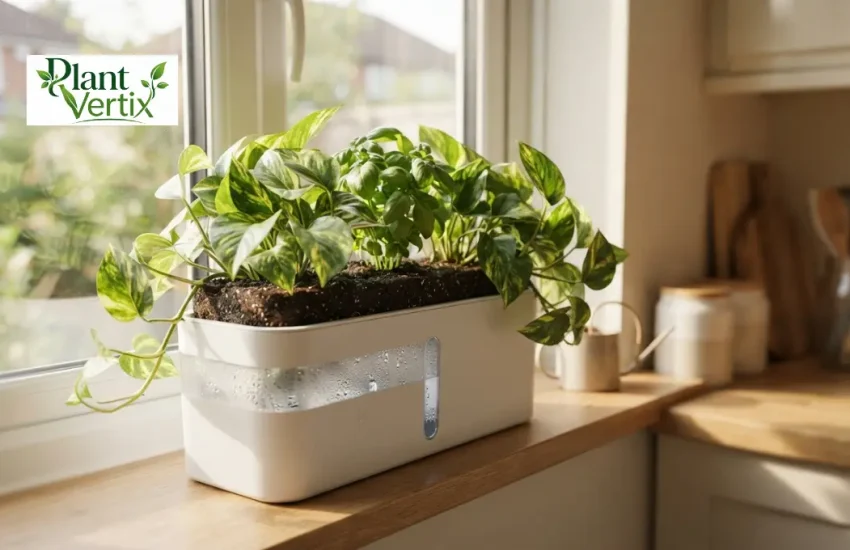
Nothing leaves. Water is applied in a measured amount and held, either in the medium or in a reservoir. Self-watering planters and wicking systems work this way.
Two consequences. You cannot flush the system, so salts from water and fertilizer accumulate over time. And the weight is permanent rather than transient, which matters on a mounted structure and is covered in our article on what a vertical garden actually weighs. A reservoir is the heaviest single component most systems have and it never gets lighter.
Our guide to self-watering vertical planters covers that route in full.
The hybrid, which is where most people end up by accident
Some containers drain and others do not, or the top tiers drain into the bottom ones and the bottom one holds everything. This is the arrangement that produces the classic rotted bottom row, and it is almost never a decision. It is what happens when drainage was not designed.
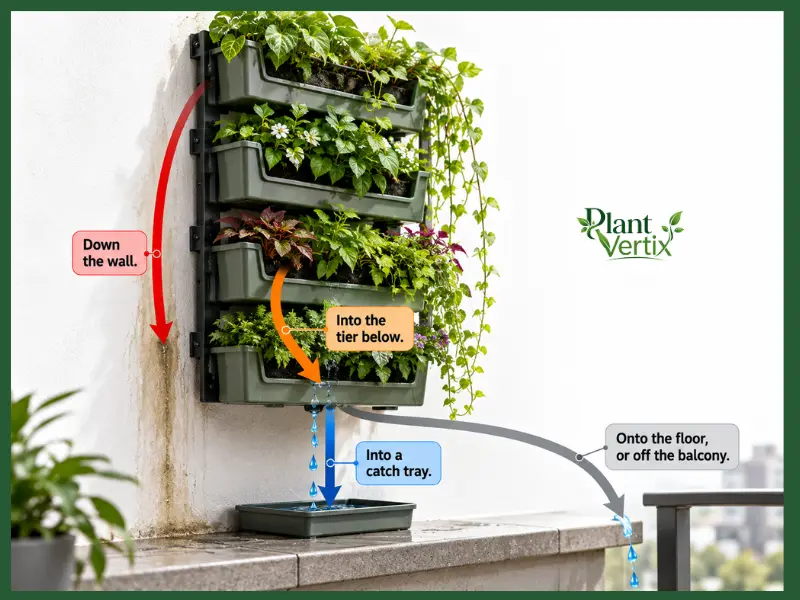
The Four Places Runoff Actually Goes
For a through-draining system, the water goes to one of these, and you should know which before you plant.
Into the tier below
The default in most stacked designs and the one that causes trouble. The bottom row receives its own water plus everything from above, several times per watering, and it never gets a chance to dry.
Our guide to how to water a vertical garden covers the full set of mechanisms behind that pattern, and this one is the most fixable of them.
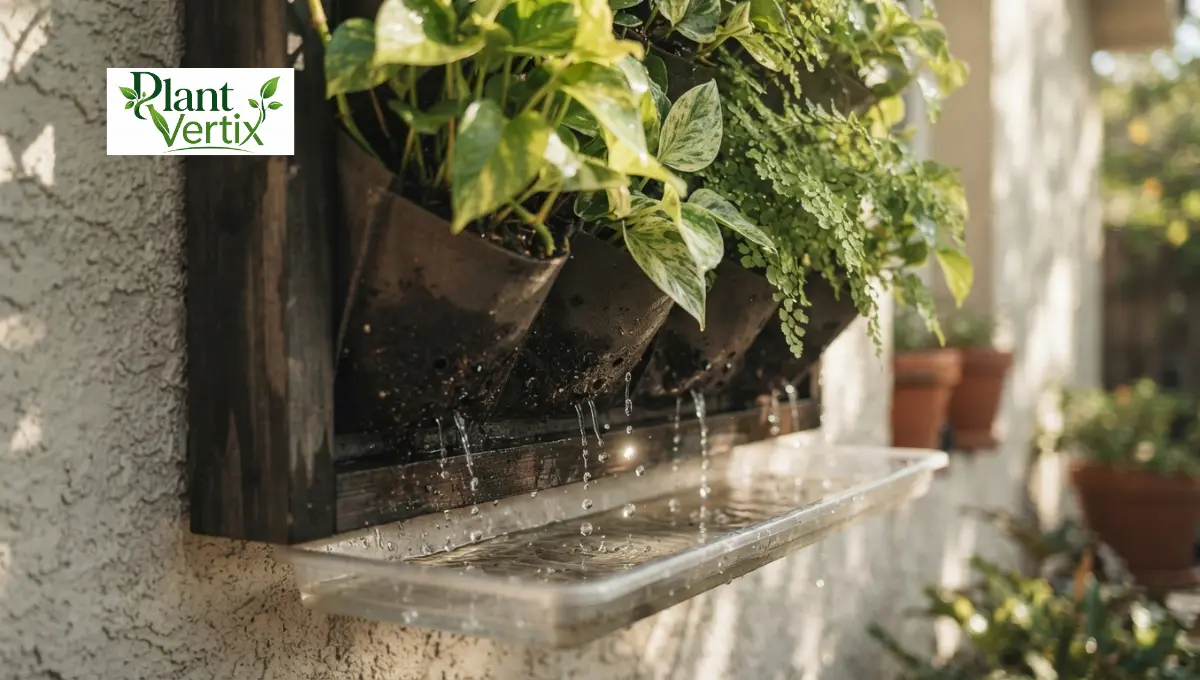
The fix is to interrupt the chain: give each tier its own outlet to a channel or a tray, rather than letting it drain into the next pocket.
Into a catch tray at the bottom
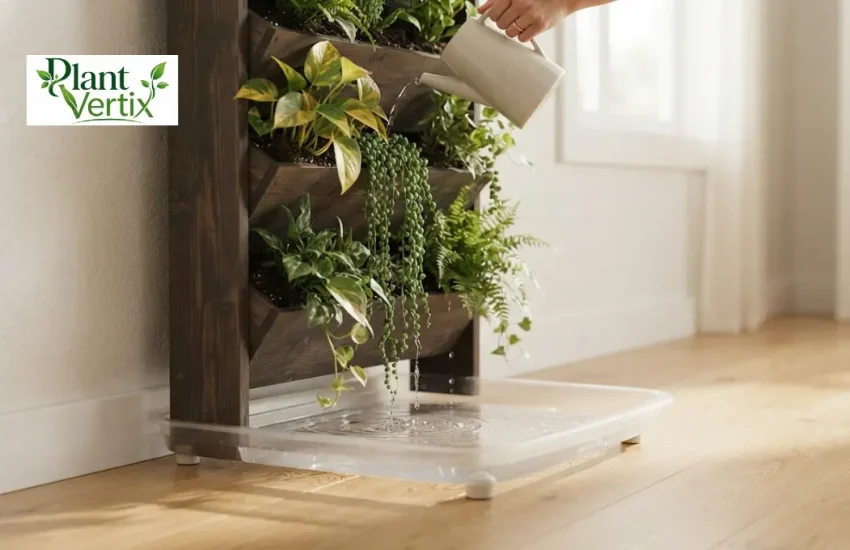
The most common deliberate arrangement, and it works if the tray is large enough and if somebody empties it.
A tray that overflows is worse than no tray, because it concentrates the water in one place on your floor instead of distributing it. And a tray left standing full is a permanent damp source under a structure that already generates humidity.
Down the wall
The failure nobody designs and everybody gets.
Water running down the face of a wall behind a planter causes staining, marks and, over time, damage to the surface. It is the largest single cause of deposit disputes in a rented property and it is entirely preventable. Our article on protecting the wall behind a mounted system covers the barrier and the air gap that stop it.
Onto the floor, and off the balcony
Outdoors this is often fine and sometimes is not. On a balcony, water leaving the edge is a question about the flat below, and that is a subject this site leaves to a sibling rather than answering here. What is worth saying is that it is a question, not a detail, and it is worth settling before you build rather than after a neighbor mentions it.
Design it Before You Plant, in Five Decisions
Each of these is difficult to change once the system is full of wet medium.
1. Does each container have a drainage hole, and do you know where its water exits? A container with no hole is a closed system whether you intended it or not.
2. Is there a route from every tier to the same place? A channel, a gutter, a tray, or a downspout. Anything is better than each tier draining into the one below.
3. Is there a catch point, and can you empty it? A tray you cannot reach is a tray that stays full.
4. Is there a barrier between the system and the wall? Not optional on any mounted system.
5. What happens if you over-water once? Everyone does. If the answer involves a floor covering or a neighbor, add capacity now.
The Measurement That Replaces Guessing
You do not need a formula for this and you can measure it in one watering.
Put a container under the outlet and water the system as you normally would. What collects is your runoff volume, on your system, with your medium, at your usual watering.
That number tells you three things: whether your tray is big enough, whether you are watering far more than the system retains, and whether anything is disappearing somewhere you have not identified.
If much less comes out than went in, the system is holding it. That is either fine, if it is a closed design, or it is the beginning of a saturated bottom tier.
The Medium is Part of The Drainage System
Easy to treat as a separate subject and it is not.
An open, free-draining medium moves water through quickly, which suits the top of a structure and shallow pockets.
A retentive medium holds it, which suits the top of a structure differently and generally suits the bottom badly, because the bottom is already receiving more than its share.
Ordinary garden soil in a shallow vertical pocket is the common mistake: it compacts, it stops draining, and then it neither drains nor holds usefully. Our guide to common vertical garden mistakes covers that among the others.
FAQ
Does every container in a vertical garden need a drainage hole?
It needs either a hole or a deliberate decision to be a closed system, and the trouble comes from having the second by accident. A container with no hole is a closed system whether you intended it or not, which means it cannot be flushed, so salts from water and fertilizer accumulate in it, and the weight it holds is permanent rather than transient. If a container does drain, the question that goes with the hole is where its water exits, and that has to be answered before the first watering rather than during it.
Why is my bottom row always wet when the top row is dry?
Because in most stacked designs each tier drains into the one below, so the bottom row receives its own water plus everything from above, several times per watering, and never gets a chance to dry. That is the arrangement that produces the classic rotted bottom row, and it is almost never a decision: it is what happens when drainage was not designed. The fix is to interrupt the chain by giving each tier its own outlet to a channel or a tray rather than letting it drain into the next pocket.
How big does the catch tray need to be?
This page gives no capacity, because it depends on your medium, your containers and how you water, and any published figure would be describing somebody else’s system. Measure it instead, in one watering: put a container under the outlet and water as you normally would, and what collects is your runoff on your system. That tells you whether your tray is big enough, whether you are applying far more than the system retains, and whether water is going somewhere you have not identified. Bear in mind that a tray that overflows is worse than no tray, because it concentrates the water in one place on your floor, and that a tray you cannot reach is a tray that stays full.
Do I need a barrier between the planter and the wall?
Yes, on any mounted system, and it is not an optional refinement. Water running down the face of a wall behind a planter causes staining, marks and, over time, damage to the surface, and in a rented property it is the largest single cause of deposit disputes. It is also entirely preventable, and the barrier plus an air gap is what prevents it.
Can I use ordinary garden soil in a vertical planter?
It is the common mistake. In a shallow vertical pocket, garden soil compacts and stops draining, and once it has done that it neither drains nor holds water usefully. Match the medium to the position instead: an open, free-draining mix moves water through quickly, which suits shallow pockets and the top of a structure, while a retentive mix generally suits the bottom badly, because the bottom is already receiving more than its share.
The Winter and Holiday Cases, Briefly
Outdoors in winter, a system that drains poorly will hold water that freezes, and a container full of frozen medium is a container under pressure from the inside.
While you are away, an automated system with no drainage plan is an automated flooding system. That is its own subject on this site and the short version is that the drainage question gets harder rather than easier when nobody is watching.
For the planning stage where all of these decisions belong, our vertical garden planning checklist is the place to make them, in the order that means you only make them once.