Vertical Garden Materials List: What You Actually Need
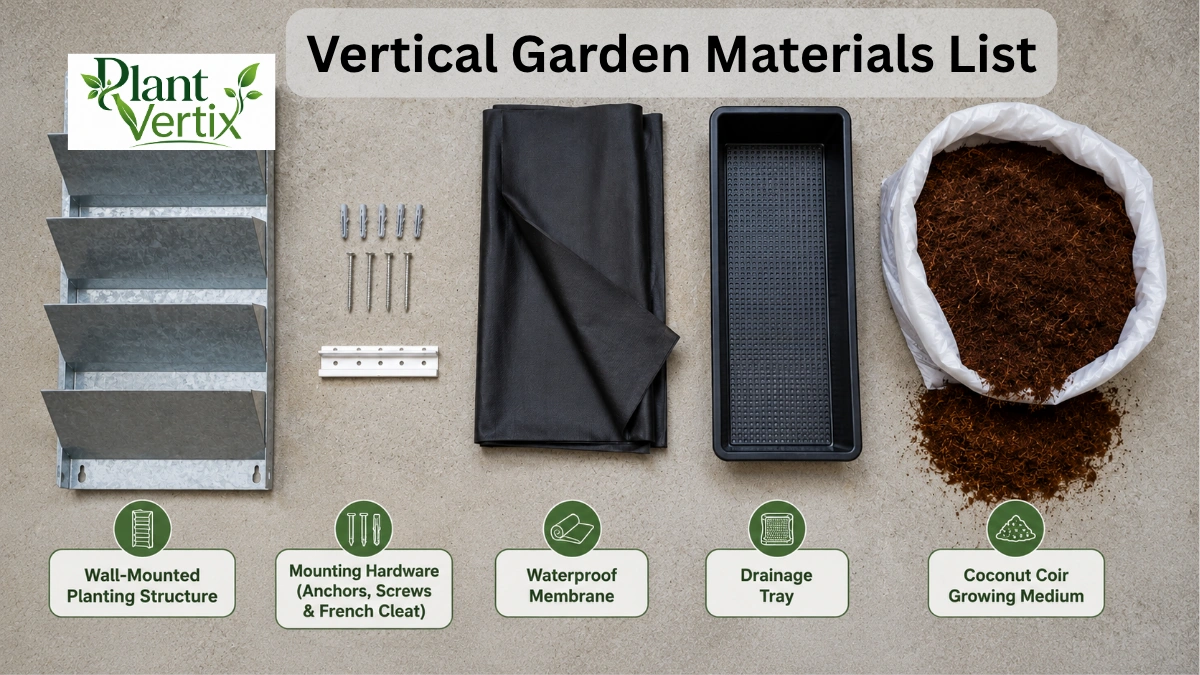
The honest vertical garden materials list has five categories, and only one of them is the planter. You need a growing structure, mounting hardware chosen by your wall type, a barrier that keeps moisture off the wall finish, a catch point for runoff, and a growing medium. Nothing on that list can be bought until you know what the wall is made of, which is why the first item is a diagnosis, not a purchase.
What Every Vertical Garden Materials List Gets Right, and Where They All Stop
I read the pages ranking for this query, and they agree almost word for word. Everyone gives you a frame (pallet, wooden frame, trellis, modular panel), a backing or climbing surface (chicken wire, lattice, plastic netting, landscape fabric), containers (pots, fabric grow bags, planting pockets, cinder block cavities), a growing medium, plants, and a tool list.
That list is not wrong. It is in the wrong order, and it leaves out the parts that decide whether the thing survives.
Most of those pages are affiliate roundups, and the rest are manufacturer supply lists attached to a kit. Both have a reason to open at the object you can buy, so the planter leads, and the hardware, the wall protection and the runoff catch arrive last.
That is backward. The planter is the most substitutable item here.
Item Zero: The Wall Diagnosis That Comes Before Any Purchase
You cannot choose a fastener before you know what you are fastening into. That is why the first line of an honest materials list is a diagnosis, not a purchase, and every ranked page skips it.
Four common cases in a home, each taking different hardware:
- Drywall over wood studs. Hollow across most of the span, solid where the framing runs.
- Plaster over lath, typical of older houses. Brittle, and it cracks rather than accepting a pin.
- Brick or concrete block, sometimes under a plaster skim.
- Wood paneling or a stud partition, with no masonry behind it.
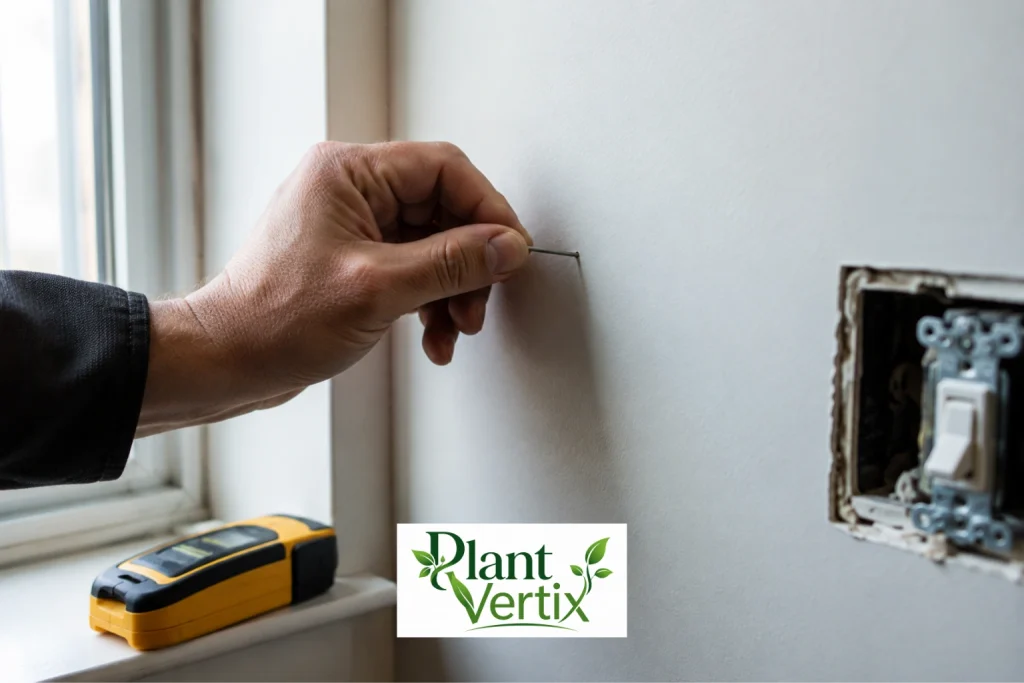
Simple checks tell you most of it. Knock and listen for hollow turning solid. Press a pin somewhere inconspicuous: drywall takes it easily; plaster resists and may craze. A removed switch plate shows the cut edge, and a stud detector maps the framing.
Outdoors, the same question applies to a fence panel, a railing or a stucco wall, and the answer is usually different from the wall inside. More in choosing where to put a vertical garden.
Category 1: The Growing Structure, The Most Visible and Least Critical Choice
This is the part you are being sold, and it has the widest range of acceptable answers.
The structure is whatever holds plants off the ground in a repeatable pattern: a wall panel with planting pockets, a stacking or tiered planter, a freestanding tower, a shelf unit, a trellis with pots hung from it, a reclaimed pallet with fabric backing.
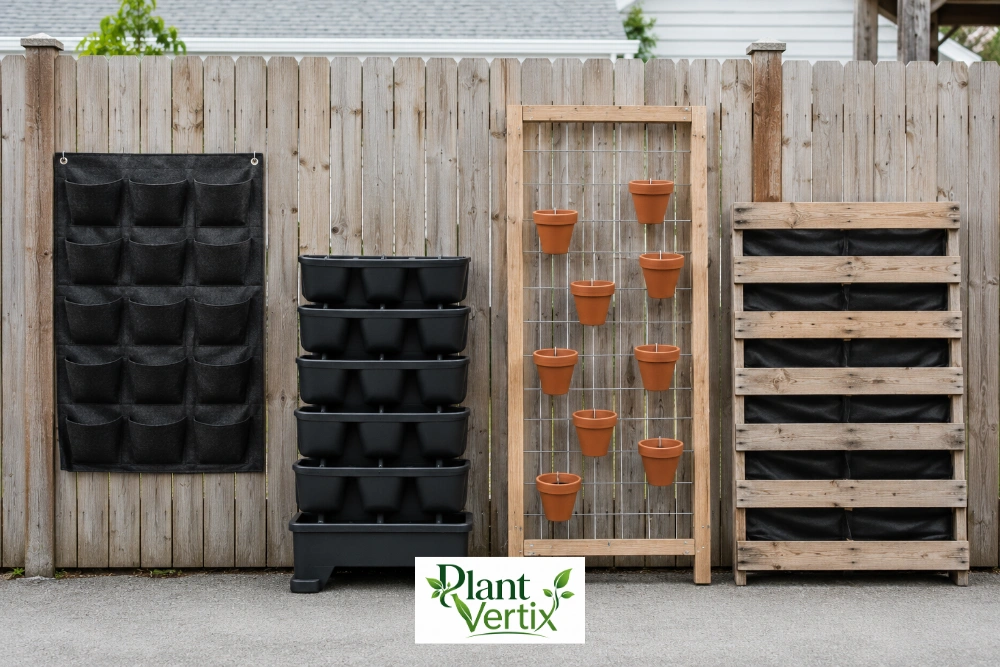
Virginia Cooperative Extension’s trellising publication (HORT-189NP, 2022) names steel T-posts, bamboo, cedar poles and rebar as frame materials, and plastic netting, wood lattice, nylon fencing or woven wire cattle fencing as climbing surfaces. That is a fair picture of how interchangeable this category is.
What matters is not the material name but four criteria: whether it drains or holds water, whether it comes down again for inspection, whether it tolerates staying damp for years, and whether you can reach it all to water.
Category 2: Mounting Hardware, Chosen by the Wall and Never by the Planter
Hardware is selected by what sits behind the surface, not by what hangs on it.
Broadly, screws into wood framing suit drywall walls where you can find the studs. Hollow-wall fixings and toggle-type anchors cover the spans where framing is not where you need it. Masonry anchors and sleeve anchors belong in brick and block. A French cleat or a pair of L-brackets spreads a load across several fixing points instead of one. Outdoors and anywhere damp, corrosion resistance joins the specification, which is why stainless and hot-dip galvanized fixings exist.
This site publishes no safe-load figures, no anchor ratings and no fastener specs, and I would be wary of a gardening blog that does. Ratings describe a dry, static load in a tested material. A planted structure is wet, gains weight on every watering, and keeps growing. The number for your wall comes from the fastener manufacturer’s published specification, a hardware professional, or your building management. If you rent, permission goes to your landlord before anything is drilled.
Category 3: The Barrier, The Item Most People Leave Off
Ask people what they forgot, and it is almost never the planter. It is the layer that protects the wall.
A vertical garden holds a permanently moist object against a finished surface. Paint, plaster, wallpaper and paneling were not designed for that, and neither was a wood fence panel. So the list needs a waterproof barrier between the structure and the wall, sized a little larger than the structure’s footprint, because the wet zone always spreads wider than the thing making it.
It needs a standoff too, a small air gap that lets air move behind the panel. Commercial living wall systems are built in. A pallet leaned against a wall has neither.
The barrier is invisible once installed, which is why no roundup leads with it. It is also the only item here whose absence damages something more expensive than the garden. If a wall behind a planted structure shows staining, a blistered finish or a musty smell, that is a question for a qualified professional.
Categories 4 and 5: The Catch Point and The Growing Medium
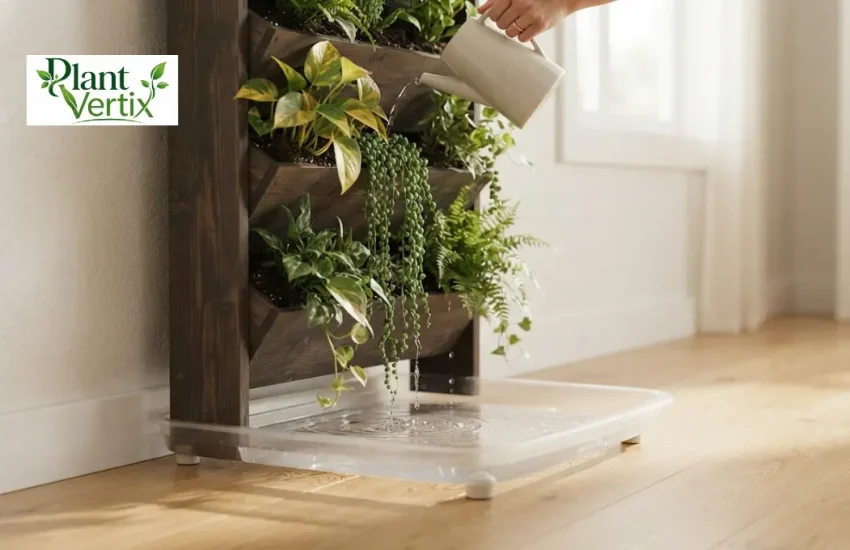
Every watering produces water that leaves the growing medium. Outdoors, it vanishes into the ground. Indoors, on a balcony above a neighbor, or against a shared fence, it has to arrive somewhere you chose. There are three normal answers: a tray or gutter under the lowest tier, rear-draining planters plumbed to a drain line, or sealed planters with the drainage plug fitted, which protect the floor but risk roots sitting in standing water.
Pick one before you buy the structure, because not every structure supports all three. A balcony has its own version, covered in vertical gardening on a balcony.
The medium is a real line item for one reason. It is most of the weight. It has to hold enough water that a shallow pocket does not dry out in a day, and drain freely enough that the lower tiers are not saturated. Bagged potting mix, coconut coir and coir-based blends are the usual categories. What I would avoid is garden soil dug from the yard, which compacts in a container and is heavy before you add a drop.
What You Already Own, and What You Can Leave Off
A useful share of the list is already in the house, which the roundups have no reason to mention. A drill, a screwdriver, a tape measure, a level, a bucket and scissors cover most builds. A climbing surface can be netting, lattice, wire fencing or string, and the Extension publication treats those as equivalents. Containers can be pots you have, food-safe tubs or fabric bags.
Virginia Cooperative Extension states the requirement as a support “strong enough to support the weight of the plant plus fruit,” a criterion rather than a product. That is the right way to read your whole list.
Four things to skip on a first build: an irrigation kit (a failure point on a structure you can already reach), cutting equipment (lumber cut to size is a woodworking project inside a gardening one), a full set of plants on day one, and sealants unless the material needs them where it is going. Indoors and outdoors differ here, and I split those into indoor vs outdoor vertical gardens.
The two categories I would not improvise on are the mounting hardware and the barrier.
The List In The Order It Has to Happen
| Order | Category | What decides it | What does not decide it |
|---|---|---|---|
| 0 | Wall or support diagnosis | Construction behind the surface | The look you want |
| 1 | Mounting hardware | The diagnosis, plus corrosion exposure | The planter you liked |
| 2 | Barrier and air gap | The wall finish being protected | Whether it is visible |
| 3 | Catch point | Where runoff is allowed to go | A structure you already bought |
| 4 | Growing structure | Drainage, removability, reach, durability | Photographs |
| 5 | Growing medium | Water holding versus drainage, and weight | Marketing on the bag |
Read top to bottom; that is the method. The full build sequence is in how to build a vertical garden for a small space, and the outdoor boundary version is putting a vertical garden on a fence.
Frequently Asked Questions
What do you actually need to build a vertical garden?
Five categories: a growing structure, mounting hardware matched to the wall, a moisture barrier, a catch point for runoff, and a growing medium, plus plants. Most published lists treat the middle three as optional.
Do you need special hardware for a vertical garden?
You need hardware matched to your wall construction, which is not the same as specialized garden hardware. Wood framing, drywall, plaster over lath, brick and block each take a different fixing. Confirm yours with the fastener manufacturer’s published specification, a hardware professional, or your building management.
What is the most commonly forgotten item on a vertical garden materials list?
The barrier and air gap protect the wall behind the structure. People plan what holds the plants, not what protects the surface they hang on, and that is the omission that costs the most to fix later.
Can you build a vertical garden without drilling into the wall?
Yes. Freestanding towers, tiered shelf units, trellises braced against a railing, and floor-supported frames put the load on the floor and use the wall only as a backdrop, which removes the fastener question entirely.
Is a pallet a good base for a vertical garden?
It can be, and it is popular because it is free. Judge it like anything else: whether it drains, whether it comes off for inspection, whether the wood tolerates staying damp, and whether a barrier fits behind it.
Source: Settlage, K., Hessler, A., and Andruczyk, M. A., “Vertical Gardening Using Trellises, Stakes, and Cages,” Virginia Cooperative Extension, publication HORT-189NP, December 2022.