Vertical Garden vs Raised Bed: How to Choose
Choose by soil volume, not by square footage. A raised bed gives each plant the most soil and the most root depth, so it is the most forgiving to water and the best home for anything that roots deep. Containers sit in the middle. A vertical garden gives each plant the least soil of the three, which is exactly why it fits where nothing else does, and exactly why it demands the most watering attention. If you have usable ground or floor space and no reason to avoid it, a bed or big containers will be less work. If your growing area is a wall, a railing, or a strip of floor two feet wide, vertical is not the compromise. It is the only method that fits.
That is the whole decision in one paragraph. The rest of this article is how to check it against your own situation, because the trade is real and the popular comparisons keep describing it backward.
What the Usual Comparison Gets Wrong
Search this question, and you get a lot of pages comparing these methods on space efficiency: how many plants per square foot, how tall, how many pockets. Space efficiency is genuinely where vertical wins, and it is not where the decision is actually made.
Here is the thing that decides it. When you go vertical, you are not saving space for free. You are trading soil volume for floor space. A pocket, a tray, or a tower tier holds a small amount of growing medium. That small volume is what makes the system light enough to hang on a wall and compact enough to fit on a balcony. It is also the buffer that keeps a plant alive between waterings, the reservoir the roots draw from, and the thermal mass that stops the root zone from cooking in afternoon sun.
Less soil means all three of those buffers shrink at once. That shows up as watering frequency, and watering frequency is the single biggest predictor of whether a small-space garden is still alive in September.
So the honest framing is not “vertical saves space, beds need space.” It is: how much soil can each plant have, and how often are you willing to water?
Vertical Garden vs Raised Bed vs Containers, Compared on What Matters
| Soil per plant | Root depth available | Watering demand | Where it physically fits | What it costs you | |
|---|---|---|---|---|---|
| Raised bed | Highest | Deepest, and roots can spread sideways into shared soil | Lowest. Large volume dries slowly | Needs a footprint of ground or a solid deck that can take it | Floor space, and it is not moving once built |
| Containers | Medium, and adjustable by pot size | Set by the pot you choose | Medium. Scales directly with pot size | Any flat surface that can carry the pots | Floor space, still, just less of it |
| Vertical system | Lowest | Shallowest, and usually fixed by the system | Highest, often daily in heat | A wall, a railing, a fence, or a narrow strip of floor | Watering attention, and a load that has to go somewhere |
Read that table left to right, and the pattern is obvious: everything vertical gains in footprint; it pays for in soil volume. Nothing here is free.
We do not build or cover raised beds on this site. This comparison exists so you can rule vertical in or out honestly. If the answer turns out to be a bed, that is a good outcome, and you should go and read a bed-specific resource rather than force a wall system to do a bed’s job.
Start With Root Depth, Because it is the Hard Limit
Soil volume is a preference question. Root depth is closer to a physical one, and it is the fastest way to eliminate a method.
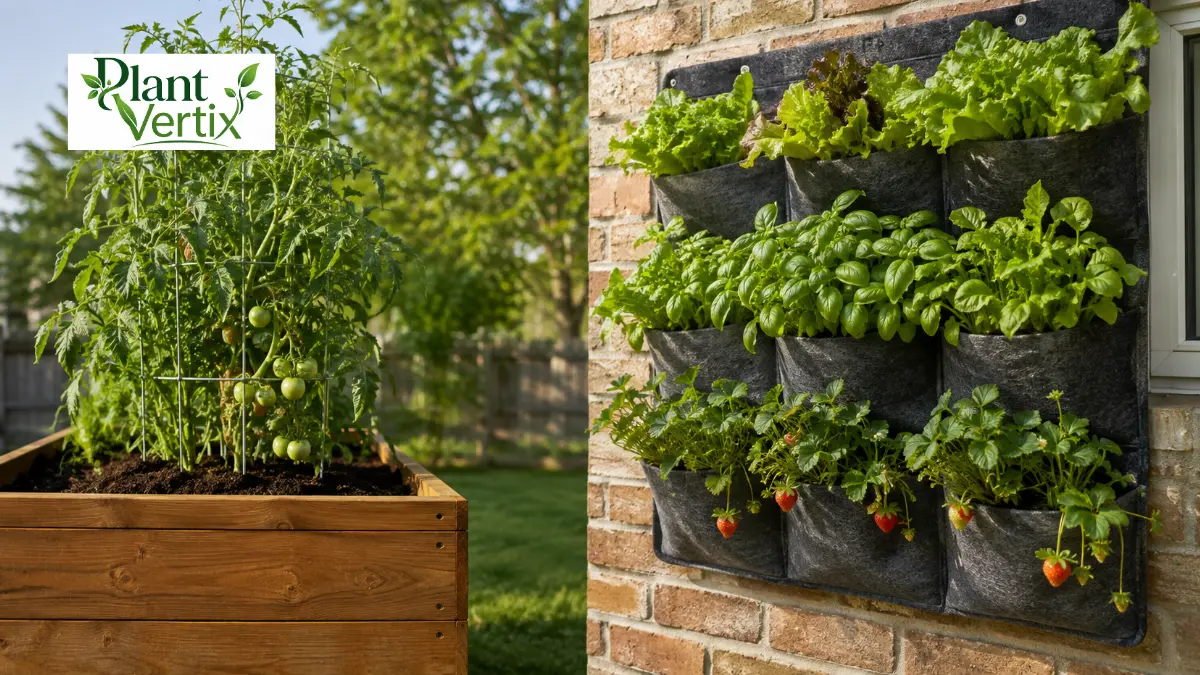
Different crops want different root depths. Shallow-rooted plants such as lettuce, most leafy salad greens, herbs like basil, chives and parsley, strawberries, radishes and many succulents are happy in the modest depths that a pocket, tray or tower tier provides. Deeper-rooted crops are a different conversation: tomatoes, peppers, eggplant, squash, and anything that produces a large fruiting plant want considerably more root run than a shallow pocket offers. Root vegetables that form a long taproot, such as full-size carrots and parsnips, need depth by definition, because the depth is the crop.
You can grow a tomato vertically. People do it, in a large container or a deep tower tier, with a trellis carrying the vine. But you are growing it in a container that happens to be up in the air, not in a pocket. A structure with shallow pockets is a leaf and herb machine, and it is a very good one. Fighting it to produce a deep-rooted crop is the most common way people conclude vertical gardening “does not work.”
There is a middle path that most comparison articles miss entirely, and it is the one we would actually recommend to most readers: use a trellis or climbing frame with the roots in real soil at the bottom. Beans, peas, cucumbers and cordon tomatoes then get full root depth from a bed or a large pot, and the vertical structure only carries the top growth. That is vertical gardening at its most efficient, and it sidesteps the soil-volume problem completely. There is more on that approach in our guide to vertical vegetable gardening in small spaces.
Then check what your surface can carry
This is the step the general comparisons skip, and on this site, it comes second only to sunlight.
A raised bed puts its weight on the ground, spread over a wide area. Nobody worries about it, and usually nobody needs to. Containers put concentrated weight on whatever floor they stand on. A vertical system puts weight somewhere new: on a wall, a railing, a fence, or on a narrow-footed frame that is tall relative to its base. That is a different structural question, and it has a different failure mode. A bed that is too heavy settles. A wall system that is too heavy for its fixings comes off the wall.
Two facts drive the arithmetic and both are worth stating plainly:
- Water is heavy. A US gallon of water weighs about 8.34 pounds, and a liter weighs one kilogram. Growing medium that is holding water weighs substantially more than the same medium dry.
- A planted system is a load that changes. It gets heavier every time you irrigate and lighter as it dries, week in and week out, for years. A picture hook is holding a static load. A planted wall is not.
This site does not publish safe-load figures, anchor ratings, or balcony capacity numbers, and that is deliberate. We are not structural engineers; we cannot see your wall, and a number that is right for one wall is dangerous on another. What we will say is that the fixing is only as strong as the material it goes into, that plain drywall or plasterboard is not a substrate for a loaded planter, and that identifying your wall type is a step you take before you choose a system, not after. If the wall is rendered, if it has a cavity, if you rent, or if anything would be hanging over a walkway, a seating area, or a spot where a child or a pet plays, the answer is to get a qualified professional to look at it. Choosing where to put a vertical garden involves reading a wall before you commit to it.
A decision path you can run in five minutes
Work down this list and stop at the first answer that fits.
1. Is there ground or solid floor you are allowed to use, at least a few feet across, with six or more hours of sun? If yes, and you want to grow fruiting or root crops, a bed or large containers will grow more food for less daily effort. Vertical is optional here, best used as a trellis over the top of it.
2. Do you have floor space but not ground, such as a balcony, deck or patio? Containers plus a freestanding vertical structure is usually the right blend. Nothing touches a wall, nothing needs a landlord’s permission, and you keep soil volume where it matters. The trade moves from wall load to floor load and tipping, which is its own topic.
3. Do you have almost no floor space, or is the only usable surface a wall or railing? This is Vertical’s home ground, and no other method competes. Plan on shallow-rooted plants, plan on frequent watering, and plan the load before you plan the planting.
4. Do you rent, or is drilling out of the question? You are not out of options, but the option set narrows to freestanding frames, tension systems, railing-mounted units and floor-standing towers. That constraint should shape the method choice from the start rather than being discovered halfway through a build.
5. Are you doing this mainly for how it looks? Say so, at least to yourself. A living wall of foliage is a legitimate goal, and it changes the plant list completely: you want reliable evergreen coverage, not a harvest. What vertical gardening actually is covers where the line between decoration and growing sits.
The answer is usually “two of the three”
The comparison format pushes people toward picking a winner. In practice, the small-space gardens that work tend to combine methods, because each one covers a different weakness.
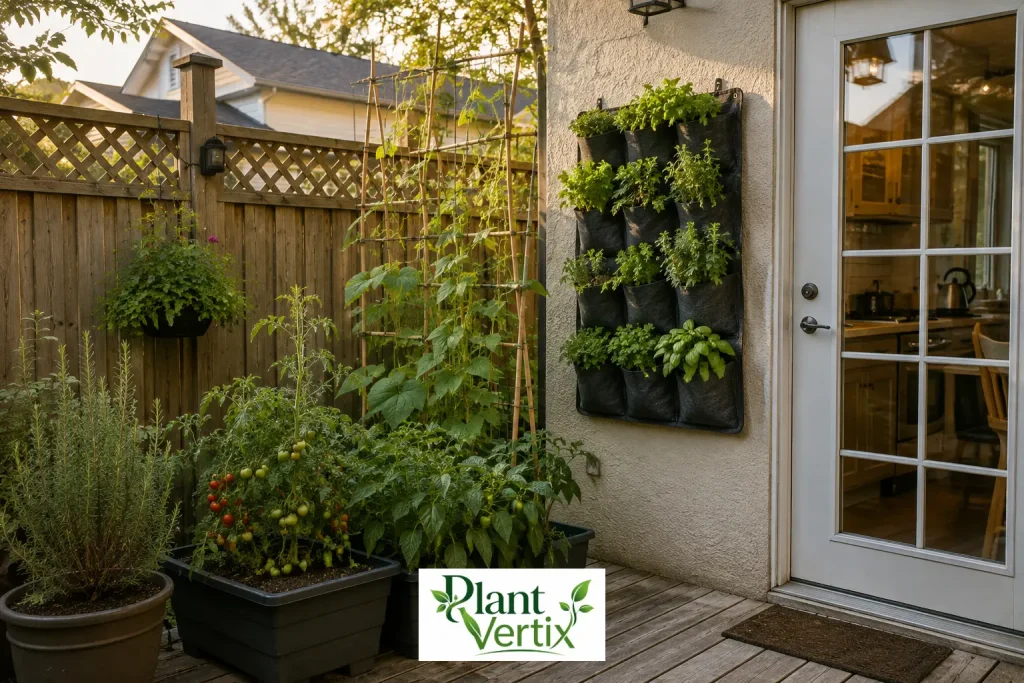
A common and sensible layout on a small patio: one or two large containers or a compact bed at floor level for the deep-rooted, high-value crops, a trellis or climbing frame rising off them so the vining plants use air rather than ground, and a wall or freestanding vertical unit carrying herbs and salad in shallow pockets where you can reach them from the kitchen door. Three methods, one space, each doing the job it is physically good at.
That layout also spreads the risk. If the vertical unit dries out during a hot week, you have lost salad, not your tomatoes.
What vertical gardening will not fix
Being honest about this is more useful than another list of benefits.
It will not create light. A shaded wall stays a shaded wall. Going vertical can even make shading worse, because a tall structure shades its own lower tiers. How much space you actually gain by going vertical covers the real numbers on that.
It will not reduce watering. It increases it, in most systems, for the reasons above.
It will not make a poor site productive. Wind, heat radiating off a wall, and lack of sun defeat vertical systems faster than they defeat beds, because there is less soil to buffer any of it.
It will not always be cheaper. A modest bed or a few big pots and a bag of growing medium can cost less than a manufactured wall system. Costs vary by region and by what you build, so compare in your own currency rather than trusting a number from an article.
If you have decided that vertical is the right method, the next question is which type of structure. Our neutral comparison of vertical garden systems sets out the criteria without recommending a product, and the full build guide for a small space runs the process in order, starting with load rather than with style.
FAQ
Is a vertical garden better than a raised bed?
Neither is better in general. A raised bed gives each plant more soil, more root depth and lower watering demand, so it grows fruiting and root crops with less daily effort. A vertical garden fits where a bed cannot go at all. If you have the ground and the sun, a bed is easier. If your growing space is a wall or a railing, vertical is the only method available.
Can you grow tomatoes and other deep-rooted crops in a vertical garden?
You can, but not in shallow pockets. Deep-rooted and fruiting crops need real root volume, so grow them in a large container or a bed and use the vertical structure as a trellis for the top growth. That gets you the space-saving without starving the roots.
Do vertical gardens need more watering than raised beds?
Generally, yes, and often noticeably more. Less growing medium means a smaller water reservoir and a root zone that heats and dries faster. In hot weather, many shallow vertical systems need water daily. Our guide to watering a vertical garden covers why the top tier dries while the bottom stays soggy.
Can I use both a raised bed and a vertical garden in the same space?
That is usually the best answer for a small yard or patio. Put deep-rooted crops at ground level, run a trellis up from them for vining plants, and reserve wall or tower space for herbs and salad greens. Each method then does the job it is physically suited to.
How do I know whether my wall can take a vertical garden at all?
Identify what the wall is made of first, because the fixing is only as strong as the material behind it. Plain drywall is not a substrate for a loaded planter. If the wall is rendered, has a cavity, is rented, or is above a walkway or seating area, treat it as a job for a qualified professional rather than a weekend project. We do not publish load figures for exactly this reason: your wall is not the wall in the article.