Tiered Hanging Planter: One Hook Carries Every Tier
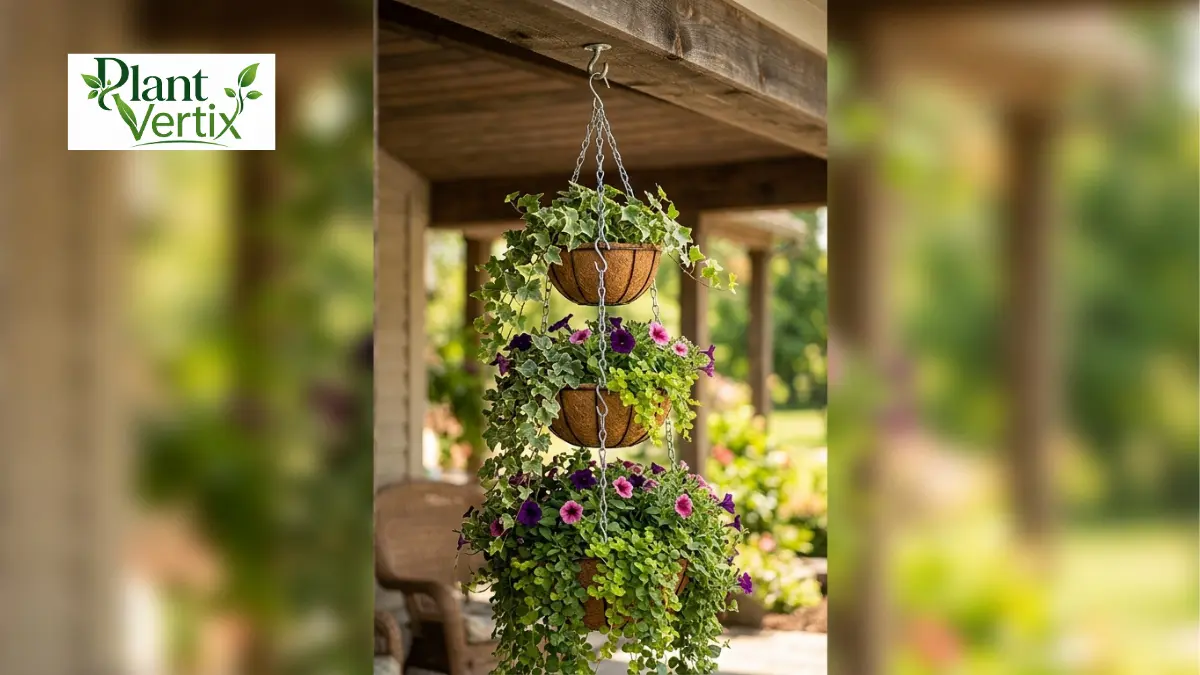
A tiered hanging planter is a column of baskets or pockets stacked on a chain, bracket, or cascading hook system, and it is a genuine vertical system, not just a row of baskets. The detail that decides whether it is safe is arithmetic that almost every product listing skips: every tier’s weight passes down through the chain to the single point where the whole thing hangs. So that one hook, bracket, or eye screw is carrying the combined wet weight of all of them at once, not just its own tier.
A tiered hanging system is only as strong as that one point, and a soaked planter weighs considerably more than a dry one. Check what the top fixing is anchored into and what it is rated for as a loaded, wet assembly before you hang anything.
What Counts as a Tiered Hanging Planter
The category covers a few related builds, and they all share the single-point problem:
- Chain-cascade planters. Two, three, or four baskets connected by chain or rope, hanging one below the other from one overhead point.
- Tiered wall brackets. A bracket mounted to a wall or fence holds a vertical row of pots or a stacked trough system, with the wall bearing the load instead of a ceiling hook.
- Column and shelf hangers. A rigid frame with several shelves or rings, suspended as one unit from a single top attachment.
Whichever version you build or buy, the mechanics are the same: weight collects downward and concentrates at the top.
The One Fixing Point Problem
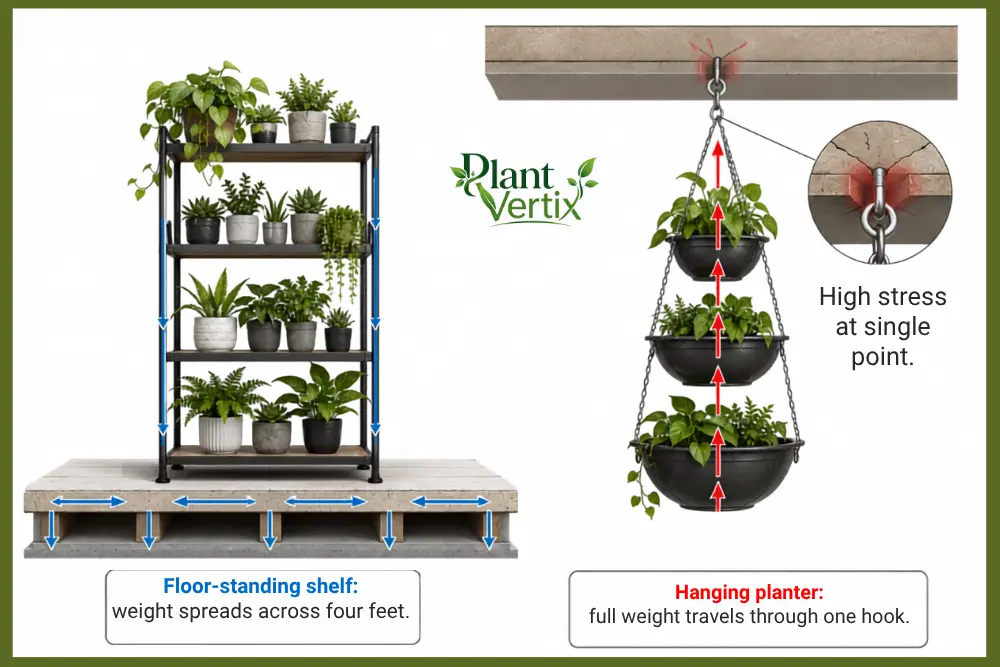
Compare this to a floor-standing tiered plant shelf, where a loaded structure’s weight spreads across four feet and the floor underneath. A tiered hanging planter has no floor to spread into. Every ounce of soil, water, and plant material in every tier travels down the chain and arrives at one hook, bracket, or eye screw. That point does not get to be “close enough” or “should probably hold.” It is the entire load path.
What the fixing point actually needs to be anchored into:
- A ceiling hook needs a joist, not drywall alone. Drywall or plaster on its own is not rated for a swinging, multi-tier load. Find the joist with a stud finder, or use a rated toggle anchor sized for the assembled weight if a joist genuinely is not reachable, and confirm the anchor’s own packaging states it is suitable for a dynamic, hanging load, not just a static picture frame.
- A wall bracket needs a stud or a masonry anchor matched to the wall material. The same rule that applies to any wall-mounted vertical system applies here, as covered in more depth in our comparison of vertical garden systems.
- A railing or pergola beam needs its own check. If you are hanging from a balcony railing or an outdoor beam rather than an interior ceiling, see our guide to railing-mounted growing systems for how that attachment is different from a ceiling hook.
- A rented apartment usually means asking first. Many leases restrict what can be screwed into a ceiling or a structural beam, even for something as small as a hook. If you are not sure, ask your landlord or building manager before drilling, and consider a no-drill option like an over-the-door hanger or a tension rod if drilling is off the table entirely.
How Much Weight is Actually Hanging There
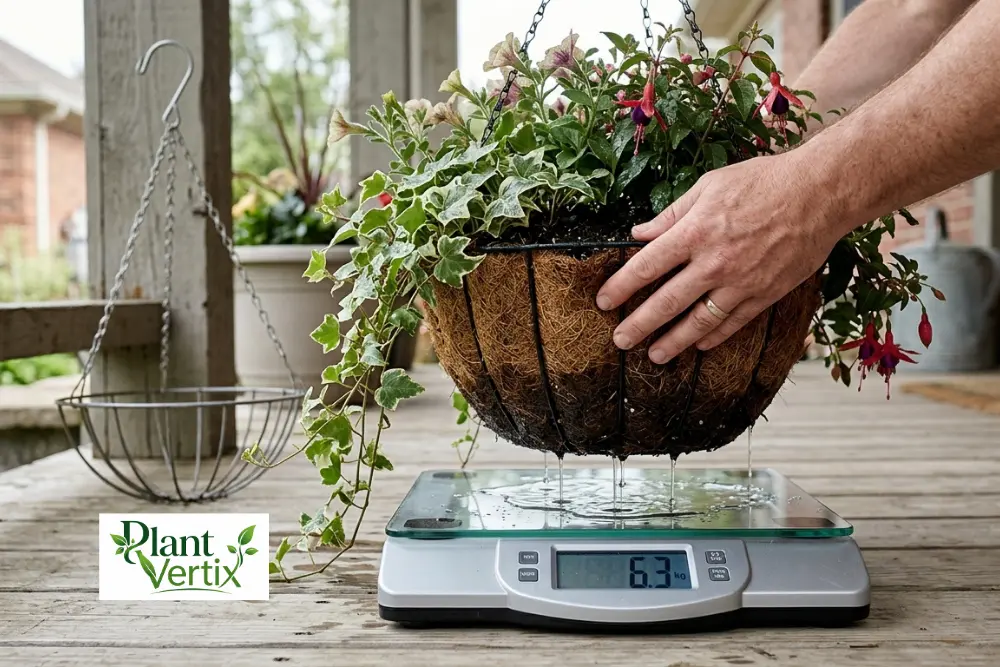
Nobody selling a tiered hanging planter tells you what your specific version weighs loaded, because they cannot know your soil, your plants, or how often you water. You can find out yourself in under ten minutes:
- Fill one pot with the growing medium you plan to use,
- Water it until it drains,
- Weigh it on a bathroom scale, and
- Multiply by the number of tiers.
Add the weight of the chain or frame itself. That is the number to take to whoever can tell you what your ceiling, wall, or railing can carry, whether that is a hardware professional, a contractor, or your building management. A measured number gets a useful answer. A guess does not.
If the planter or hook came with a stated weight rating, treat it as a ceiling to stay well under, not a target to plan toward, and read what the rating actually assumes (usually a static, evenly distributed load, tested dry, not the swinging, watered assembly you will actually hang).
Chain, Hooks, and Swivels: The Weakest Link is the Point, Not the Material
A chain rated for a certain load is only as strong as its weakest connector. Inspect every S-hook, carabiner, and swivel point in the assembly, not just the chain itself:
- S-hooks should be closed or crimped, not left open where a chain link can work its way out under repeated swinging.
- A swivel joint lets the wind spin the whole column instead of twisting the top fixing. This matters more than it sounds, because repeated twisting is exactly the motion that works a screw or hook loose over months.
- Rust and corrosion on outdoor hardware are not cosmetic. A chain link or hook that has visibly thinned or pitted from weather exposure has lost strength that is not obvious at a glance, and outdoor hanging hardware should be checked at the start of each growing season.
Wind: The Sail Effect Nobody Mentions
A tiered hanging planter presents a tall column of foliage that catches wind over its whole height, and the swinging motion that results puts a cyclical, not steady, load on the top fixing. A gust that would barely move a single hanging basket can set a three- or four-tier column swinging hard enough to work a loose hook free over a season. If your hanging spot is exposed, an eave, an open balcony, anywhere wind gets a run at it, favour a shorter column, a swivel-free rigid frame, or a wall-mounted tiered bracket over a long chain cascade.
Watering Changes the Weight Distribution, Not Just the Total
Water poured into the top tier drains down and partly reaches the tiers below it, which our watering guide for vertical gardens covers in more detail. In practice, this means the lower tiers of a cascade system tend to run wetter, and therefore heavier, than the top one, while the top tier is the one most likely to dry out fastest between waterings.
Neither is dangerous on its own, but it means the “loaded weight” you measure right after watering is close to the heaviest the system ever gets, which is exactly the number worth using when you check a fixing point’s capacity.
Where a Tiered Hanging Planter Fits, and Where It Does Not
It fits well in a sheltered spot with a confirmed, solid overhead fixing: a porch beam over a joist, an interior ceiling with joist access, or a wall bracket into a stud. It suits trailing plants, herbs, and shallow-rooted flowers better than anything with a deep, heavy root ball, since root mass adds weight exactly where the chain has the least slack to work with.
It fits poorly in an exposed, windy spot, on a ceiling or wall you cannot confirm the structure of, or for anyone who cannot get a straight answer from a landlord or building manager about what is allowed. In those cases, a freestanding tower or a floor-standing tiered shelf achieves a similar visual effect without depending on one overhead point.
FAQ
How much weight can a tiered hanging planter hold?
It depends entirely on what the top fixing point is anchored into, not on the planter itself. A hook or bracket into a ceiling joist or a wall stud generally holds far more than one into drywall or plaster alone. Weigh your own loaded, watered assembly and confirm the fixing’s suitability with a hardware professional or your building management rather than relying on a general figure.
Is a tiered hanging planter safe on an apartment balcony?
It can be, if you have a confirmed structural point to hang it from and your lease allows it. Many rentals restrict drilling into a ceiling or a shared structural beam, so check with your landlord first and consider a no-drill option such as a tension rod or an over-the-door hanger if hanging from a fixed point is not permitted.
Do I need to check the hanging hardware regularly?
Yes, at least at the start of each growing season for anything left outdoors. Look for open or bent S-hooks, rust or pitting on chain links, and any sign that the top fixing has started to work loose or pull away from its anchor.
Does a tiered hanging planter get heavier over the season?
Usually, yes. Root systems fill out and gain mass, and many gardeners add or upgrade plants as the season goes on. Re-weigh a sample pot occasionally rather than assuming the spring-time weight still applies by late summer.
What is the difference between a tiered hanging planter and a tiered plant shelf?
A hanging planter routes its entire weight through one fixing point overhead. A tiered plant shelf puts weight on the floor through several feet instead, which trades a pull-out risk for a tipping risk. Neither is automatically safer; the right choice depends on whether you have a confirmed overhead fixing or a stable floor to stand on.