Rain Gutter Garden: The Cheapest Real System
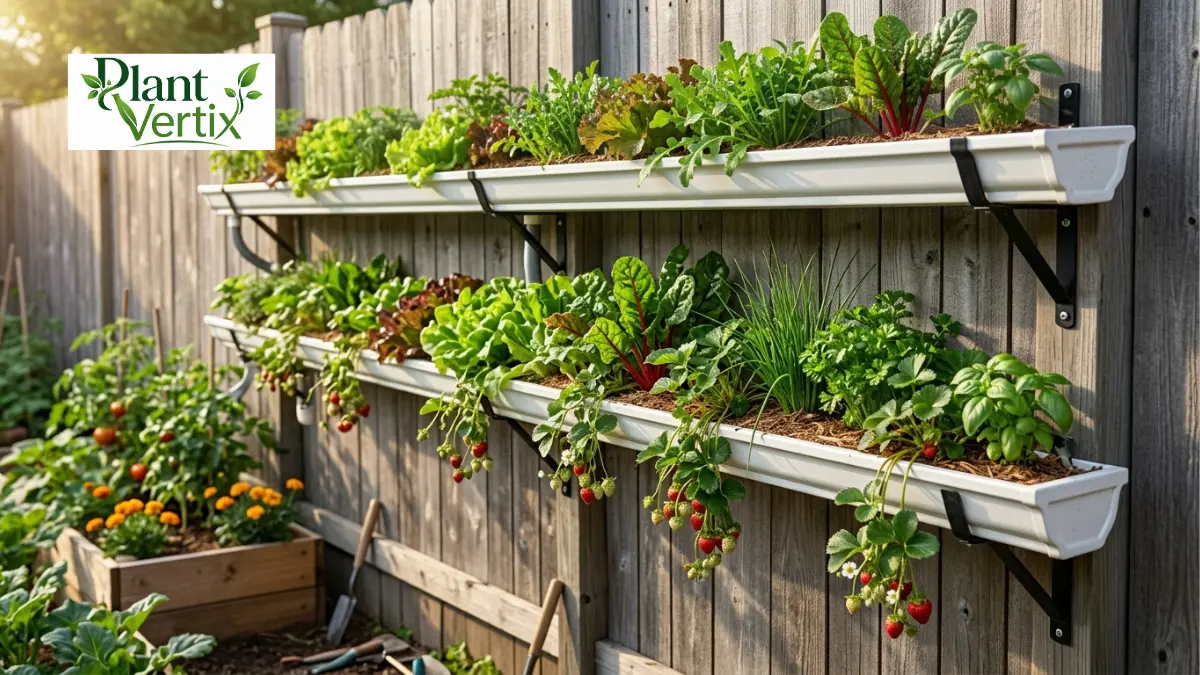
A rain gutter garden turns ordinary gutter sections into shallow, horizontal planting troughs mounted on a fence, wall, or railing, and it holds up as a genuine growing system, not just a budget novelty.
The short version: cut the gutter to length, cap both ends, drill drainage holes along the bottom, and mount it with brackets spaced closely enough that a long run full of wet soil does not sag or pull free over time. That last part, the mounting, is where most gutter garden guides go quiet, and it is the part that decides whether the build lasts a season or comes down in the first heavy rain.
What a Rain Gutter Garden Actually Is
Standard gutter sections, cut into shorter lengths and capped, become narrow planting troughs that can be mounted horizontally in a stack, several rows high, on any vertical surface strong enough to carry them.
The shallow depth suits shallow-rooted crops well: lettuce, herbs, radishes, strawberries, and salad greens are the usual picks, and most guides agree that gutters need at least six hours of direct sun a day to grow well. Reading the sun and wind at your chosen spot before you cut anything is worth doing first; our guide to where to put a vertical garden covers how to read a site properly.
Materials: Vinyl, Aluminum, or Galvanized Steel
The three common gutter materials behave differently once you are using one as a planting trough rather than a rain channel:
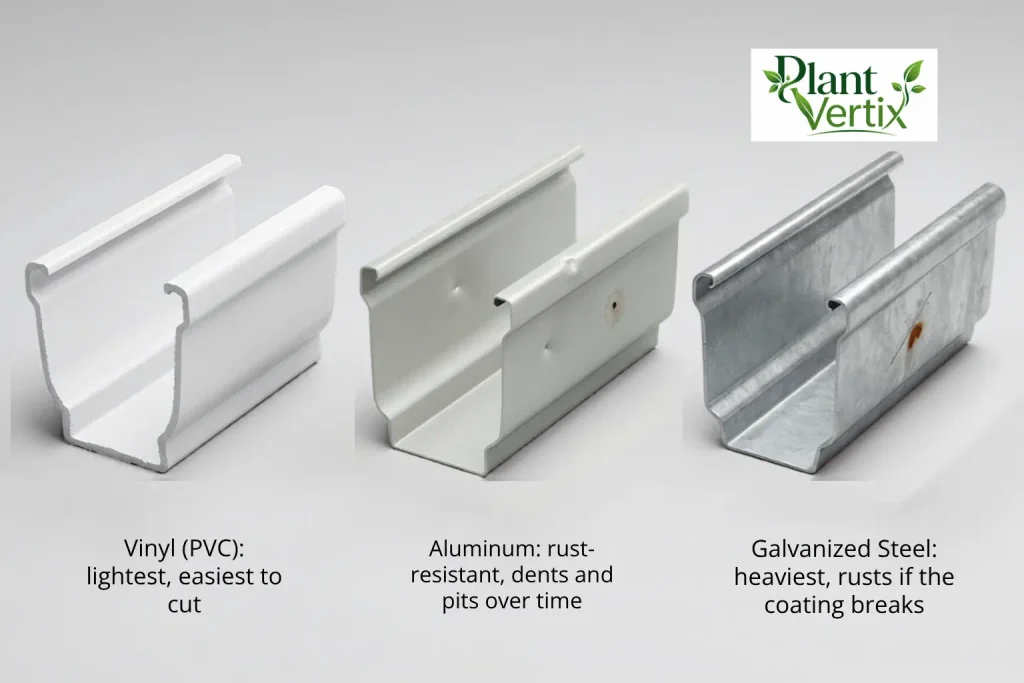
- Vinyl (PVC) gutter is the lightest and easiest to cut with a hacksaw or fine-tooth saw, and it is the most common choice for a first build because it is inexpensive and forgiving to work with.
- Aluminum gutter is lighter than steel and resists rust, but it dents more easily and can develop pinhole corrosion faster where soil sits against bare metal continuously, rather than draining through in seconds the way rainwater does.
- Galvanized steel gutter is the heaviest of the three and the most durable if the coating stays intact, but any scratch through to bare metal becomes a rust point under a permanently damp growing medium.
Whichever material you choose, the constant contact with wet soil is a different environment than the brief contact with flowing rainwater the material was originally designed for, so expect a shorter working life than the same gutter would have on a roofline.
Building It: Cut, Cap, Drain, and Line
- Measure your mounting surface and cut the gutter to fit. Shorter runs, four to six feet, are easier to handle and mount securely than one long continuous piece.
- Drill drainage holes along the bottom, spaced every few inches, so water moves through rather than pooling and drowning the roots.
- Fasten end caps with the sealant or glue appropriate to the material (silicone for vinyl, the manufacturer’s gutter sealant for metal) so soil and water do not leak out the sides.
- Line the bottom with a thin layer of screen or landscape fabric over the drainage holes. This keeps soil in while still letting water pass, which is the detail that keeps the growing medium from washing straight out the bottom the first time you water. Our watering guide for vertical gardens covers how drainage and watering frequency interact once the system is planted.
- Fill with a lightweight potting mix, not garden soil, since garden soil compacts and drains poorly in a shallow trough.
Mounting: The Part That Decides Whether It Lasts
A rain gutter garden is a long, horizontal, distributed load, which is a different mounting problem than a single hanging basket or a compact panel. The weight is spread along the whole run rather than concentrated at one point, but that only helps if the brackets supporting it are spaced closely enough to share the load evenly.
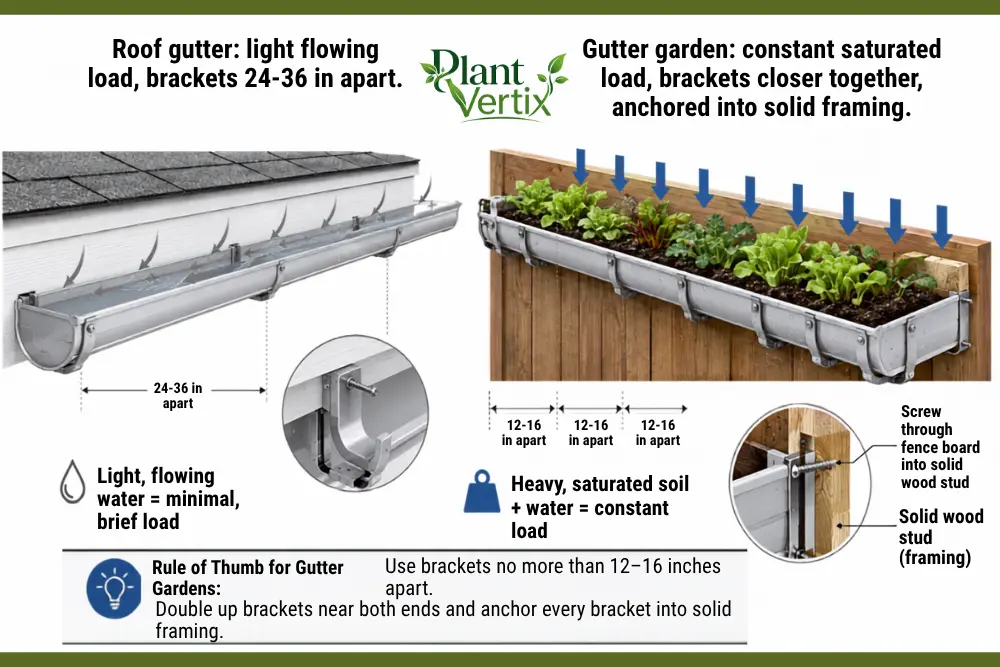
Roofing gutter installers, who mount empty gutters meant to carry brief, flowing rainwater rather than a permanent, saturated load, generally space support brackets somewhere in the range of 24 to 36 inches apart, tighter in colder or high-load climates. A gutter garden carries a heavier, constant, static load than a rain gutter ever does, so treat that spacing as a loose maximum, not a target, and space brackets more closely if you can, particularly toward the ends and at any joint.
What the bracket is anchored into matters as much as how many there are. A bracket screwed into a wooden fence rail or a wall stud holds a saturated gutter garden far better than one going into thin fence paling, siding alone, or hollow trim with no framing behind it. Find the solid framing member before you mount anything, the same rule that applies to any wall- or fence-mounted vertical system, covered in more depth in our comparison of vertical garden systems.
A wet, planted gutter is heavier than it looks when empty. Fill one capped section with the potting mix you intend to use, water it until it drains, and weigh it on a bathroom scale before you decide how many brackets to use or whether your fence or wall can carry the finished run. If you are mounting to a shared fence, a rented property’s fence, or anywhere you do not have final say over what gets attached, check with whoever does, a landlord, a building manager, or a neighbour sharing the fence line, before you drill into it.
What Almost No Gutter Garden Guide Mentions: Fence Ownership and Shared Structures
Most gutter garden tutorials assume the fence or wall is unambiguously yours to drill into. On a rental, a shared property line, or a building with a managed exterior, that assumption does not hold.
A fence between two yards is frequently a shared structure even where only one household maintains it, and a managed apartment exterior almost always has rules about what can be fixed to it. This is easy to skip because the build itself is so cheap and casual-looking, but the mounting question is identical to any other wall-fixed system: confirm you are allowed to attach to the surface before you do.
What to Grow in a Rain Gutter Garden
The shallow soil depth is the limiting factor. Lettuce, spinach, arugula, and other loose-leaf greens do well, along with herbs like chives, thyme, and parsley. Strawberries are a favourite for gutter gardens because their roots are naturally shallow and the trailing runners hang attractively over the edge. Root vegetables that need real depth, carrots and anything beyond a small radish, generally do not have enough soil to work with in a standard gutter’s depth.
For a wider look at which plants suit which structure and tier position, see our guide to matching plants to tier position by weight and light, and for the mounting fundamentals that apply across every wall- or fence-fixed system, our neutral framework for vertical garden systems covers the criteria in full.
FAQ
Do gutter gardens actually work long-term, or do they sag and fail?
They work well when the material is matched to the load and the brackets are spaced closely enough to share the weight of wet soil along the whole run. Sagging and pull-out failures usually trace back to brackets spaced too far apart, or brackets screwed into something without solid framing behind it, not to the gutter material itself.
What size drainage holes does a gutter garden need?
Small holes spaced every few inches along the bottom are enough to let water pass without soil washing out, especially once a thin screen or fabric liner sits over them. Holes that are too large or too widely spaced tend to either clog with roots or let soil escape.
Can I mount a gutter garden on a rented property’s fence?
Only with the landlord’s or property manager’s agreement, since a fence is a fixed structure and drilling into it is a modification most leases address somewhere. If drilling is off the table, a freestanding or clamp-mounted alternative is worth considering instead.
Is vinyl or metal gutter better for a garden build?
Vinyl is lighter, cheaper, and easier to cut, which makes it the more forgiving choice for a first attempt. Galvanized steel or aluminum lasts longer under constant soil contact if you are willing to work with heavier material and metal cutting tools.
How much weight does a full rain gutter garden section add to a fence or wall?
It depends on the length, the gutter material, and how wet the soil is when you measure it, so there is no single figure that applies to every build. Weigh one filled and watered section yourself and multiply by the number of sections before deciding how the run will be mounted.