Wall-Mounted Planter Rails: How to Choose and Mount One
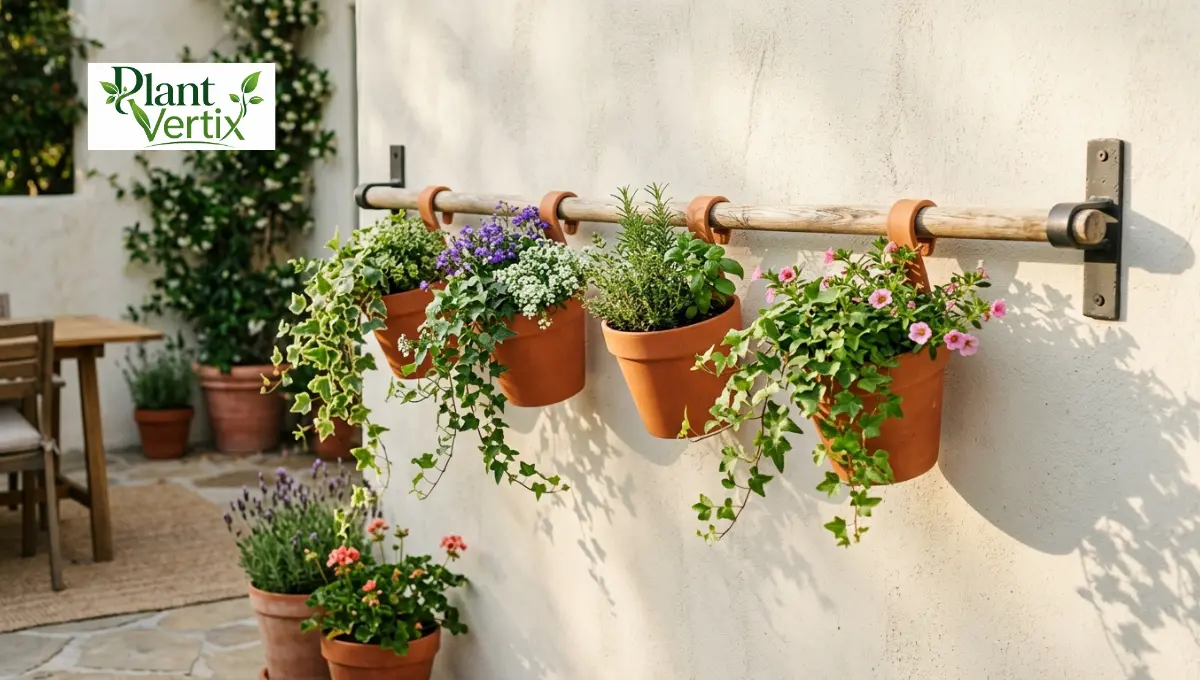
A wall-mounted planter rail is a horizontal track fixed to the wall that individual pots slide onto or hang from, rather than each pot being screwed into the wall on its own, or built into a solid panel system. The rail itself is usually light. The weight problem is what hangs on it.
A rail gathers the full weight of every pot along its length and passes all of it into just two or three fixing points, so each of those anchors carries more per point than the same pots would if they were spread across a wall. That concentration is the number to understand before you buy one, and it is the part most rail listings do not mention.
This is the middle option between a full living wall and a single hook. If you want a handful of pots up off the floor or the counter, in a row, without committing to a whole panel system, a rail is usually what you are picturing.
What a Rail System Actually Is
Most rail systems on the market now are a single dowel or track, usually wood or aluminium, mounted to the wall at both ends with brackets. Individual pot holders slide onto the rail and lock or wedge in place, so you can add, remove, or reposition pots without touching the wall again. A few systems add a middle support bracket for longer rails or heavier planned loads.
The appeal is real: one wall intrusion (two or three fixing points) instead of one hole per pot, and you can rearrange the row seasonally without new holes. That is a genuine advantage over mounting individual brackets, and it is worth stating plainly before the caveats below.
Rail, Individual Brackets, or a Full Panel: Which One Fits
These are three different structures answering three different needs, and the search results for “wall mounted planter rail” are dominated by one or two specific products rather than an honest comparison, so here is the actual decision.
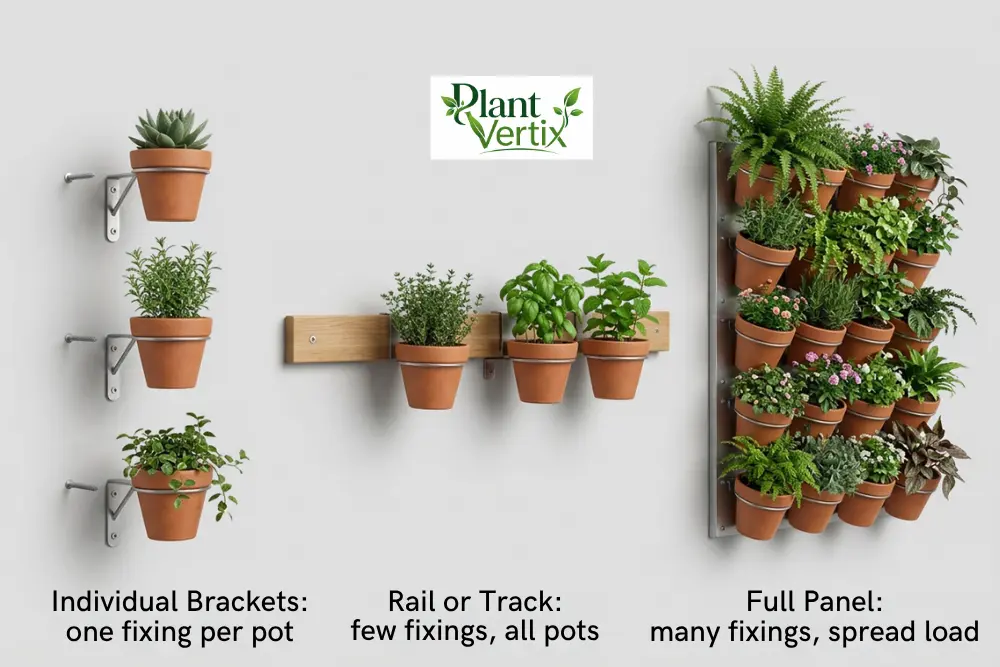
| System | Fixing points | Best for | Watch for |
|---|---|---|---|
| Individual hooks or brackets | One per pot | A few pots, spaced however you like, lowest commitment | Most flexible, but each pot needs its own fixing rated for its own weight |
| Rail or track | Two to four total, regardless of pot count | A tidy row of small to medium pots, minimal wall holes | All weight funnels into a few fixings; adding pots does not add fixings |
| Full panel or pocket system | Many, spread across the frame | Dense planting, a real “wall” of greenery | Distributes weight better per point, but the total load is much higher |
If your instinct is “I don’t want a whole wall of it, just a few pots up off the ground,” a rail or individual brackets are both reasonable starting points. The choice between them comes down to whether you would rather manage one heavier connection or several lighter ones. For the full comparison of every structure type against your wall, your lease, and your budget, see vertical garden systems compared.
Why a Rail Concentrates Weight Where the SERP Does Not Say So
Search a rail product, and you will find installation photos, dowel diameters, and drip tray features. What you will not find is a plain statement of the load math, because the sellers are not the ones who have to answer for your wall.
Here is the mechanism. A rail is a beam. Every pot hung along it adds its weight to that beam, and the beam transfers the sum of all of it to whatever holds its ends (and its middle bracket, if it has one) to the wall. Add a fourth pot to a three-pot rail, and you have not added a fourth fixing.
You have added weight to the same two or three fixings that were already there. That is different from individual brackets, where a fourth pot means a fourth, independent fixing rated for that pot alone.
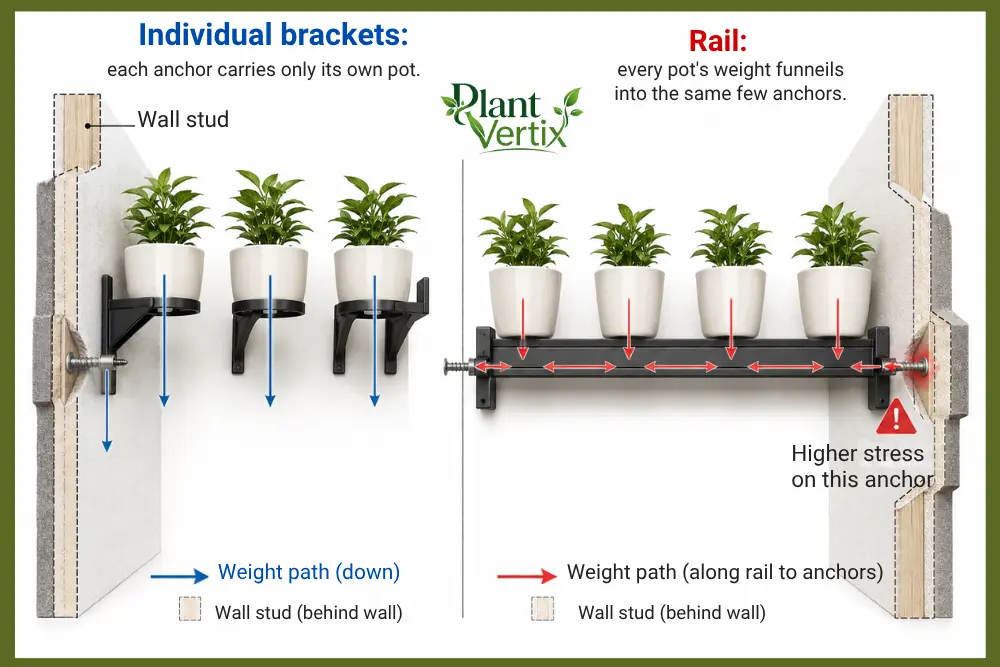
This is not a reason to avoid rails. It is a reason to size the rail’s planned load, saturated, before you choose the fixing, not after. What a vertical garden actually weighs works through that calculation in full, including the part that catches people out: growing medium gets much heavier once it is watered, and a rail is carrying that saturated weight every day the pots are full, not just on the day you filled them.
Matching the Fixing to What’s Behind Your Wall
A rail’s own hardware usually states a rated capacity for its brackets. That number describes the bracket, tested by its manufacturer, under conditions it specifies. It does not describe your wall. Drywall, a timber stud, plaster over masonry, brick, and solid concrete are different problems with different real capacities, and the correct fixing changes with each one.
This site does not publish anchor ratings or wall capacities as guidance, because the honest answer depends on what is actually behind your wall and on the fixing’s own spec, not on a number a gardening article can hand you. Confirm the fixing’s rated capacity with its manufacturer, and for anything mounted to a rendered wall, a shared wall, or a balcony structure, get an opinion from a builder or structural engineer before you drill.
When Individually Mounted Pots are the Better Call
Skip the rail and mount pots individually when:
- You want very different pot sizes or weights in the same grouping. A rail is easiest to plan when the pots are similar. Mixing a large, heavy planter with two small ones onto one rail concentrates an uneven load, which is harder to size a fixing for than three independent, appropriately sized fixings.
- You are not confident about hitting studs at both rail ends. A rail needs both (or all) of its fixing points to land somewhere solid. Individual pots give you more freedom to place each one exactly where a stud actually is.
- You want to add or remove pots over time without touching the load math each time. Every pot you add to a rail changes the total the existing fixings carry. Every pot you add as an individual bracket is its own, separate decision.
Spacing and Sizing Pots on a Rail
Leave more room than looks tidy at install. Pots grow into their space, foliage spreads sideways, and a rail packed edge to edge on day one has nowhere to go and traps still, humid air against the wall behind it, which invites fungal issues over a season. As a working guide, plan pot centres roughly one and a half times the pot’s own diameter apart, and check that gap again once plants fill out, not just when the rail is empty.
Watering matters here too. A row of individually watered pots dries and drains differently than a shared reservoir system. If you are pairing a rail with a self-watering insert, see self-watering vertical planters for how that reservoir adds sustained, not occasional, weight to the same fixings.
The Two Questions to Answer Before You BBuy
- What are you hanging on it, fully grown and freshly watered, not empty? How much does wet potting soil weigh is the number that actually matters, not the bag’s dry weight.
- What is behind the wall at both (or all) of the rail’s fixing points, and is the fixing rated by its own manufacturer for that total? If you cannot answer that, you are not ready to mount the rail yet.
Get those two answers first, and the rest of the decision — dowel material, bracket style, pot spacing — is genuinely just preference. For the build sequence that puts this question first instead of last, see how to build a vertical garden for a small space, and for the mistakes that come from skipping this step, see vertical garden mistakes.
Frequently Asked Questions
Do wall-mounted planter rails damage the wall?
The rail itself makes two to four holes, fewer than mounting each pot separately. The larger risk is sustained moisture behind pots mounted close to a finished wall, which is a different problem from the mounting holes themselves.
How many pots can I put on one rail?
There is no universal number. It depends on the rail’s own rated bracket capacity, what is behind your wall at the fixing points, and the saturated weight of every pot you plan to hang. Confirm the bracket’s rating with its manufacturer and size your total load against it.
Is a rail stronger than individual hooks?
Neither is inherently stronger. A rail concentrates the same total weight into fewer fixing points, so each of those points needs to be rated for more. Individual hooks spread the same total weight across more, individually rated fixings.
Can I mount a rail without hitting a stud?
You can, with anchors rated for the wall type and the load, but drywall alone rarely supports more than a light, small pot without a stud or a heavy-duty anchor rated for the specific weight. If you cannot locate a stud at both fixing points, that is a real constraint on rail placement, not a detail to skip.