Freestanding or Mounted: Make the Decision Once, Properly
Half of everything written about vertical gardening assumes you are drilling into a wall. The other half assumes you are not. Almost nobody tells you which of the two you are, so most people read both halves and end up more uncertain than when they started.
This page settles it. Six questions, in an order that means you can usually stop after two, and then you can ignore half the advice on this subject permanently.
What You Are Actually Choosing Between
Before the questions, the two options on the dimensions that genuinely differ.
| What you are choosing on | Freestanding | Wall mounted |
|---|---|---|
| Permission to make holes | Not needed | Needed, and a lease, a shared wall or a protected building can rule it out |
| Holes in the wall | None | Yes, and filling, matching paint and possibly a repair when it comes down |
| Where the load goes | Into the floor, which is already designed to carry weight | Out of the wall, which is a specific question about that specific wall |
| Floor space | Needs it, which can be decisive in a small flat or on a narrow balcony | Uses none |
| Failure mode | Tipping, worst when the planting is heavy and high | Nothing to tip |
| Height | Limited to what the structure can hold safely | Can reach heights a freestanding unit could not hold safely |
| Moving it later | Comes with you, and can be rearranged when the light changes with the seasons | A commitment |
The first row is not a trade-off, it is a gate: if holes are not allowed, the rest of the table is decoration. So is a wall you cannot identify and a wall you cannot check for services, which is why the questions below come in the order they do. Two things the table cannot weigh for you: the flat-against-a-wall look, which is taste, and getting behind the system to service it, which is easier when it stands on the floor.
Question 1: Are You Allowed to Make Holes?
If the answer is no, you are freestanding, and the decision is made. Skip to the bottom.
No is a more common answer than people expect. Rented property, a lease that prohibits alterations, a building with restrictions on balconies, a wall that is shared, a listed or protected building, or a partner who has views. What your lease permits is a separate article on this site, and the practical version of the question is simple: if you would have to ask, ask before you buy, not after you build.
If the answer is yes, keep going.
Question 2: Do You Know What the Wall is, and is it Sound?
Not “is it a wall”. What is behind the surface, and is it in good condition.
A wall you cannot identify is a wall you cannot choose an anchor for. Our article on what different wall types can take covers how drywall, plaster, brick, block and siding differ, and why the same fixing behaves completely differently in each.
If you cannot establish what your wall is, or if it is damp, crumbling, hollow in unexpected places, or has been repaired in ways you do not understand, you are freestanding by default until somebody who knows has looked at it. That is not caution for its own sake; choosing a fastener for an unknown substrate is choosing at random.
If you know the wall and it is sound, keep going.
Question 3: Is There Anything in the Wall?
Wiring and pipework run inside walls, and their routes are not always where you would expect.
Before any hole, in any wall, you use a detector and you check the known service routes: vertically above and below sockets and switches, horizontally alongside them, and around anything that suggests plumbing on the other side.
If you are not willing to do that, or the wall is one where you cannot be confident, that is a genuine reason to be freestanding, and it is a better reason than most.
If you hit something, stop. That is an electrician’s or a plumber’s job from that point, not a matter of trying a different spot.
Question 4: How Heavy Will it Be When it is Wet?
This is the question that decides more of these cases than any other, and almost nobody asks it in the right form.
A planted system weighs one thing dry and a heavier thing after watering, every time. Our article on what a vertical garden actually weighs sets out why the planter’s rated capacity and the wall’s capacity are two entirely separate questions, and our piece on how much wet potting mix weighs explains why the multiplier you will find quoted online has no traceable source.
The useful move is to weigh it rather than estimate it: empty, filled dry, and again after watering to saturation. That third number is the load.
A heavy system pushes you toward freestanding, because a floor is already designed to carry weight and a wall fastening is a specific engineering question about a specific wall.
Question 5: Is There Floor Space, and Who Else Uses it?
Freestanding needs floor. That is its cost, and in a small flat or a narrow balcony it can be decisive.
Freestanding also has a failure mode mounted systems do not: tipping. A tall structure with heavy planting up high, in a home with children or animals, or in a corridor people move through quickly, is a different proposition from the same structure in a spare room.
If it is tall and heavy and the space is busy, the honest answer may be to secure it, and securing it to a wall puts you back into questions 1 through 3.
Question 6: How Long is This Staying?
Mounted is a commitment. Removing it later means holes to fill, paint to match, and possibly a repair, and that is a project of its own.
Freestanding moves. It comes with you, it can be rearranged when the light changes with the seasons, and it leaves nothing behind.
If you rent, or you might move within a couple of years, or you are not sure this is the right wall, that weighs heavily toward freestanding, and it is a legitimate reason on its own.
What Each One is Genuinely Better at
Assuming you have got here with both still available.
Mounted wins on: floor space, since it uses none; the flat-against-a-wall look; stability, since there is nothing to tip; and reaching heights a freestanding unit could not hold safely.
Freestanding wins on: no permission needed; no holes; movable; easier to service, because you can get behind it; and the load goes into the floor rather than out of a wall. Our guides to tiered plant shelves and freestanding towers cover the main options.
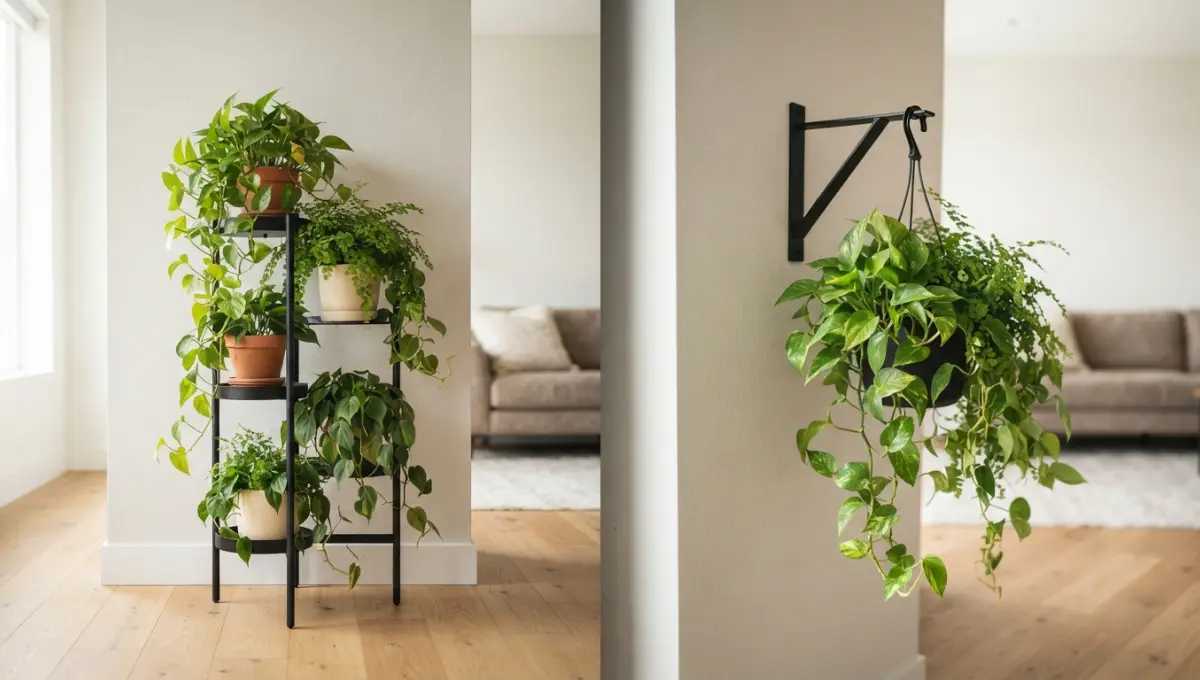
The hybrids are worth knowing about: a leaning ladder rests on the floor and touches the wall lightly, and a system hung on a railing or an over-door hanger borrows an existing structure. Both keep the load off a wall fastening without needing floor area in the middle of a room.
The Short Version
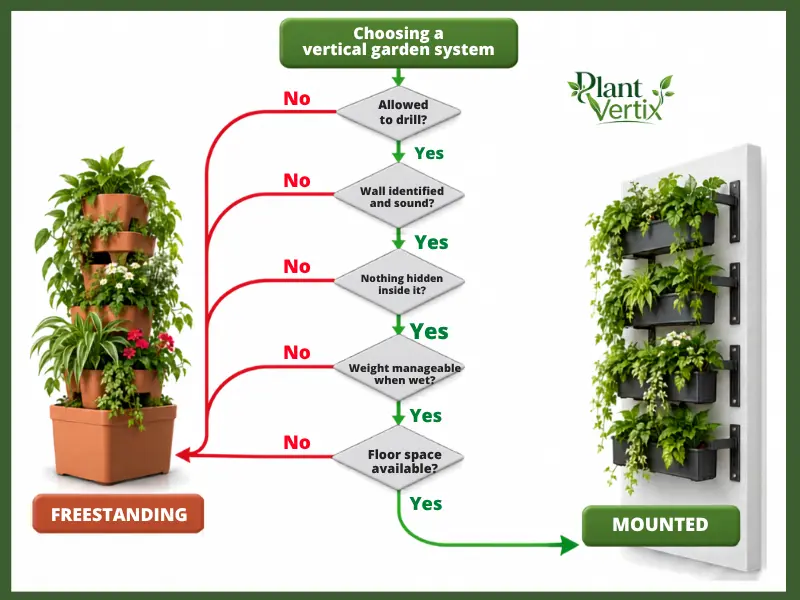
Cannot drill, do not know the wall, cannot check for services, or it will be heavy when wet: freestanding. Four independent routes to the same answer, and any one of them is enough.
Can drill, know the wall, checked it properly, and the load is modest and understood: mounted is available, and it will use less space.
Not sure: freestanding. It is reversible, and the mounted version will still be there in six months if you decide you want it.
FAQ
If I rent, is the decision already made?
Effectively yes. Question 1 settles it: if you are not allowed to make holes, you are freestanding and the remaining questions do not apply. The same goes for a shared wall, a protected building, or any situation where you would have to ask permission, and the time to ask is before you buy rather than after you build.
What if I do not know what my wall is made of?
Then you are freestanding by default until somebody who knows has looked at it. A wall you cannot identify is a wall you cannot choose an anchor for, and picking a fastener for an unknown substrate is picking at random. The same applies to a wall that is damp, crumbling, unexpectedly hollow, or repaired in ways you do not understand.
How do I work out how heavy the system will be?
Weigh it rather than estimate it. Take it empty, then filled dry, then again after watering to saturation. That third figure is the load, and a heavy one pushes the decision toward freestanding, because a floor is already designed to carry weight while a wall fastening is a specific question about a specific wall.
Is freestanding always the safer option?
No, it trades one failure mode for another. Mounted systems cannot tip; a tall freestanding structure with heavy planting up high can, and that matters most in a home with children or animals or in a corridor people move through quickly. If the answer is to secure it to a wall, you are back at questions 1 through 3.
What if I drill and hit something in the wall?
Stop. From that point it is an electrician’s or a plumber’s job, not a matter of trying a different spot. Before any hole in any wall, use a detector and check the routes services usually take, vertically above and below sockets and switches, horizontally alongside them, and anywhere plumbing is likely on the other side.
Where this article stops
It does not tell you what your wall or your floor will carry, and it publishes no figure you could treat as permission. Those belong to building management, your landlord, or a qualified professional, and they are the right people to ask once you know which of the two systems you are asking about.
If the answer to several of these questions is that this particular space is not suitable for either, that is also a real outcome, and our article on when not to build a vertical garden is the one that says so plainly.