Vertical Garden While on Holiday: Keeping It Alive
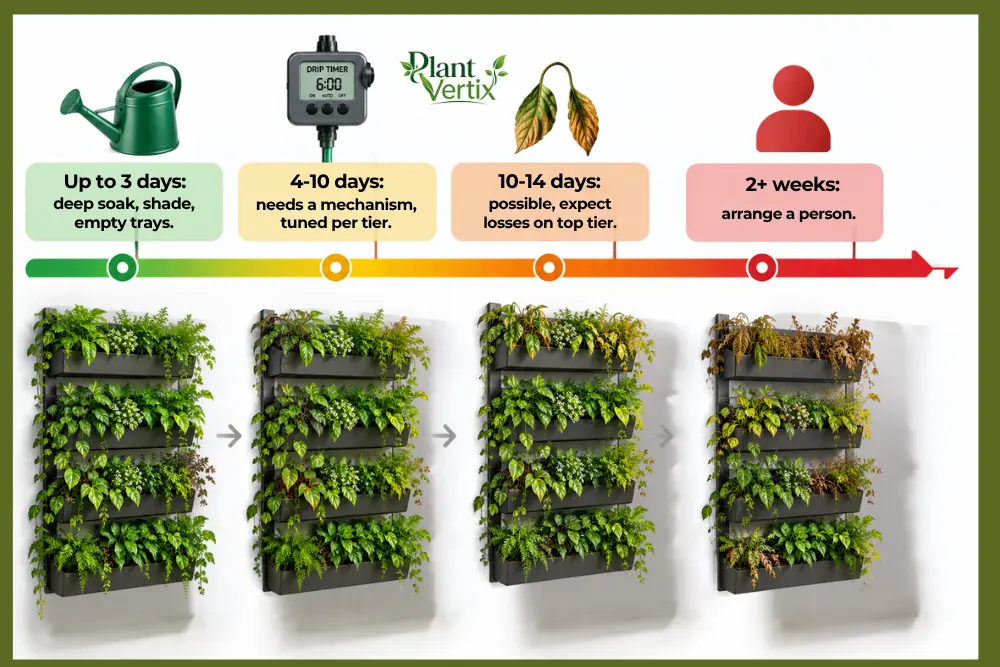
A vertical garden left alone fails from both ends at once. The top tier runs dry while the bottom tier sits wet, so any away-from-home watering method has to treat the tiers as separate problems rather than as one planter. Up to about three days, a deep soak plus shade and shelter usually carries an established wall.
From roughly four days to two weeks, you need a mechanism, and it has to deliver water to the top rather than trust it to trickle down. Beyond two weeks, the Royal Horticultural Society’s holiday advice is to arrange for a person, and for a vertical system, that is the right answer too.
The rest of this article is about why the middle band of that ladder is harder on a wall than on a windowsill, and what each mechanism actually does to each tier when nobody is watching it. We do not sell irrigation equipment, and nothing here is a product recommendation.
A Wall Fails Top-Down, and That Changes the Whole Problem
On a shelf of pots, every pot has the same relationship with gravity. Water goes in the top, surplus leaves the bottom, and a trick that works for one pot works for all of them. A vertical system breaks that symmetry in four ways at once.
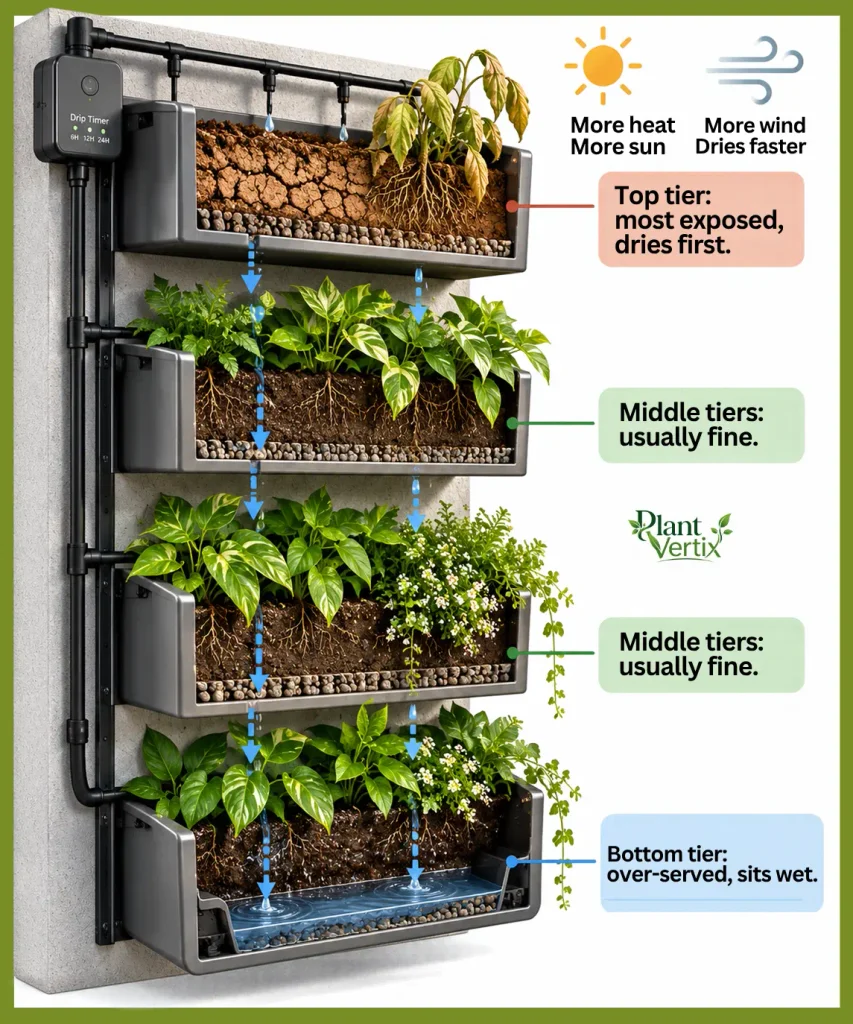
The top tier is the most exposed part of the structure. It usually catches more direct sun and more moving air than anything below it, and moving air strips moisture from a container faster than still air does.
The pockets are shallow, and shallow behaves differently. A saturated container drains until gravity can no longer pull water out of the medium, leaving a wet layer at the base that simply stays there. Research on potting media in containers finds that this saturated zone is a property of the medium rather than of the pot, so its depth stays much the same whether the container is deep or shallow. In a shallow wall pocket, that fixed wet layer is a larger share of the total root zone, which is why the bottom of a vertical system can stay soggy long after the surface looks dry.
Water passing through arrives somewhere. Anything you pour or drip into the top tier does not stop there. Part of it leaves the bottom of that pocket and lands on the tier below, which is already receiving its own dose.
Nobody is emptying the tray. At home you notice standing water in a catch tray and tip it out. On day nine of a trip, nobody does, and the bottom row sits in it. The tier-by-tier pattern behind all of this is worked through in watering a vertical garden, which is worth reading before you choose an away-from-home method rather than after.
| Tier | What it usually runs out of first | What an unattended method tends to do to it |
|---|---|---|
| Top | Water, within a day or two in hot, bright, breezy conditions | Under-serves it, because most methods rely on gravity moving water downward from a single point |
| Middle | Nothing dramatic, which is why it survives most trips | Roughly right, and the tier people judge the whole system by when they get home |
| Bottom | Air at the root zone, not water | Over-serves it, from its own dose plus everything that drained through from above |
Four Conditions Decide How Long Your Wall Can Coast
Trip length is only half the question. The same wall can be fine for a week or dead in four days depending on the conditions it is sitting in, so judge it by conditions rather than by the time of year.
Heat and light on the wall itself. A wall in long hours of direct sun and high temperatures loses water many times faster than the same wall in cool, low light. Extension guidance for hanging baskets, which share the small-volume, high-exposure problem, is to check them daily and to expect that they can need water more than once on a hot sunny day. Anything with that appetite is not going to coast for a week untouched.
Exposure to wind. An open balcony rail or a roof terrace dries a top tier far faster than a sheltered courtyard wall.
Volume per pocket. Small fabric pockets and thin panels hold little water and little buffer. Deeper modules and towers hold more, and buy you days rather than hours.
What is planted where. A thirsty leafy plant on the top tier is the first thing to die and the hardest thing to automate around. Moving it down and putting something tougher up top is a structural fix that costs nothing, and which plants belong on which tier is the decision that most often removes the problem entirely.
Leaving a Vertical Garden While On Holiday: The Trip-length Ladder
Up to about three days. Water thoroughly before you leave, top tier last and slowly, then check that water reached the bottom of each pocket rather than running around the medium. Empty every catch tray on the way out the door. If the wall is in strong sun, move whatever is removable into shade.
The Royal Horticultural Society makes the same point for indoor plants: moving them to a cooler spot or away from a bright window helps prevent drying out, and for a short absence a good watering beforehand is often all that is needed.
Four to ten days. This is the band where a mechanism earns its place, and where the tier asymmetry decides which mechanism. Match the method to the tiers, not to the wall as a whole.
Ten days to about two weeks. Possible, but only with a system you have already watched run, plus a reduced plant load. Expect to lose the thirstiest top-tier plants and plan for that rather than being surprised by it. In cool, low-light conditions, the same wall may need nothing at all for that period.
Beyond two weeks. The RHS says plainly that for absences longer than a couple of weeks, you should arrange for someone to water in person. A vertical system makes that advice stronger, not weaker, because the failure modes are silent: a clogged emitter starves one tier and a stuck valve floods another, and neither announces itself. Past two weeks, the correct answer is a person, not a device.
What Each Mechanism Does to Each Tier
This is the part general away-from-home plant advice skips, because it is written for pots on a floor. In a vertical system, the same method produces a different result at different heights.
| Mechanism | Top tier | Bottom tier | The unattended failure mode |
|---|---|---|---|
| Deep pre-trip soak only | Dries first, often within days | Holds moisture longest | Runs out quietly; no warning, no recovery |
| Wick from a small reservoir | Works only if the reservoir sits at or just below that pocket | Works well; reservoirs are easy to place low | Reservoir empties, then the wick dries and stops moving water even after you refill it |
| Capillary matting on a flat tray | Not usable unless the tier is a level shelf with real contact | Good on shelf-type tiers | Mat dries out at the far end, or pots lose contact and stop drawing |
| Gravity feed from a raised tank | Served first, and fastest while the tank is full | Receives its own dose plus everything draining from above | Flow falls as the tank empties, so the first days deliver more than the last |
| Timer plus drip line with per-tier emitters | Can be served properly, which no other method manages | Needs less delivery than the tiers above it deliberately | A clogged emitter, a flat battery, or a valve that sticks open and floods the wall |
| Taking modules down and grouping them | Not applicable, the tiers no longer exist | Not applicable | Only works if modules are removable, and saturated modules are heavy to lift |
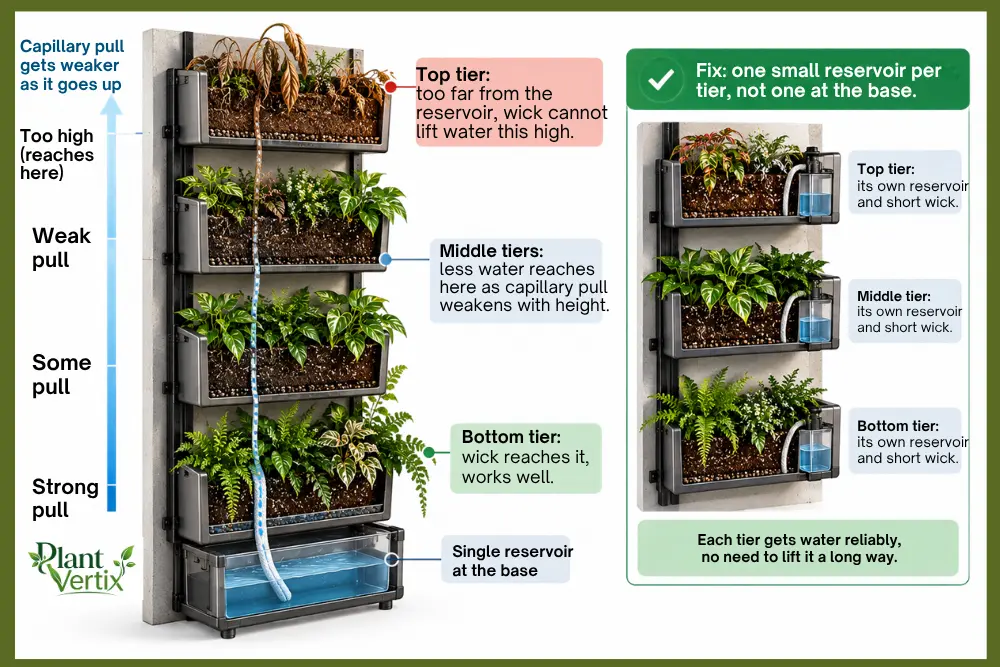
A wick cannot climb a wall. Capillary action moves water upward through a wick or a medium over a short vertical distance, and it weakens as height increases until gravity wins. Published estimates of the workable distance vary with the wick material and the growing medium, so we are not going to put a number on it here.
The design consequence is the point: a single reservoir standing at the foot of a tall structure will not feed the top of it, no matter how good the wick is. Systems that work put a small reservoir close to each pocket it serves, which means several reservoirs rather than one.
That has a cost you can calculate: water is permanent weight while the reservoir is full, and the load your fixings carry is the system at full reservoirs plus saturated medium. What a vertical garden actually weighs works through that calculation, and whether the wall can carry it is a question for building management or a qualified trade, not for a garden article.
A timer is the only method that can be tuned per tier, and it is also the only one that can flood the wall. Per-tier tuning means fewer or lower-output emitters low down and more up top, which is the reverse of what feels natural. Whatever you set, run it on a shorter cycle than you think you need, because an unattended overdose has nowhere to go: it soaks the wall behind the system for days. That is exactly the situation wall protection behind a mounted planter exists to prevent, and it is far cheaper to prevent than to repair.
The Move Most Guides Never Mention: Stop Being Vertical
If your system is modular, the highest-return thing you can do before a long trip is take it down. A tiered shelf, a set of hanging modules, a rail of individual planters or a stacking tower can often be lifted off the wall, stood on the floor in shade, grouped closely together, and set on a tray or on capillary matting.
That converts a vertical problem into the horizontal one every generic guide is quietly assuming you have. Grouped plants shade each other and raise humidity around themselves; matting only works on a flat surface with real contact, and nothing is draining onto anything below it.
Two honest limits. Saturated growing medium is heavier than most people expect, so plan the lift and get help rather than wrestling a full module off a bracket at height. How much wet potting soil weighs gives you the arithmetic before you try it. And a permanently fixed living wall is not coming down, which is a real argument for choosing removable modules in the first place if you travel often.
Electricity Near a Watered Wall
Any pump, controller or timer that runs from mains power near a structure you water is not a garden question. Battery-powered tap timers and gravity feeds avoid the issue entirely, and that is a good reason to prefer them for a system you will leave running unattended. If your plan involves a mains-powered pump, an outdoor socket, or an extension lead anywhere near a wall that gets wet, that work stops with a qualified electrician.
Outdoor and wet-location wiring is governed by national rules, BS 7671 and Part P in the United Kingdom and the NEC in the United States, and neither of us can size that for your setup from here.
Run it Once Before You Rely on it
Set any system up at least a week before you leave and watch it run. The RHS gives the same instruction for good reason: a system that has never run unattended has never demonstrated anything. Over that week, check three things specifically.
Does water actually reach the top tier, measured by the medium being damp a finger’s depth down rather than by seeing droplets? Is the bottom tier drier at the end of a cycle than at the start, or is it accumulating? And does anything drip where it should not, because a slow drip you tolerate for an hour becomes a stain over ten days.
If you are handing the wall to a person instead, give them the same three checks in writing, plus the order to water in, from bottom tier to top, and one instruction that will not occur to them: empty the catch tray, do not just look at it.
Coming Home
Do not deluge a dry wall. Growing medium that has dried hard sheds water down channels instead of absorbing it, so the first watering should be small and slow, repeated after twenty minutes or so, until the medium takes water normally again.
Check the bottom tier first, not the top. A sour or stagnant smell there means the root zone has been saturated too long, and the fix is drainage and air, not more water. Lift out anything that is clearly dead, so it is not sitting wet against neighbours. Then triage: a crisp top tier usually recovers or is cheap to replant, while a drowned bottom tier is the failure that takes months to undo. If you came home to both, the system was correct in principle and simply wrong in balance, and the tuning for next time is less water low down, more up top.
Frequently Asked Questions
How long can a vertical garden survive without watering?
It depends on heat, light, wind, container volume and plants, not on the calendar. RHS advice for indoor plants is that in cool, low-light periods they can go a week or two with no attention if watered well beforehand, and an established wall in those conditions behaves similarly. In hot, bright, breezy conditions, the top tier can be in trouble within two or three days, while the bottom tier is still wet.
Will a self-watering system let me leave a vertical garden while on holiday?
It extends the interval; it does not remove the need to check. A reservoir has a limit, and once it empties, the system behaves like an ordinary planter with no buffer left. How the mechanism works, and what it does to the load on your wall, is covered in self-watering vertical planters.
Can I just put a timer on it and leave for three weeks?
That is the arrangement that produces the worst outcomes, because a timer fails silently in both directions. A blocked emitter starves one tier and a stuck valve floods the wall, and three weeks is long enough for either to be permanent. After about two weeks, arrange for a person.
Should I move my vertical garden before a trip?
If it is modular and you can lift it safely, yes. Grouping the units on the floor in shade, on a tray or on capillary matting, is more reliable than any single device, because it removes the tier problem instead of trying to compensate for it.
Is it better to soak everything heavily right before leaving?
Water thoroughly, but not beyond what the medium can hold. Extra water does not stay in the top tier waiting to be used; it drains to the bottom tier and starts the drowning problem earlier. A thorough soak plus shade beats a flood every time.
Sources
- Royal Horticultural Society, “Houseplants: Holiday Care Tips” (rhs.org.uk), read 2026-09-02: wick and capillary matting methods, moving plants away from bright windows, setting a system up in advance, and arranging for someone to water in person for absences longer than a couple of weeks.
- Iowa State University Extension and Outreach, “Creating and Growing Hanging Baskets” (yardandgarden.extension.iastate.edu), read 2026-09-02: check baskets daily, and it may be necessary to water more than once a day on hot sunny days.
- Avery Rowe, “Effect of drainage layers on water retention of potting media in containers,” PLOS ONE, 2025, read 2026-09-02: the saturated zone at the base of a container is a property of the medium, so a shallower container holds proportionally more water.